
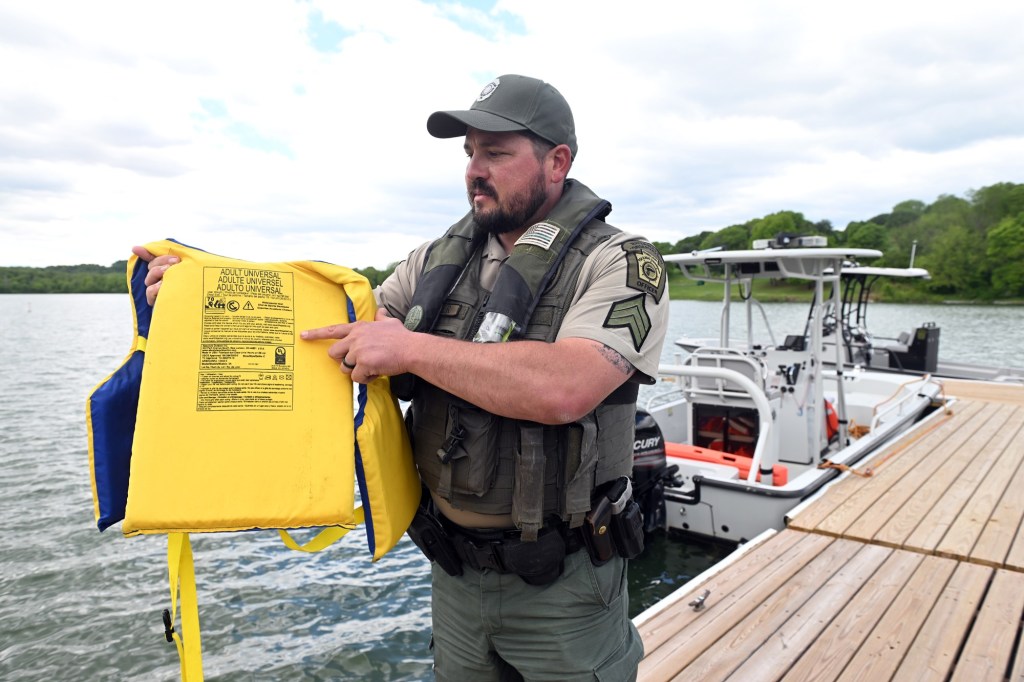
It’s a small step, but for hundreds of boaters annually, simply wearing a life jacket has made the difference between a day on the lake and a tragic accident.
Just how effective life jackets are at their job can’t be understated, according to officials from the U.S. Army Corps of Engineers, U.S. Coast Guard Auxiliary and Pennsylvania Fish and Boat Commission.
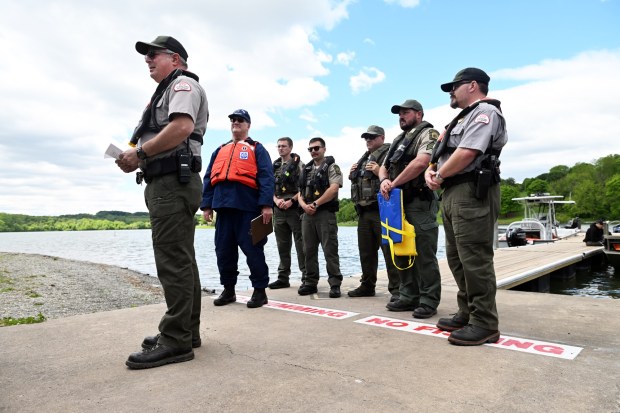 Jeff Piscanio, operations manager at Blue Marsh Lake, discusses boating safety along with members of the U.S. Coast Guard Auxiliary and the Pennsylvania Fish and Boat Commission during a safety event at Blue Marsh Lake on Friday, May 15, 2026. (BILL UHRICH/READING EAGLE)
“In (boating) fatalities that have happened, in 75% or more of cases, people weren’t wearing life jackets,” said Walter Conway, district captain with the U.S. Coast Guard Auxiliary.
Officials stressed that message and more during a boating safety press conference at Blue Marsh Lake’s boat ramp in Bern Township last week ahead of Memorial Day and the start of the summer outdoor season.
“One of the most common issues we see is not having the required type of life jacket,” said Sgt. Travis Miller, assistant regional supervisor for the state Fish and Boat Commission. “For jet skis what we often see is people wearing the orange (collar style) life jacket. They’re not aware that you need to be wearing a life jacket that goes around your whole body.”
He noted that all permitted life jackets have a U.S. Coast Guard approved logo.
Wearing a life jacket is required by state law on all boats or personal watercraft less than 16 feet, and all boats must have one life jacket per person on board.
“Probably our biggest excuse (for not wearing a life jacket) is, ‘I can swim. I don’t need one. I can get back on my boat,’” Miller said.
Miller pointed out that person won’t be able to do that if they’re knocked unconscious or otherwise injured.
People often rationalize not wearing life jackets by simply having them on their boat, but even that might not be enough, Conway said.
“Take a life jacket and try to put it on in the water,” Conway said. “Good luck. It’s challenging (for me) and I can swim like a fish.”
No alcohol
Another safety measure people can take is not drinking and boating, officials said.
They said alcohol is not allowed on the lake.
“We are out here patrolling Blue Marsh looking for people who are intoxicated on the water,” Miller said. “You will get a BUI (boating under the influence) if we catch you.”
Other commonly overlooked boating rules include fire extinguishers for boats with enclosed gas containers, personal floatation devices for boats over 16 feet, and a horn or other sound-producing device for emergency signaling
“A lot of times people don’t realize or think they don’t need it, but it is required equipment,” Jeff Piscanio, operations manager with the U.S. Army Corps of Engineers, said of the sound device.
For a full list of boating regulations at Blue Marsh, see the Army Corps of Engineers website.
Keep a lookout
Situational awareness is key when boating, and many novice boaters may not be aware of best practices.
“This is a very busy lake, there’s a lot of jet ski activity here, a lot of unpowered vessels, kayaks, boats sitting relatively low that are not necessarily visible when you’re on a motorboat,” Piscanio said. “Just always keep a proper lookout.”
Kayaks and other slow craft looking to avoid faster traffic can also stick to designated slow, no-wake zones, Miller noted.
They include the two arms of Blue Marsh formed by Spring Creek and Tulpehocken Creek, as well as anywhere within 100 feet of the shoreline.
“Keep your head on a swivel,” Conway said. “Boats don’t have brakes, so you have to anticipate things. The drone of the engine can lull you. There’s a lot more noise on the water than people realize.”
For the most part, Miller said, people follow the rules.
“We do see a lot of compliance with wearing life jackets,” Miller said. “Especially this time of year, it’s busy, a lot of people are out.”
To help ensure safety, Conway said the U.S. Coast Guard Auxiliary is offering free vessel safety checks, boat safety classes and more.
For more information on those and other safety resources, visit uscgboating.org.
Conway said safety officials want people to enjoy everything Blue Marsh has to offer.
“We really appreciate the people around here,” Conway said. “We just want them to have a good day and go home safe.”