
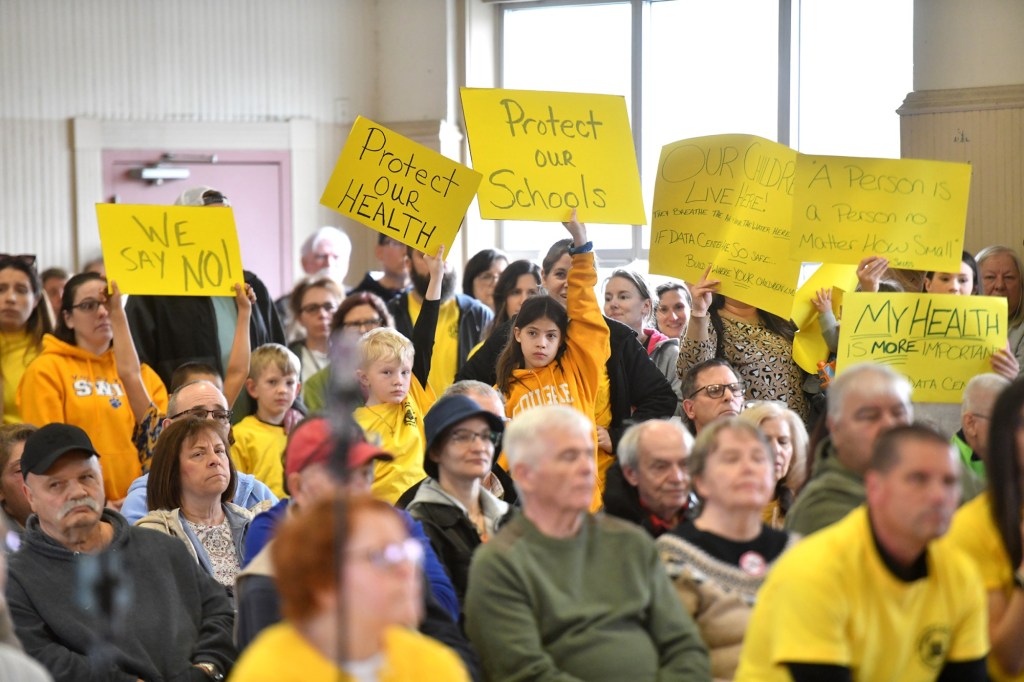
Moosic is in the final stages of crafting one of Lackawanna County’s most comprehensive pieces of data center legislation.
Watching the rapid rise of data center proposals in the region, Moosic Borough Council could hold a hearing as early as June to consider adopting an ordinance to define and regulate data centers by mandating numerous restrictions and required studies as prerequisites for any project to move forward.
“Our hope is that we have a really strong piece of local legislation that will regulate the industry,” council President Marilyn French said. “Our fear is there are not strong regulations at the state level or at the federal level, so we want to do anything we can to protect our community before anyone tries to come here.”
Moosic plans to bring a draft of its ordinance to a Pennsylvania State Association of Boroughs conference early next month to get feedback from boroughs across the state, French said. If borough officials find that they have a strong ordinance, Moosic could hold a public hearing at its June 8 council meeting, she said.
Council also sought input from the community on the draft ordinance during a work session Monday.
Municipalities in Pennsylvania are required to allow for every lawful land use somewhere within their borders, including data centers. Failing to do so exposes local governments to legal challenges for exclusionary zoning, leaving municipalities scrambling to amend their zoning before receiving any applications for data centers.
Since January 2025, Lackawanna County communities have received proposals for more than a dozen data center projects, totaling nearly 100 individual data center buildings proposed across Archbald, Clifton and Covington townships, Dickson City, Jessup, Newton Twp., Olyphant and Ransom Twp. Developers also previously applied for and then withdrew plans for up to four data centers in Blakely.
Prior to the proliferation of proposals, virtually none of Lackawanna County’s 40 municipalities adequately addressed data centers in their zoning ordinances, with two of the only towns to include them, Jessup and Archbald, later revising their zoning standards because their ordinances did not define data centers and were excessively permissive with where they allowed them.
Moosic benefited from watching communities like Archbald navigate zoning for data centers, French said.
“If we were in Archbald’s position, we would have been scrambling to try to get something really strong,” she said. “If we had put in before we had an ordinance drafted, then we would be scrambling to get all of the education and talk to all of our peers.”
Moosic’s ordinance defines data centers and related uses while classifying them as special exceptions in its manufacturing zone. As special exceptions, data centers would require approval from the Moosic Zoning Hearing Board while adhering to restrictions established in the zoning ordinance.
Dickson City took a very a similar approach, with its solicitor and planner successfully defending that strategy Wednesday when the Dickson City Zoning Hearing Board unanimously voted to deny a data center developer’s challenge to the borough’s data center zoning, including its decision to restrict data centers in a manufacturing zone.
Requirements in Moosic’s draft ordinance include:
• Height restrictions of 45 feet, inclusive of roof-mounted equipment such as cooling and ventilation systems, HVAC units, cooling towers and solar facilities.
• 500-foot setbacks from residential areas and “sensitive receptors” like schools, daycares, long-term care facilities, hospitals, places of worship, parks and recreational facilities.
• Landscape buffer, screening, fencing and aesthetics standards.
• A thermal impact and heat dissipation study providing a detailed study showing the amount of heat to be produced and released into the atmosphere during normal operations, and strategies to minimize heat dissipation and achieve a neutral impact on surrounding studies, with a preliminary study, interim study and as-built study six months after a data center receives its occupancy permit.
• A requirement for backup power equipment and facility emissions to use the best available technology to minimize air pollution, requiring backup generators to use the U.S. Environmental Protection Agency’s stringent tier 4 emissions standards.
• A detailed decommissioning or repurposing plan, including detailing what will trigger the closure of the facility, how long decommissioning or repurposing will take, the amount and time of site restoration needed, and a plan for utility coordination.
• Noise restrictions with stricter standards for pure tones and low-frequency sounds, and requirements for American National Standards Institute-compliant sound meters.
• Preliminary, interim and as-built sound studies. Maximum decibel level restrictions do not apply during power outages, but sound studies must evaluate and report anticipated decibel levels when all emergency power generation equipment is running, including backup generators.
• A vibration study from a qualified professional demonstrating that there is no vibration from the data center perceptible to the human sense of feeling beyond the property line.
• A water utilization report must be submitted with the zoning application detailing total daily intake volume and sources, discharge volumes and destinations, cooling system type and efficiency, and compliance with borough stormwater regulations. If the data centers use public water, they must have a will-serve letter showing a utility or public authority will supply the water; if it uses a nonpublic source, they must submit a water feasibility study. The borough will not approve a study unless it demonstrates adequate water supply, and that it won’t adversely impact groundwater or surface water in the vicinity.
• An energy management plan including annual electricity demand, what supply sources will be used, energy storage capacity, and efforts made to maximize use of renewable or clean energy. If it connects to the grid, it must include a will-serve letter while noting known impacts on electric rates or availability.
• An emergency management response plan.
By limiting data centers to its manufacturing zones, Moosic would allow them only in a handful of locations throughout the town, including its northern tier near the Scranton border by Davis Street, the bottom of Rocky Glen Road, and the site of the former DuPont or Goex gunpowder plant on Moosic’s southern border near the Wilkes-Barre/Scranton International Airport. The northernmost site is already slated for a warehouse.
Referencing a pending ordinance doctrine that would require any data center applications to abide by the still-underway zoning standards, French said the borough wanted to have a moratorium in place, educate themselves and watch what’s happening in other communities.
“We can pull the best from everything and have something really strong,” she said. “We’re setting the parameters around the industry instead of them dictating to us what it should be.”