
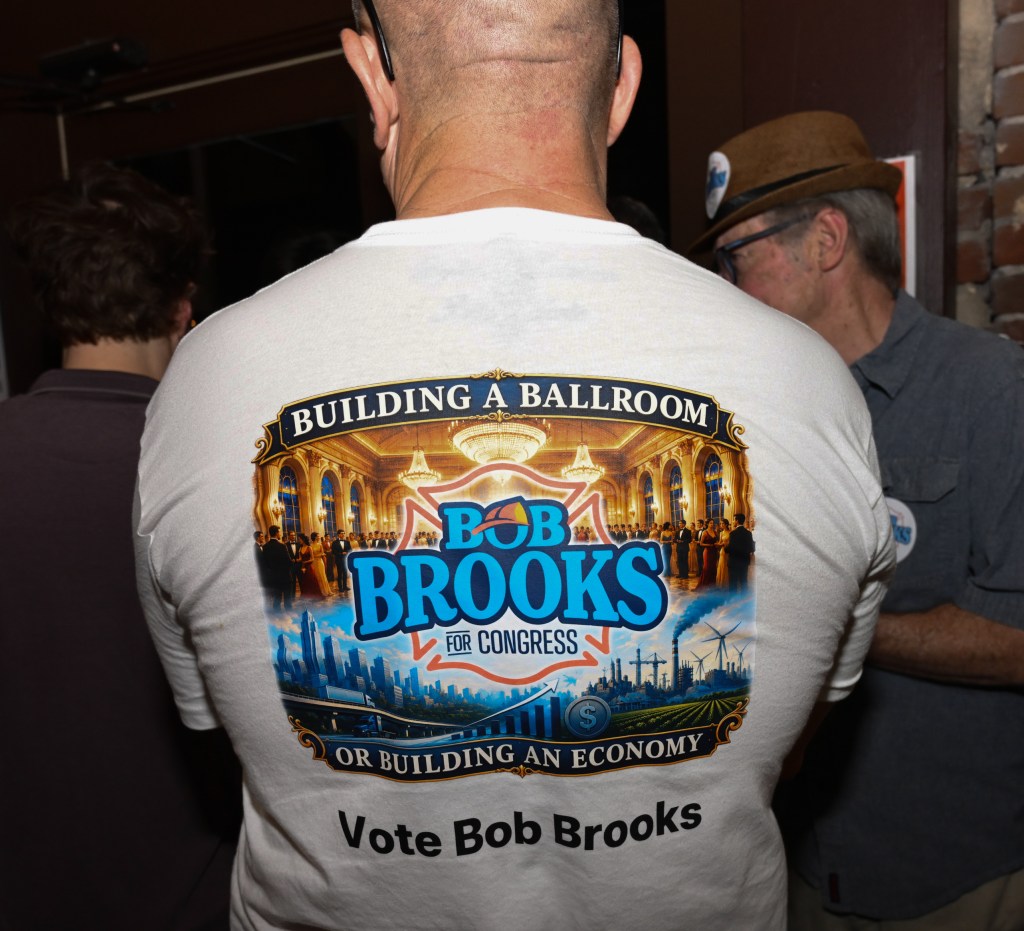
Bob Brooks, the former Bethlehem firefighter and union leader who entered the race for Lehigh Valley’s seat in Congress with the backing of prominent Democrats, decisively won the primary Tuesday, setting him up to face GOP Rep. Ryan Mackenzie in November.
Brooks’ victory is not a surprise to those who followed the race closely. He secured the most prominent endorsements — from local mayors to Gov. Josh Shapiro — plus millions of dollars in support from well-funded outside groups and the backing of dozens of local unions and progressive groups.
But his convincing win — Brooks garnered more than 41% of all the votes cast in the district’s 367 precincts, almost as much as the next two closest competitors combined, according to unofficial totals — is notable when facing three other Democrats in the race — former federal prosecutor Ryan Crosswell, former Northampton County Executive Lamont G. McClure and former PPL engineer Carol Obando-Derstine — who each had their own support and advantages.
It is also proof that the hundreds of thousands of dollars spent by anonymous outside groups to attack his campaign and boost that of McClure’s (who was not involved in that effort) did not sway voters as intended.
Here is how Brooks won decisively, and how he could fare in November in one of the most competitive and consequential House races in the country. The 7th District is considered a “toss-up” by the Cook Political Report, meaning the race is expected to be extraordinarily close and could determine which party controls the House of Representatives next year.
Brooks’ win
Brooks was the last of the Democratic candidates to jump into the race, announcing his run in August, but at the time he already had the backing of figures like U.S. Sen. Bernie Sanders, U.S. Rep. Chris Deluzio and the Service Employees International Union, which sent a busload of volunteers to the polls Tuesday in support.
Shapiro threw his support behind Brooks not long after his announcement, and at an April debate, Brooks disclosed that both Deluzio and Shapiro recruited him to run.
“Chris Deluzio and Josh Shapiro tapped me on the shoulder,” Brooks said in April. “They wanted me to look at the numbers, check out what was going on in the race, and at that point in time, I decided I thought I was the best candidate. … I felt like I had the best shot to go unseat Ryan Mackenzie.”
Just two weeks before the primary, the Democratic Congressional Campaign Committee, the official campaign arm of the Democratic Party, officially backed Brooks in the primary, essentially tipping the scales in his favor, which angered some of his opponents.
The DCCC’s gamble paid off, however: On Tuesday, Brooks won all four counties in the district.
He put up his strongest performance in Northampton County, with 44% of the vote. Brooks’ dominance in Northampton County was so strong that he won in each of the 155 voting districts in all corners of the county.
McClure, as its former county executive, underperformed in his home county, with only 29% of the vote.
Brooks’ victory came in spite of over $1 million in ad spending from an anonymous group called Lead Left PAC, which aimed to portray both Brooks and Crosswell as secretly aligned with the MAGA movement, and McClure as a “true progressive Democrat.” McClure lagged his opponents in fundraising, posting just $20,000 in campaign contributions in his last finance report before the primary.
All three candidates named in the ads denounced the group behind it — which some evidence ties to right wing-groups.
Voters at some Lehigh Valley polls Tuesday night said they were sick of negative political advertising.
Attack ads in the Lehigh Valley’s race for Congress are nothing new: In 2024, pro-Mackenzie groups spent nearly $11 million on ads and mailers critical of his opponent, then Rep. Susan Wild, and pro-Wild groups spent around $5.9 million on attacks against Mackenzie.
Janet Pratt, who voted Tuesday alongside her husband, Bob, at the Ag Hall polling place in Allentown, said they both came out to vote for Gov. Josh Shapiro, state Rep. Mike Schlossberg, and the candidates those two Democrats endorsed, including Bob Brooks.
“They’ve been doing a great job,” Janet Pratt said. “I believe in them, and I believe in who they support.”
Asked if the barrage of negative attacks against candidates including Brooks and Crosswell affected her vote, she scoffed.
“I hate negative ads,” she said. “Absolutely not.”
Another voter who cast her vote in Allentown, who declined to share her full name, said the negative ads made her want to “investigate” the candidates further. A Democrat, she declined to say who she voted for, but said she considers herself an independent voter who did thorough research on all four candidates before making her pick.
“What [the negative advertising] does, for me, is cause me to investigate,” she said. “Because I don’t trust the ads. You know, I think we’re at that point, for me anyway, I don’t know that I believe everything, good or bad. So I say, OK, well, I need to investigate further. If I put in a vote for this person, what is their record? What do they stand for?”
Chris Borick, professor of American politics at Muhlenberg College, said anonymous groups’ spending on primary elections is becoming increasingly common — for example, Democratic groups aimed to boost far-right state Sen. Doug Mastriano in the 2022 gubernatorial primary because they believed he would be an easier candidate to beat in the general election.
In Brooks’ case, the attacks were unsuccessful, but they could set the stage for further attacks in the general election.
“This practice that we saw of outside parties from the opposition engaging in primaries is becoming more common, and certainly was a substantial part of this campaign and of course, if the goal was to knock Brooks out, it failed in a major way,” Borick said. “But part of the goal, I think, from those efforts is not only to perhaps get an outcome in the primary that the opposition would most like, but also to damage and wound the winner if they can’t get their preferred candidate across the finish line. And so if you look at the amount of money spent targeting Brooks and Crosswell, to a degree, it didn’t deliver the primary goal, but maybe those individuals and groups feel that they have been able to put some dents in him that could pay dividends down the road.”
Brooks’ appeal
The breadth of support Brooks achieved worked in his favor, Borick added. It is rare to see Shapiro, a relatively moderate Democrat, and the Working Families Party, a highly progressive left-leaning group, on the same page, but both backed Brooks in the primary.
Brooks’ policy platform includes progressive positions such as enacting Medicare for All and raising taxes on billionaires and corporations, as well as some more moderate positions backed by Shapiro, like “cutting red tape” to building more market rate housing and an “all of the above” approach to energy production, including funding renewable, nuclear and natural gas production.
“The coalition that he has been able to assemble, that has Democrats who are widely considered progressive, and Democrats generally considered quite moderate and mainstream, behind him, is quite impressive,” Borick said. “And ultimately, he will need a unified Democratic Party [in November].”
In addition to his policies, Brooks voters believe his working class, “everyman” persona and demeanor appeals to voters across the political spectrum, too.
On the campaign trial, Brooks has frequently talked about being raised by a single mom and the dozens of odd jobs he has worked throughout his life to make ends meet, including bartender, dishwasher, warehouse worker and pizza delivery driver.
And in a video celebrating his victory on the social media platform X — the very first video his campaign posted after the race was called in his favor — Brooks says with a laugh, “I really need a beer.”
His working class background and humble, relatable demeanor are why Democratic analysts believe he has the best chance. The Bench, a new political action committee founded in the wake of Democrats’ underperformance in 2024, is backing Brooks and other candidates with “real-world experience” like teachers, nurses, veterans, farmers and first responders, according to its website.
Brooks’ blue collar roots are genuine, his friends say. That could be key to winning back working class voters who are disillusioned with Democrats and have left the party in droves.
“I do think that when people look at Bob, they see a real person,” said Lou Jimenez, president of the Bethlehem firefighters union, who calls Brooks a friend and mentor. “They don’t just see a politician. They see a person who has been through the struggle, and who has came up above the struggle, and kept on getting through different obstacles throughout his life. Nobody is perfect. We have all had setbacks in our lives and we have all worked through them, and I think Bob’s story is a lot of people’s story.”
As voters’ perceptions of the Democratic Party continue to sink — the party as a whole has only a 35% approval rating, according to polling averages compiled by Real Clear Politics — groups like the Bench and others that are backing Brooks believe that candidates like him can win back disillusioned voters.
His primary opponents’ grievances about DCCC tipping the scales in Brooks’ favor were quickly sidelined in favor of a victory for Democrats in November. Crosswell, a runner-up who criticized party officials for backing Brooks — saying in an early March statement, “This election is not the DCCC’s or the D.C. insiders’ decision” — encouraged his supporters to get behind him in the general election.
“I’m all in on doing whatever I can to help Bob Brooks and our other Democratic nominees win in November,” Crosswell wrote in a Wednesday social media post. “Tough primaries are healthy and important. But I hope we can all come together now.”
McClure, in his concession speech, also urged his supporters to back Brooks in November.
On to November
Democrats have momentum heading into the 2026 midterm elections in November. House Republicans only have a four-seat majority in the House, so netting just five seats would bring Democrats the majority next year. Donald Trump’s approval ratings have slumped below 40%, according to Real Clear Politics, which also compiled dozens of polls showing that Democrats are favored to win a majority in the House this fall.
But Brooks’ path to Washington is unlikely to be as straightforward as his primary win.
The Lehigh Valley’s congressional district is still one of the most competitive in the country, and he is up against a well-funded opponent — Mackenzie’s campaign has nearly $2.6 million on hand to spend as of April 29, according to Federal Election Commission records.
Brooks has painted Mackenzie as a “career politician” who is out of touch with the Lehigh Valley’s working people. Mackenzie had been a state representative in Lehigh County since 2012 before his election to Congress.
Mackenzie will not be easy to beat, according to Republican strategist and commentator Sam Chen.
Brooks positioned himself as the most progressive candidate in the primary, which Chen believes could be a liability in the general election where the voting population is a lot more moderate. He also expects an ongoing lawsuit with his former mother-in-law to be a liability in the race — Carol Wiley, mother of his ex-wife, Jennifer Lynn Brooks, sued Brooks for allegedly failing to pay a $130,000 judgement against him over a property ownership dispute. Brooks is seeking to have the lawsuit dismissed.
Brooks, at an April debate, called the legal dispute a “joke,” and noted that his ex-wife is supporting him in the ongoing lawsuit and has endorsed his run for office.
Still, it will inevitably become political fodder for Mackenzie and the GOP as they seek to hold on to the seat, alongside other attacks on Brooks that include his support from well-funded outside political groups and his family’s personal wealth (which is anywhere between $148,000 and $3.2 million, according to financial disclosures, though Brooks has said he is “not a millionaire.”)
Mackenzie is also a skilled campaigner, flipping the Lehigh Valley’s seat in Congress by just one percentage point (4,000 votes) in 2024 even though he was outspent by Wild.
“[Mackenzie] has got the money, work ethic smarts, it’s going to be tight,” Chen said. “The last race was tight. He could lose it. If he does, though, it’s going to strictly be because of a ‘blue wave,’ not because he was outworked. The biggest mistake his opponent could make is underestimate him.”
Reporter Eugene Tauber contributed to this story.
Reporter Lindsay Weber can be reached at Liweber@mcall.com.