
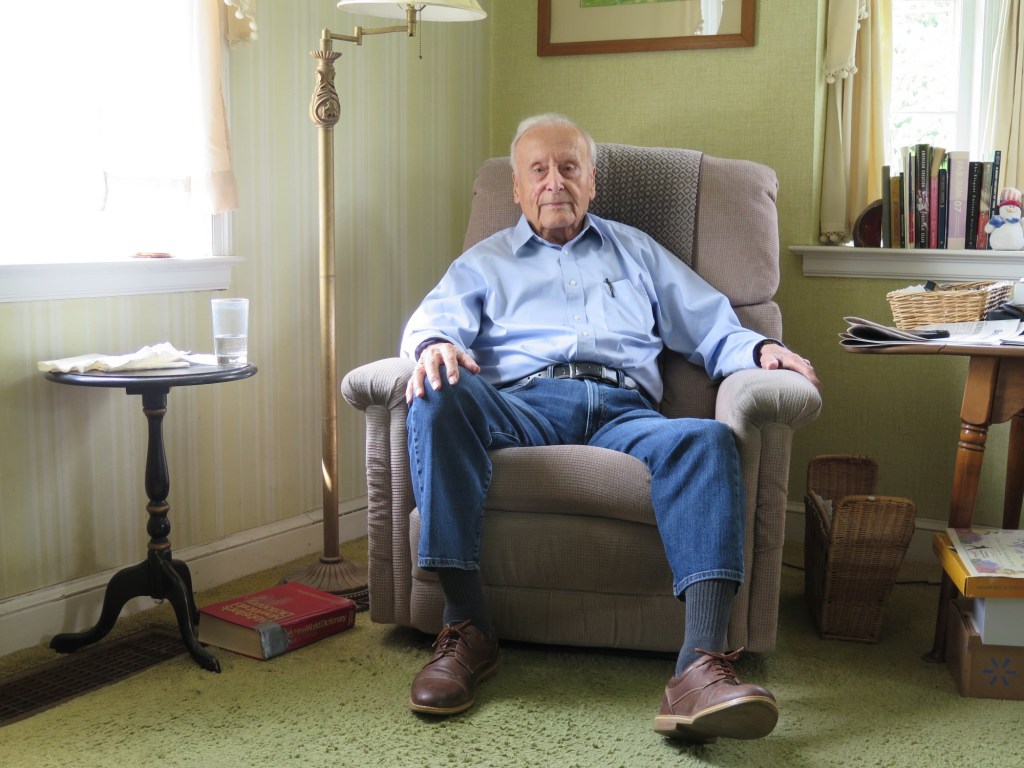
Dealing with the stress of high-pressure situations is something Bob Hartline knows a little bit about.
The 101-year-old Mount Penn man was a Navy and Marine pilot during World War II, finding himself inside the cockpits of cutting-edge planes.
It was incredibly dangerous work that consistently put Hartline’s life on the line. But he never bowed to the pressure, he never let the fear win.
And that’s the kind of mindset Hartline is trying to muster yet again as he faces a new, albeit less life-threatening, challenge.
The veteran will be honored onstage during a special Memorial Day concert broadcast on PBS Sunday night.
“I’m a little apprehensive,” he admitted about being put on display for the country to see. “I’m not young anymore, I’m trying to reduce stress in my life.
“But I’ve been exhibit A before, and I flew with a heck of a bunch of nice guys and I want to honor them.”
A call to duty
Hartline was a senior at Mount Penn High School in December 1941 when Japan launched its surprise attack on Pearl Harbor, forcing the U.S. into World War II.
When he graduated that spring, he knew exactly what he needed to do.
“What I thought was I was going to be in the service one way or another,” he said.
His father had served in the Navy during World War I, and Hartline had long been interested in aviation — building model airplanes as a hobby.
“So I thought I would apply to be a Navy aviation cadet,” he said.
Hartline headed to the recruitment office in Reading, where he promptly failed his eye exam. Undeterred, he hopped on a train and headed to another recruitment office in Philadelphia.
This time, he passed.
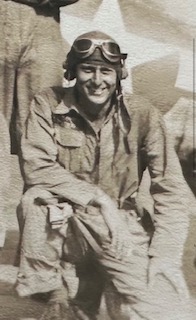 Bob Hartline during his time as a U.S. Marine pilot during World War II. (Courtesy of Bob Hartline)
Hartline was sworn into the Navy on Nov. 17, 1942, and called into service the following March.
“Apparently they didn’t need us right away,” he said with a smile.
Hartline again boarded a bus, this time with a group of fellow recruits. They traveled to Maryland, where they began their training.
“I thought it was about time,” he said. “I’m pretty sure we all had the same attitude.”
Hartline, who previously had only been in a plane when he paid for a ride at Reading Airport, went through civil pilot training. He went to preflight school in Chapel Hill, N.C., primary training in Kansas, and instrument and advanced training in Texas.
After a total of about 17 months, Hartline graduated. He became the second-youngest naval aviator ever, missing out on the title of youngest to former President George H.W. Bush by just two days.
Flying high and fast
Hartline served for four years as a pilot, first for the Navy and later as a Marine.
Although he remained stateside during the war, Hartline used his aerial skills flying Hellcats, Wildcats, TBM Avengers and, his favorite plane, the mighty Corsair.
Many of the planes were brand-new models, with Hartline one of the first pilots to put them in the air.
“You know you’re going to be able to fly the plane because all airplanes fly about the same,” he said. “So you just give it the throttle, go down the runway and you’re off. It’s that simple.”
In 1945, Hartline joined the Marine’s VRF-1 Ferry Squadron, which transported planes to the West Coast so they could be deployed to the Pacific theater.
“There were two factories on the East Coast producing airplanes for the Navy,” he said. “They built 46,000 airplanes for the Navy alone. And all those planes on the East Coast had to be taken to the West Coast.”
Over five months, Hartline ferried 18 brand-new planes and three used ones across the country.
After the U.S. dropped atomic bombs on Hiroshima and Nagasaki in August 1945, effectively ending the war, Hartline was sent to Japan.
“Somebody found out I was having a good time ferrying planes so they sent me to Okinawa,” he said.
Hartline spent about six months there, during which time he flew over both A-bomb sites.
“Of course, the damage was devastating,” he said. “All you could see were the streets, there was nothing else. Everything was destroyed.”
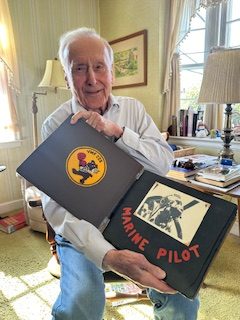 Bob Hartline in an undated photo showing off an image of himself when he served as a U.S. Marine pilot during World War II. (Courtesy of Bob Hartline)
Hartline said he is proud of his time in the service, even if it didn’t go exactly as he planned.
“Initially I wanted to join the service, be a hero, come back and marry a beautiful girl,” he said.
While he didn’t get a chance to make his mark in the skies over Europe of the Pacific Ocean, the rest of his plan did come together pretty well.
After being discharged in May 1946 as a Marine captain and returning to Berks County, he did meet a girl. They married and raised two sons.
And Hartline kept his eyes on the skies. He continued to fly until into his 80s.
When it’s on
The National Memorial Day Concert will air on PBS Sunday starting at 8 p.m.