
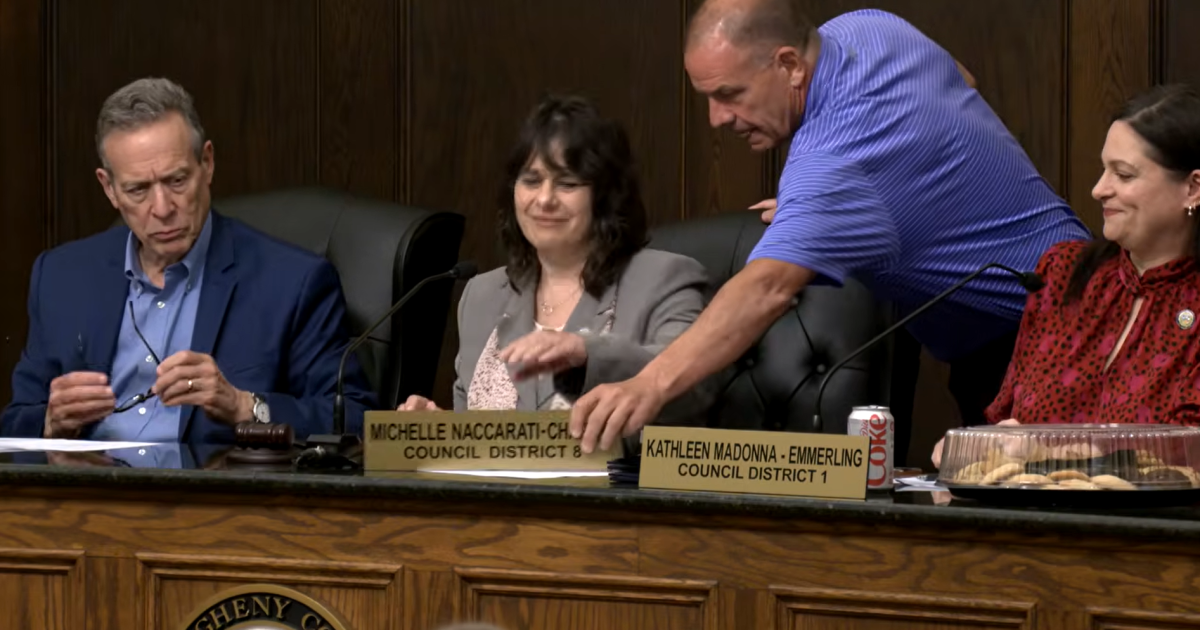
Allegheny County Council members on Tuesday unanimously chose second-term councilor Michelle Naccarati-Chapkis to replace Pat Catena as the body’s president. The reorganization comes just days after Catena resigned the position amid controversy over a campaign mailer sent as part of his unsuccessful bid for a state House seat.
There were no other contenders, and no votes against Naccarati-Chapkis’ nomination, originally made by council member Nick Futules. Catena cast his vote for Naccarati-Chapkis by phone.
“The gavel is yours,” said council at-large member Bethany Hallam after the vote.
“Now everyone knows how to properly pronounce my last name,” Naccarati-Chapkis said.
She thanked the council presidents who came before her, who each “helped shape this council and this county” — and pointed out “something notable about that list,” which is that “until today, this role has always been held by a man.”
Naccarati-Chapkis’ ascension to the presidency also marks the first time in county history women will helm all three branches of local government; She joins County Executive Sara Innamorato and Allegheny County Court of Common Pleas President Judge Susan Evashavik DiLucente. Women also hold two of the county’s four row offices: Erica Rocchi Brusselars is the county treasurer, and Amy Weise Clements is the acting county controller.
“We are continuing that progress. Progress is not a single moment, it is a pattern we choose to continue,” Naccarati-Chapkis said. “In Allegheny County, women in leadership are no longer the exception.”
Residents in District 8, which includes eastern communities such as Braddock, Monroeville, Plum and Wilmerding, reelected Naccarati-Chapkis by a wide margin last November. Long active in the nonprofit sector, she’s emphasized environmental concerns and public safety issues while on council. Among the top concerns for members are the county budget, housing and economic development, she added Tuesday.
“I will not take this moment lightly,” Naccarati-Chapkis said of her new position. “I commit to you … that I will lead with openness and honesty and transparency — not because it sounds good, but because I believe government only works when the people it serves actually trust it.”
The president steers council’s agenda and can set the tone for the legislative branch’s relationship with the county executive; Catena pushed the body to be more independent and move beyond its reputation as a “rubber stamp” for the executive’s policy agenda.
Naccarati-Chapkis may guide council through some significant organizational changes: Members are considering two ballot questions that, if approved by voters, would allow council to hire additional staff. She will also vacate her seat on several key committees including budget and finance, public safety and government reform, and must appoint other members to step in.
Community members and advocates began calling for Catena to step down shortly after the flyer first circulated. It attacked his opponent in the state House race for being backed by “an extreme left group that advocates for transgender athletes in our sports.” Critics said the message targeted transgender people and made Catena unfit to represent county residents.
He likely would have faced an effort to remove him as president on Tuesday, had he not stepped down.
But he retained his seat on council. At the meeting, several public commenters called for Catena to leave that position as well.
“His seat would better be filled by a legislator that doesn’t use trans people as political fodder,” said Samantha Fitzgerald.
First-term council member Kathleen Madonna-Emmerling was the first to publicly declare her interest in replacing Catena, but withdrew from consideration Tuesday afternoon.
“I volunteered as a candidate for Council President because I believed it was important to offer a fresh vision for Council leadership grounded in transparency, accountability, and respect for the public’s voice,” she wrote in a social media post. “I am grateful for the conversations this process sparked and remain optimistic about the opportunity to continue advancing openness, collaboration, and accountability through our shared work.”
Speaking with reporters after the meeting, Naccarati-Chapkis said she plans to use council’s upcoming summer recess to talk with members “a little bit more about their priorities.”
“But in all, I feel like we’re on a good path forward,” she said.
At the same meeting, members approved rules meant to protect transgender people incarcerated at the Allegheny County Jail. The vote was unanimous, with Catena voting for the protections along with the rest of council.
Advocates, including the re-established ACT UP Pittsburgh, have been raising awareness about the disproportionate violent threats trans people face while incarcerated, and urging local officials to increase protections where federal officials continue to target gender-affirming care.
Under the rule passed Tuesday, safeguards for transgender people outlined in the federal Prison Rape Elimination Act could still be enforced at the county level.
“Incarcerated trans women and intersex people already face discrimination and violence at higher rates than cis people,” B Kleymeyer, a member of ACT UP Pittsburgh, said during public comment. “Enshrining the Prison Rape Elimination Act into the county code is the first step towards making sure our trans incarcerated community is safe, but it is only the beginning.”
Officials have said that the ACJ has a “zero-tolerance” towards sexual assault and sexual harassment, and that it follows a policy that dictates how trans and intersex people should be treated. But the county has faced sharp criticism and even a lawsuit alleging the jail has violated those rules. (The county settled the suit in 2022 and did not admit to any wrongdoing.)
“Local officials still have both the authority and the responsibility to ensure incarcerated trans people are protected from sexual violence and abuse inside the Allegheny County Jail,” Jill Ratliff, a member of ACT UP Pittsburgh, told council.
In a statement, the group said “The vote marks a long-overdue protection for incarcerated people in Allegheny County.”