
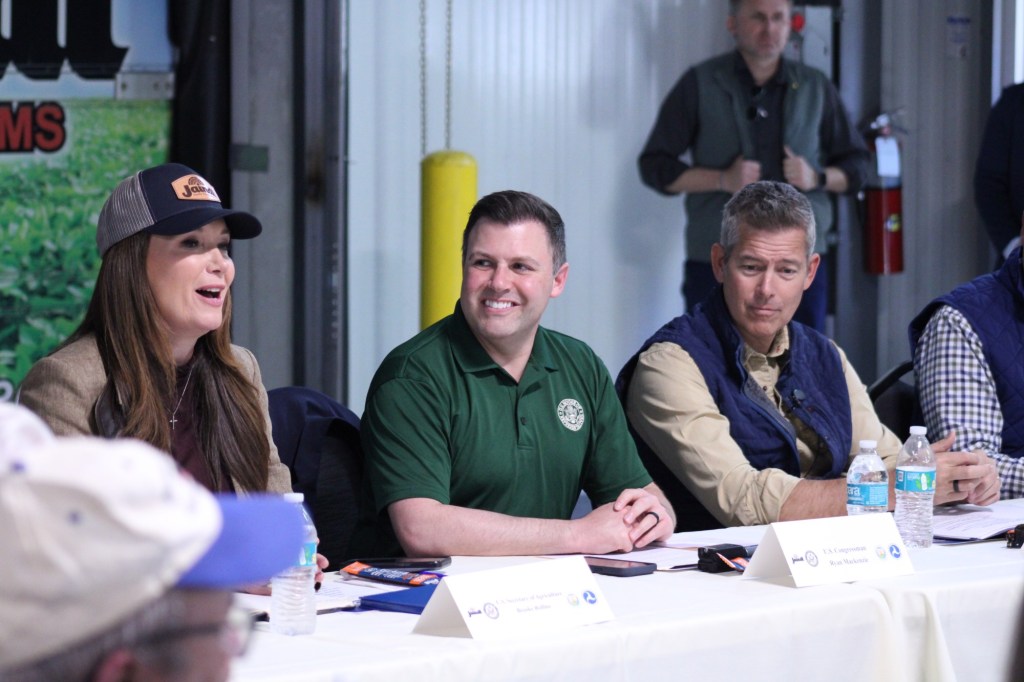
Two prominent members of President Donald Trump’s administration fielded questions this week from Lehigh Valley farmers feeling crunched by the rising cost of fertilizer and diesel fuel due to the war in Iran.
Transportation Secretary Sean Duffy and Agriculture Secretary Brooke Rollins participated in a roundtable with local farmers and food producers at Jaindl Farms in North Whitehall Township on Tuesday. U.S. Rep. Ryan Mackenzie moderated the discussion.
Fertilizer prices have shot up since the U.S. war with Iran closed the Strait of Hormuz, through which around a third of global fertilizer passes. Around 70% of farmers reported not being able to afford all the fertilizer they need due to shortages caused by the conflict, according to a survey from the Farm Bureau.
Diesel fuel — which powers tractors and much of the equipment farmers use — has also shot up in price by at least 45% since the start of the conflict, per reporting from the New York Times.
Kathy Raub, co-owner of Raub’s Farm Market near Easton, asked the two federal officials how they would help farms like her own struggling to afford those increasing costs.
“What is being done to handle the outrageous fertilizer cost to the farmers? It has gone up exponentially this year, and it has been on the increase the last few years,” Raub said. “It has become an extreme hardship on farmers across the country. What efforts are being made to try and ease that burden?”
Rollins said the Trump administration is addressing the issue by increasing grant funding for American fertilizer plants and fast-tracking the permitting process for a Louisiana ammonia facility (ammonia is used in some types of fertilizer) due to open in 2029.
The Trump administration is taking a similar approach to fuel production. Duffy called for bolstering American energy production in order to shield U.S. farmers from disruptions abroad.
Both secretaries also placed blame on former President Joe Biden and Democratic leaders for their efforts to roll back fossil fuel production, incentivize clean energy and accept more fertilizer imports instead of producing it domestically.
“This is, I don’t want to say a blip, but this is short in time, if you look at how the president has invested in American energy dominance,” Duffy said of diesel prices.
Officials also announced at a news conference following the roundtable that the Trump administration will temporarily waive restrictions on truck deliveries of fertilizer in 30 states, including Pennsylvania, which they said will allow more timely and affordable deliveries.
Jeff Raub, Kathy’s husband and co-owner of the family farm, said he is glad to hear about the efforts the Trump administration is taking, but farmers will feel little relief if the Strait of Hormuz does not reopen in the near future.
While U.S. and Iranian officials are negotiating a peace resolution to the conflict, news of U.S. strikes on Iranian missile sites this week cast doubt on hopes for a quick resolution.
“The strait’s got to be open. It’s a global market, we produce a lot more fuel in this country than we did, but it’s traded on the market, just like grain,” Jeff Raub said. “It’s all based on supply and demand. So if the demand is there, and the supply is not there … it all affects our prices.”
Dawn Godshall, executive director of the nonprofit Community Action Lehigh Valley, asked Rollins for an explanation for several canceled deliveries of federal food aid. Community Action’s food bank has seen 11 deliveries of food from an emergency food aid program via the U.S. Department of Agriculture canceled since Trump took office, Godshall said.
Rollins said that the canceled deliveries are “news to me,” and she vowed to look into it.
Reporter Lindsay Weber can be reached at Liweber@mcall.com.