
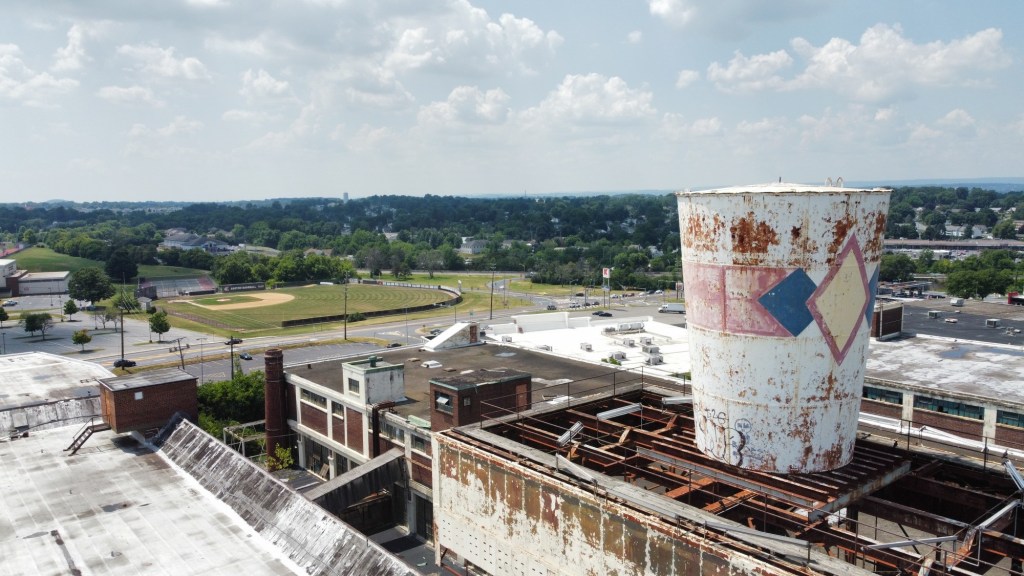
After a lengthy delay in the bureaucracy of county government, redevelopment of the perennial project in my neighborhood — the Dixie Cup factory in Wilson — is again a matter of public discourse. This time, a Tax Increment Financing ordinance is being considered to cover the cost of revitalizing the site into 405 market rate units.
The TIF ordinance calls for the developer to set aside 10% of units constructed as affordable housing, or making an in-lieu payment of $27,000 per unit covering the 10% provision, or about 40 apartments. The Wilson Area School District and the Wilson Borough Council voted in favor of the TIF ordinance, citing the long abandoned and neglected site as a possible source of community and economic revitalization. However, the most contentious component of the TIF, the opt-out language for the affordable housing component, has been largely irrelevant to either body. That has changed with the ordinance finally reaching Northampton County Council.
Anyone who has followed the starts and stops of this site’s redevelopment would not be surprised to hear that county commissioners were decidedly less unanimous in their public hearing on the TIF. In fact, it’s highly unlikely the TIF has the votes to even pass. Several county commissioners have been critical of the TIF since it was introduced over a year ago, citing the length of time for the TIF, the lack of affordable housing in the project or the absurdly low contribution the developer can make to get out of having to build any affordable units in the redeveloped Dixie Cup building.
This seemingly creates a conflict between the local authorities and the county council critics, but such a framing misses the important nuance of this debate. Proponents for the TIF ordinance are really proponents for the Dixie Cup’s redevelopment, while the critics are those with issues with the TIF, not the redevelopment. The best proof of this was the most recent hearing: several supporters of the ordinance spent the majority of their time speaking about the potential of a renewed Dixie; critics meanwhile focused on the details of the TIF itself. These positions are not mutually exclusive: a person can support the site’s redevelopment while also being critical of the terms of the TIF. I am one of those people.
Because the redevelopment is 405 units, if the developer, the New York-based Skyline Investment Group, decides to go with the payment alternative the total cost would be $1,080,000 ($27,000 x 40 units). The developer has indicated it plans to do the latter. In spite of the TIF ordinance being public for over a year, there has yet to be any public rationale for why $27,000 was chosen as the opt-out figure. It certainly does not cost $27,000 to build a single unit of affordable housing. Throughout this period, this opt-out figure has been a continual source of scrutiny and frustration among those on the Northampton County Council. As I argued during the Council’s public hearing on the TIF, this figure is insultingly low and jeopardizes the passage of the TIF. My solution to this dilemma is simple: increase the number.
In a time of political absolutism, it is important to actually listen to the other side of a political debate, particularly on local issues like this one. As I have suggested, the proponents of the Dixie Cup redevelopment are right to see this project as the linchpin to a possible economic renaissance. At the same time, the critics are right to scrutinize the merits of the TIF and openly wonder if they are in fact getting a good deal. For either side to be outraged, dismissive or hostile to the other is to fall into the trap of political tribalism and to see policymaking as a zero-sum game.
Policy should be about making good things happen. As I see it, everyone wants the Dixie Cup redeveloped. As a humble taxpayer, I do not have the power to amend this ordinance to address the valid concerns of the critics. But each of the nine Northampton County Commissioners do. If the proponents on Council are serious about getting the Dixie Cup building redevelopment done, they need to be open to amending the TIF. And if the critics are serious about supporting Wilson and the wider tax base, they need to offer amendments that will get this TIF passed. As my fix to the affordable housing opt-out language demonstrates, there are ways to amend the ordinance that address the concerns and priorities of both sides. The question for the Northampton County Council to consider on Nov. 6 is this: Are you willing to work together for the greater good?
This is a contributed opinion column. Armando Moritz-Chapelliquen is a Wilson resident. The views expressed in this piece are those of its individual author, and should not be interpreted as reflecting the views of this publication. Do you have a perspective to share? Learn more about how we handle guest opinion submissions at themorningcall.com/opinions.