
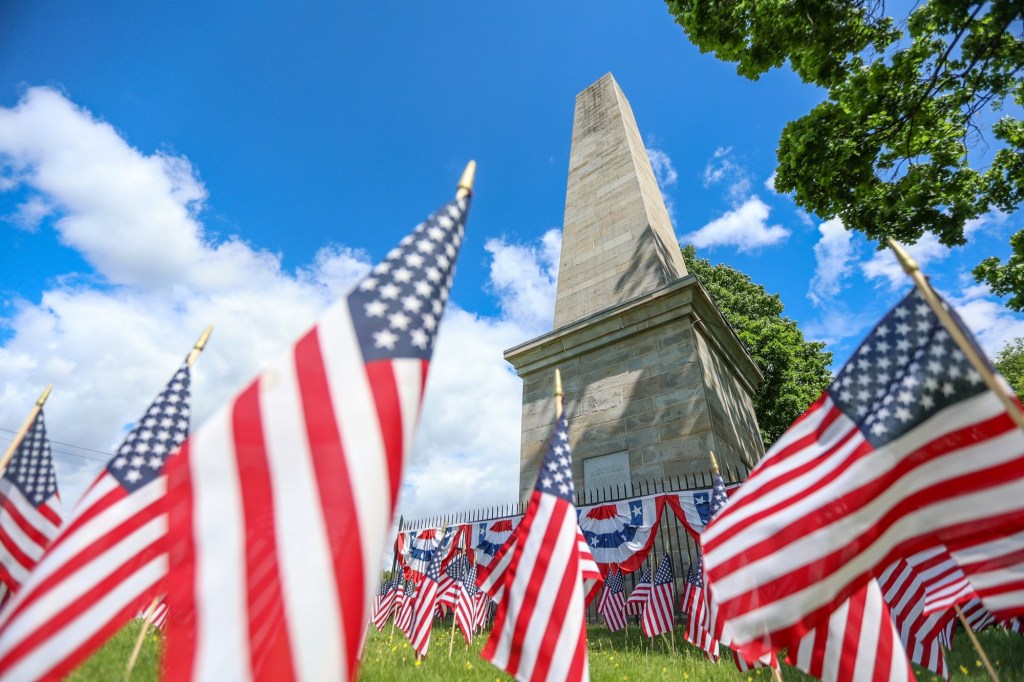
Picture a vast wilderness, lush trees overwhelming the hill, a river cutting through the stone and raging down its center. Imagine being dropped into this place, wandering for days before you encounter another person, and knowing it might be days before you see another.
If that sounds appealing, picture a similar reality of life there. One in which self-sufficiency is not only an admirable trait, but necessary for survival. One in which money is no object, because its value isn’t accepted. One where cannons of war and threats of terrorism are all-too-frequent occurrences.
In this case, “there” is actually “here.”
This summer, the United States of America turns 250 years old, and it will do so as an unquestioned and long-established world power governed under the rules set forth by the world’s oldest and longest-honored written constitution. In industry and economy and military might, it has come a long way since declaring its independence on July 4, 1776.
The same can be said for a region so critical to its rise.
In 1776, Wilkes-Barre was a township. Scranton didn’t exist, at all. Most who lived in the sparsely populated Wyoming Valley considered themselves residents of Connecticut. Schuylkill County was a frontier mountain wilderness; a reputation as a perilous frontier established during the French and Indian War was only beginning to subside.
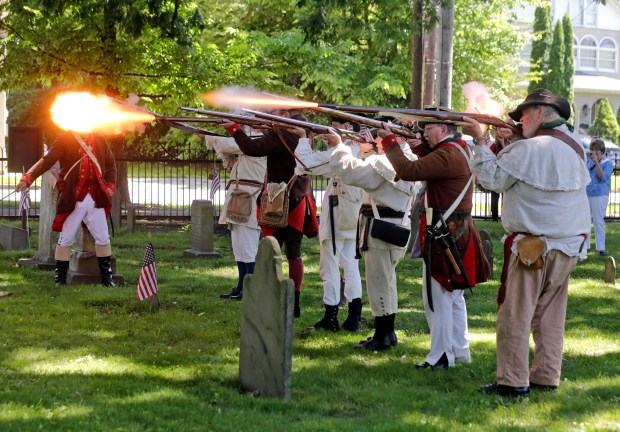 Members of the 24th Connecticut Militia Regiment fire a musket volley during the ‘First to Fall’ Memorial Service at the Jenkins Harding Cemetery in West Pittston on Sunday, June 29, 2025. The fourth annual service, sponsored by the West Pittston Historical Society, honored Revolutionary War patriots, specifically brothers Benjamin and Stukley Harding who were ambushed in the days before the Battle of Wyoming on June 30, 1778. BILL TARUTIS / CONTRIBUTING PHOTOGRAPHER
The anthracite coal fields that later formed the region in the 1800s sat underground, largely untapped. Churches were few; Schuylkill County had just two. The Wyoming National Bank, the area’s oldest financial institution, wasn’t chartered for another 90 years. Land north of Blue Mountain was inhabited only by a handful of squatters until the Penn family officially purchased the land from Native Americans in 1752.
Everything was new, untamed and up for grabs. Nothing was certain.
“For anybody who was around at that time,” said William V. Lewis, D.A., commissioner and vice chairman of the Pennsylvania Historical and Museum Commission, “it was a pretty terrifying place to live in.”
The lay of the land
Few facts depict how isolated the Wyoming Valley and surrounding areas would have seemed 250 years ago more than a consideration of the population.
The first U.S. Census didn’t take place until 1790, but even the most aggressive population estimates for the entire area at the time don’t exceed 3,000 permanent white settlers. Today, that is comparable to the current population of the boroughs of Avoca, Jermyn and Coaldale, currently among smaller towns in Luzerne, Lackawanna and Schuylkill counties, respectively.
Town meeting records estimated there were 430 able-bodied men in the entire valley just four months before the signing of the Declaration of Independence.
In Schuylkill County, there were fewer than 2,000 residents. Walk into a cabin alongside the Schuylkill River then, and you most likely wouldn’t encounter a resident who spoke English. Most were of German descent and spoke a distinct dialect of that language — known as Pfälzisch — that settlers brought from Germany’s Rhine region.
“Signs were in German. Deeds were in German. Wills were in German. Public records here have actually been translated from German over time,” said Orwigsburg’s Randy Lindenmuth, a member of the Schuylkill County Historical Society’s board of directors who wrote a booklet titled “Frontier Life in Schuylkill County 1749 – 1776: The Dawn of Independence.”
Town centers were relatively convenient places where residents could gather to learn news — often via pamphlets tacked to posts — or trade goods. One was located where South River Street and Northampton Street in Wilkes-Barre intersect today.
“They also had (wooden) stocks there,” Lewis said. “So if you were arrested, say, for gossiping or for stealing, they would put you in the traditional stocks like they had in New England, where your head and arms are immobilized. They’d have you stay out there for a couple hours so they could embarrass you.”
One thing just about all seemed to agree on about the area as the United States prepared for revolution was, it was great for farming.
With farmers in better-populated areas of New England struggling to get optimal yield from overworked soil — settlers knew little of crop rotation and fertilization in those days — waves of settlers from Connecticut made the trek into what they considered their territory’s “Western Reserve” by 1769.
Once in the Wyoming Valley, they learned what Native Americans learned before them: When the Susquehanna River flooded each spring, it provided the soil with nutrients and minerals that enabled crops to grow more consistently.
Those who farmed the area mainly grew corn, wheat, barley and potatoes. The harvesting of flax was essential for textiles.
All of it was critical, Lewis pointed out, for the currency of the time period: trade. Fortunes built in coming decades by settlers had little to do with anything considered important at the time.
“There was British money, but very few people had it. There was Pennsylvania money, but nobody trusted it,” Lewis said. “They didn’t trust early Continental money or U.S. government money. It took a long time before people gained a trust in paper currency. They just felt the safe thing to do was, ‘If you need chicken, give me some wheat. If I need wheat, I’ll give you some eggs.’”
A fight for territory
It might have all added up to a simple, peaceful life in this area if it weren’t for King Charles II’s rudimentary knowledge of the New World’s geography.
At the beginning of his reign as king of England, Scotland and Ireland in 1662, Charles II granted the Connecticut Colony and its governor, John Winthrop, a sprawling transcontinental land charter that included Connecticut and all areas west that weren’t already settled by New York. They considered the Wyoming Valley part of their Western Reserve, which they conceivably would have argued stretched to the Pacific Ocean.
Near the end of his reign in 1681, Charles II granted William Penn a fairly massive land grant of his own, promising Penn land from the Delaware River north to New York to repay a £16,000 debt the Crown owed to Penn’s father.
By 1770, that was causing major problems.
It would be fair to call Northeast Pennsylvania war-stricken by 1776, with obvious cross-claims to the territory. When members of the Penn family learned that settlers from Connecticut were staking claims in the area, they sent a sheriff to attempt to evict them. The Connecticut settlers fought back.
Ultimately, the debate led to a series of conflicts known as the Yankee-Pennamite Wars that raged in the area through the first half of the 1770s. Downtown Wilkes-Barre was a literal war zone then, with cannon fire regularly being exchanged by Connecticut settlers manning Fort Durkee and Pennamites at Fort Wyoming, just about 1,000 feet from each other along South River Street. There were several other significant battlegrounds, ranging south toward West Nanticoke, too.
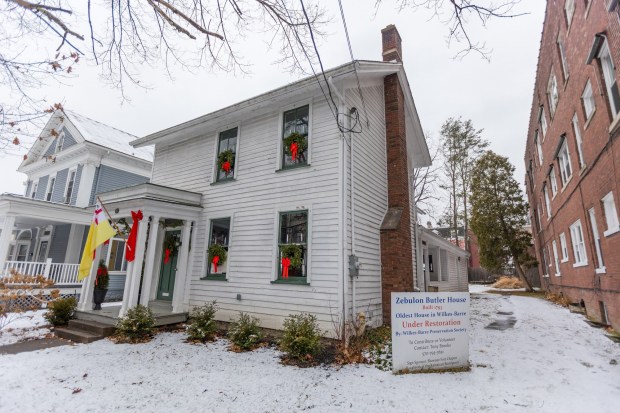 The exterior of the Zebulon Butler House in Wilkes-Barre on Tuesday, Dec. 23, 2025. (JASON ARDAN / STAFF PHOTOGRAPHER)
Those tensions cooled to a simmer by 1776, when many able-bodied men in the area — most notably Zebulon Butler — joined Gen. George Washington’s army in the American Revolution. But, it doesn’t mean life in what became Northeast Pennsylvania became less challenging.
The mostly older people, teenagers and women left behind faced challenging times, tending to the farms that were starting to become more robust throughout the valley. Around them, British forces turning a focus to keeping the South tried to create distractions for Washington’s troops here with sporadic raids.
Leaders from both the Yankees and Pennamites were kidnapped. Frustrated by the seizure of their land, Native Americans staged attacks. The Battle of Wyoming in 1778 — the bloody massacre in which more than 300 area settlers were killed by British soldiers and Iroquois warriors who teamed with them — went down in history as the area’s only Revolutionary War battle, but it also stands as the culmination of the series of local conflicts that led up to it.
“Wherever you looked around, there was danger,” Lewis said. “There were multiple reasons why people wanted to get out of town.”
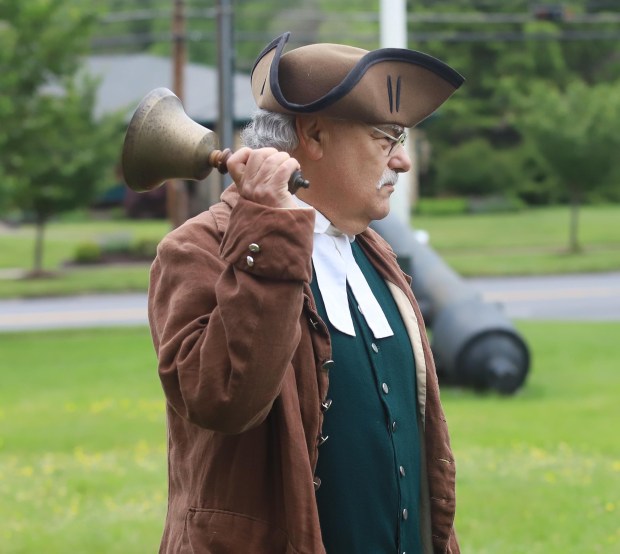 Renactor Mark Kahn portraying Josiah Entwhistle rings a bell to call everyone to be seated duringa Memorial Day Remembrance Service hosted by the 24th Connecticut Militia Regiment at the The Wyoming Monument on Sunday May 24th 2026. The event featured period music, remarks by various speakers, a musket volley tribute and a roll call of those who perished during the Battle and Massacre of Wyoming on June 30th and July 3rd of 1778. (Dave Scherbenco / Contributing Photographer)
Building a nation
They stayed, though. And they changed the course of American history by doing so.
In 1782, the Decree of Trenton resolved the territorial dispute between the Connecticut settlers and the Pennamites in the Wyoming Valley, making the Wyoming Valley part of Pennsylvania. It also gave Connecticut settlers who cultivated the land rights to their property.
Luzerne County was formed in 1786, and Schuylkill took its shape by 1811. Scranton began pumping out iron and steel in the mid-1800s, leading to the birth of Lackawanna County.
But it was the settlers who braved revolution, withstood land conflicts and formed the culture that would come to define the area, that drove it to prominence.
“It took some pretty tough people to work their way through that,” Lindenmuth said. “It had to be tough, but they made it. Damn, did they make it.”