
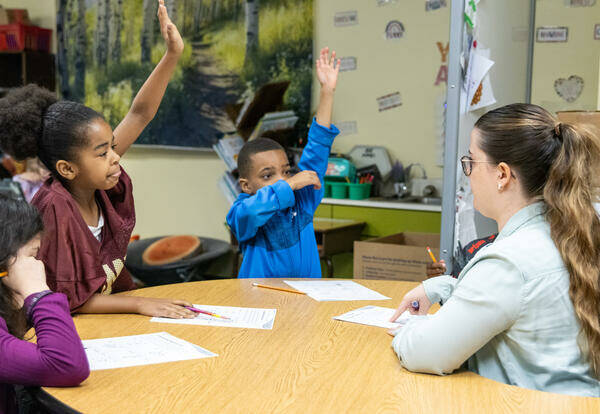
An inclusive instruction model for elementary reading and math classes has shown growth in students’ academic performance, Steel Valley School District educators say.
Rather than pulling out special education students for small group instruction, special education staff joins the classroom teacher for individualized, small group and full class instruction.
Kim Winters, principal of Barrett Elementary in Steel Valley, appreciates the new approach. “Instead of pulling out students with an IEP, they push into the regular education classroom,” she said.
An IEP is an “Individualized Education Program,” a common term in education for a plan created for a student with a disability or special needs.
The initiative has been rolled out over the past year also at Steel Valley’s Park Elementary School.
The classroom teacher and learning support teacher guide instruction and adapt material to meet students’ needs.
“It’s easier when they realize it’s not something extra. It’s helping them,” Winters said. “We’re putting extra support in the classroom and you can be more flexible.”
Steel Valley serves students in Munhall, Homestead and West Homestead.
Nearly 27% of students districtwide require special education services.
Public school districts are legally required to ensure students with disabilities are educated in the least restrictive environment appropriate to their needs.
“Historically, they are identified as special education students and placed in a classroom, because that is specialized instruction,” said Melissa Cheslock, Steel Valley’s director of pupil services. “We noticed over the years there are a lot more cons than pros.”
Students with special needs still receive additional academic and behavioral support to meet their needs, Cheslock said.
Winters said immersing special education students in the regular education classroom has shown benefits.
Data from district academic progress testing found:
• 3 of 4 first grade special education students met projected growth in math
• 3 of 6 second grade special education students met projected growth in math, and three met projected reading growth
• All four special education students in third grade met projected math growth, and three of four met projected reading growth
• 5 of 9 fourth grade special education students met projected growth in math, 5 of 10 met projected reading growth and seven met projected science growth
Almost every student on the special education courseload showed some growth academically, Winters said.
“As far as (state testing) goes, our hope is growth,” Cheslock said. “To show proficiency, it takes time. We have to be immersed in this model for a number of years.”
In the 2024-25 school year, 16.7% of Barrett students scored proficient or advanced on English state assessments. Almost 17% were proficient or advanced in math, the state reports.
The immersive strategy also gives teachers the opportunity to provide enrichment for students performing well on a subject or topic, Winters said.
“Teachers are very good at using data to drive instruction,” she said. “It’s a matter of teachers diving into data and using that on a daily basis.”
Barrett and Park elementary schools closed at the end of this school year for a new, merged Steel Valley Elementary School. Winters will be the principal of that building. The inclusive teaching model will continue there, she said.
“I’m excited to see how it all comes together,” Winters said. “Being able to bring it all together is only going to benefit all students.”