
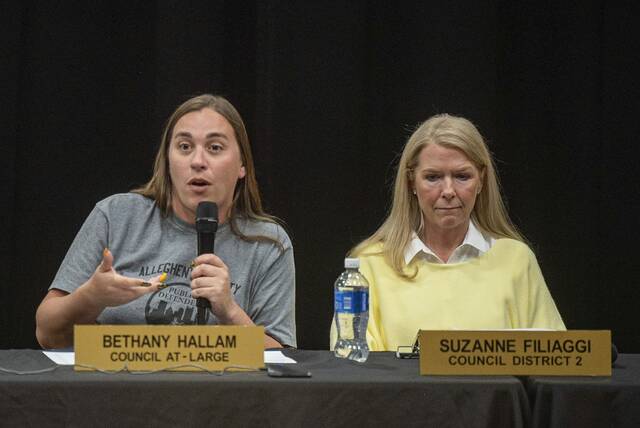
Property reassessments, historically among Allegheny County’s most politically charged issues, drew minimal public interest Wednesday as about a handful of residents addressed council during a public hearing in Monroeville.
Those who spoke largely voiced concerns regular reassessments could lead to higher taxes for homeowners.
The hearing focused on a bill introduced in March that would require countywide property reassessments every three years beginning in 2028.
The proposal seeks to establish a regular reassessment schedule after years of debate over how and when the county should update property values.
The sparse turnout at the Community College of Allegheny County’s Boyce Campus auditorium contrasted sharply with the controversy that has frequently surrounded countywide reassessments, which have fueled political battles over property values and taxation in Allegheny County in previous years.
Residents who spoke Wednesday largely expressed concern over the possibility of higher taxes as the cost of living continues to rise.
Residents raise tax concerns
Marian Gardner of Monroeville.
is a retired nurse of 45 years living on a single income. Gardner said she fears rising property taxes could make it impossible for seniors like her to remain in their homes.
She urged council to consider the impact reassessments could have on older residents who are already struggling with increasing costs for food, medicine, insurance and other necessities.
“I never thought that I would be in a position of, ‘do I buy food for me, for the dogs, my medicine’ — you know: pay for this, pay for that,” Gardner said. “What scares me is, did they take enough consideration into seniors who are living by themselves, who are trying to survive on one salary?”
Allegheny County Councilman Dan Grzybek, D-Bethel Park, who sponsored the legislation, said council has put provisions in place to protect longtime homeowners, especially those with more modest incomes, such as the Longtime Owner-Occupant (LOOP) Tax Relief Program.
In February, county council approved the program, designed to provide protections to longtime homeowners and occupants.
Nigel Broadbant of Oakdale, said he was concerned that regular property reassessments would shift more of the tax burden onto homeowners, especially seniors and those on fixed incomes.
He questioned aspects of the LOOP program, including its relationship to the Homestead Exclusion or Act 50, which reduces the assessed taxable value of a primary residence or working farm. Broadbant urged officials to lower the program’s proposed 7% annual tax increase cap.
“These are some of the most vulnerable people in society and must be protected with no way of increasing their income,” Broadbant said. “They have earned their right to a dignified retirement.”
Council says reassessments are not a revenue grab
Councilwoman Suzanne Filiaggi, R-Franklin Park, who chairs the Assessment Practices Committee, said property reassessments are intended to ensure fairness in the tax system, not to raise additional revenue for the county.
Under Pennsylvania law, taxing bodies generally must remain revenue-neutral when a reassessment takes effect, meaning they cannot collect more than 5% above the previous year’s property tax revenue.
If overall property values increase after a reassessment, the county must lower its tax rate, or millage, to prevent a major increase in total revenue.
Instead, reassessments are designed to reflect changes in property values over time. Because Allegheny County’s last countywide reassessment occurred in 2012, some properties might now be worth significantly more or less than their assessed values.
“I would say this is not an attempt at a money grab,” Filiaggi said.
Lawsuits, tax debates and school district support
Council Chief Clerk Jared Barker said the lack of public engagement had surprised the council. Even the first public hearing on the proposal, held in early May in West Mifflin, drew limited participation.
Written comments have also arrived at a slow pace, Barker said, averaging about one per day. Written testimony will be accepted through July 27.
The issue of property taxation and reassessments has caused disagreements and multiple lawsuits over the past two decades.
“One of my fears and one of the reasons that really caused me to introduce this legislation is because I don’t want to get to the point in which we lose a lawsuit like we have before,” Grzybek said.
Most recently, Pittsburgh Public Schools sued the county in April 2024, alleging the county’s outdated property assessment system violated the state constitution’s uniformity clause, which requires local and state taxes to apply the same measure to all taxpayers or properties, according to court records.
Visiting Judge Kenneth Valasek, from Armstrong County, dismissed the lawsuit in February 2025, finding the district could avoid harm simply by raising its tax rate rather than suing the county, court records said.
The district appealed to Commonwealth Court, which heard arguments in March. The case remains pending.
Abigail Gardner, spokeswoman for Allegheny County, said the County Executive’s Office did not comment on the proposed bill because of the ongoing litigation.
Allegheny County has previously been sued over delayed reassessments and lost those cases — including one that resulted in a court order requiring the county’s 2012 reassessment.
In 2024, Allegheny County raised property taxes for the first time in more than a decade, ending one of the most heated debates of the budget season. After months of disagreement over competing proposals, council approved a 36% increase, raising the millage rate from 4.73 to 6.43 mills.
County Controller Amy Weise Clements previously spoke in support of reassessment mandates, saying the previous property tax increase helped temporarily offset costs for the 2025 budget year and generated an additional $132 million in revenue.
She said Monday that conducting reassessments more regularly would help make the process more efficient as property values continue to fluctuate.
However, Weise Clements also warned county departments that taxes alone would not solve the county’s “considerable fiscal concerns.”
Vanessa Lynch, a director on the Fox Chapel Area School Board, and Jon Drager, director of finance for Gateway School District, both spoke in support of the mandate.
“Over the past three years, we’ve lost out on approximately $7.6 million, averaging a little bit over $2.5 million per year in real estate tax revenue,” Drager said. “The current assessment in Allegheny County isn’t just outdated, it’s extremely volatile. Countywide reassessment would provide the school districts with a stable, predictable tax base for budget forecasting.”