
Beth Ann Rosica’s writings are a blend of news, opinion, and analysis.
Pennsylvania is the nation’s third most regulated state for childcare centers, and some state lawmakers want to ease regulations as families shoulder rising childcare costs.
According to a recent report by the Archbridge Institute, the Commonwealth ranks at the bottom for regulatory childcare freedom as compared to other states. It identifies two options to make childcare more affordable for families: state-sponsored programs and deregulation.
 Downloaded from the Archbridge Institute report.
Pennsylvania already spends a significant amount of money on childcare. The Commonwealth Foundation reports the state spent over $420,000,000 on childcare subsidies in 2024-2025, and Governor Shapiro is proposing over $460,000,000 for the upcoming budget year. Despite these vast numbers, parents are still stuck spending a large chunk of their income on daycare.
“Statewide numbers for 2024 show the average annual cost of center-based infant care in Pennsylvania at $14,910, or 11.5 percent of the median married household income and 40 percent of the median household income for single-parent families,” the Commonwealth Foundation reports. “It is more expensive to send two children to daycare than one child to an in-state college.”
Several state legislators are focused on changing regulations in Pennsylvania to make it easier and less expensive for childcare providers to operate.
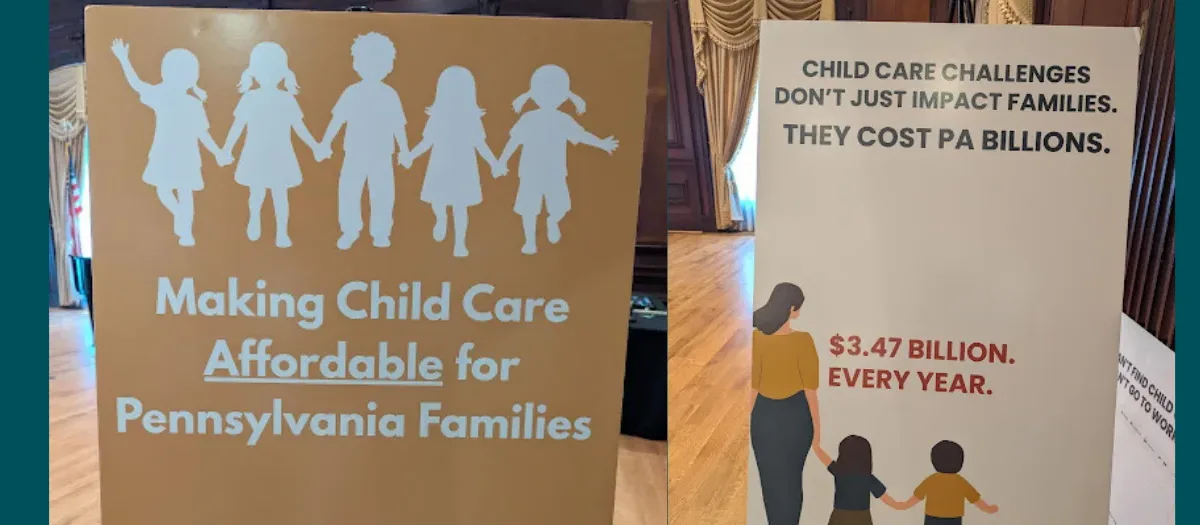
Last week, the Pennsylvania House Republican Policy Committee hosted a multistate roundtable in partnership with the Women’s Public Leadership Network (WPLN) Summit and the Greater Philadelphia YMCA. WPLN educates, organizes, and inspires women to seek public office and become effective leaders, and the YMCA is the largest provider of childcare in the state.
Pennsylvania Representatives Kate Klunk (R – York County), Kristin Marcell (R – Bucks County), and Martina White (R – Philadelphia) hosted the roundtable and were joined by female legislators from across the country, including Kentucky, South Carolina, Hawaii, Maine, Idaho, West Virginia, and Utah.
Representative Klunk serves as the Children and Youth House Committee Chair and Representative Marcell serves as the House Republican Policy Committee Vice Chair. Their efforts over the last year include listening sessions across the state which will culminate with the introduction of new bills aimed to make it easier for childcare providers to operate.
“When my local YMCA and YWCA came to me upon becoming chair, I asked them what their challenges were, and they were the ones who really started us on this journey,” Klunk said. “Today, I’m so very proud that we will be rolling out a 14-bill package that really speaks to everything that we’ve heard and continue to hear.”
The overregulation of childcare programs in Pennsylvania spans many different areas including staff credentials, staff ratios, maximum group size by age, and inconsistent licensing inspections. Additionally, the current regulations do not allow for electronic signatures, creating time consuming processes. Representative Klunk spoke at the roundtable about the changes proposed in her upcoming legislation to address these issues and to also create a public child care advisory board with parent input and a study on the child care regulations.
Shaun Elliott, Greater Philadelphia YMCA President and CEO, addressed the group about the overburdensome regulations and highlighted that the average salary for a child care worker is not a living wage.
“It is so complicated to run childcare programs,” said Elliott. “The regulations get in the way of providing quality services, and there is dual reporting to both the Departments of Education and Human Services.”
He explained that kids need more, parents have high expectations, staff want and deserve higher salaries, and the regulations are not conducive to meeting diverse needs.
The discussion expanded as participants shared experiences from other states. A legislator from Idaho said the easiest answer is to simply “deregulate.” The Archbridge report ranks Idaho as number one in the country with the lowest regulatory burden for childcare facilities.
The Commonwealth Foundation report highlights the top three regulation issues ripe for reform as worker credentials, child to staff ratios, and maximum group size. Addressing these issues would significantly lower costs.
“By streamlining excessive worker credentials, adequating [sic] staff-to-child ratios, and ending maximum group sizes, Pennsylvania can lower the cost of operating high-quality childcare centers up to 20 percent per child,” the report concludes. “These changes would allow providers to allocate resources more efficiently and empower centers to better serve their communities. Pennsylvania would then be both competitive and affordable for high-quality childcare services in the country.”
Similar to education issues, Pennsylvania does not need to invest more funding to make childcare affordable. Last year, I explained that our Commonwealth spends more money than most other states on education and ranks in the bottom third in academic achievement. Pennsylvania received an A in educational funding, and a D in educational achievement.
Rather than throwing more money at the problem, the state can simply revise overburdensome regulations to make childcare more affordable for families and more cost efficient for providers. The expense to deregulate is practically zero.
Pennsylvania’s childcare crisis is not simply a funding problem — it’s a regulatory one. While taxpayers continue to pour hundreds of millions of dollars into subsidies, families still struggle to afford care and providers face unnecessary barriers to operating and expanding. Sensible reforms that eliminate outdated regulations could reduce costs, increase access, and strengthen the childcare workforce without adding another dollar to the state budget. Sometimes the most effective solution isn’t spending more — it’s getting government out of the way.
Beth Ann Rosica resides in West Chester, has a Ph.D. in Education, and has dedicated her career to advocating on behalf of at-risk children and families. She covers education issues for Broad + Liberty. Contact her at [email protected].