
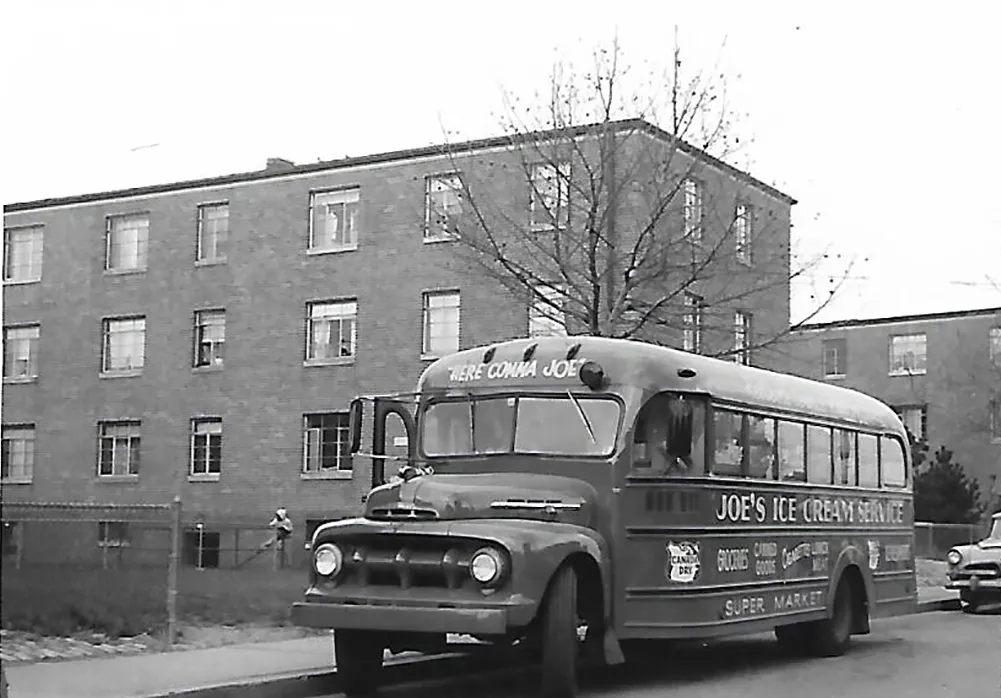
Between 1940 and 1955, the Housing Authority of the City of Pittsburgh built nine public housing communities. These dense apartment complexes had approximately 8,000 units, but none of the essential infrastructure of other neighborhoods, including grocery stores. By 1951, mobile grocery stores had begun operating in the Hill District’s Allequippa Terrace and Addison Terrace and St. Clair Village off Beck’s Run Road.
The mobile grocery stores that served Pittsburgh’s public housing appeared decades before the term food desert first appeared in print in the 1990s. Yet, they fulfilled an essential function that contemporary mobile groceries perform in food deserts throughout North America and Europe. The converted buses and bread trucks and the people who drove them have all but disappeared from Pittsburgh history and memories, yet the residents of public housing communities depended on them. “People knew that Joe’s bringing the bus up here at 1 o’clock,” recalls Chris Pirollo, whose father Joe operated one of the mobile markets.
The mobile markets filled an important gap created by 1940s slum clearance and later urban renewal. “I think one of the shortcomings of public housing is the lack of businesses and stores around these developments,” historian Dan Holland told NEXTpittsburgh. He’s written about urban renewal and displacement in Pittsburgh in academic articles, a University of Pittsburgh doctoral dissertation and a 2025 book, “Communities of Resistance and Resilience in the Post-Industrial City.”
But where people shopped for food in the years after Pittsburgh built its first public housing hasn’t been part of Holland’s research. The topic has eluded other scholars whose books, dissertations, documentaries and articles have dissected Hill District history and life for decades. Though the Pittsburgh Courier in 1946 published a comprehensive survey of the city’s Black residents’ shopping and buying preferences, no follow-up appeared after urban renewal began.
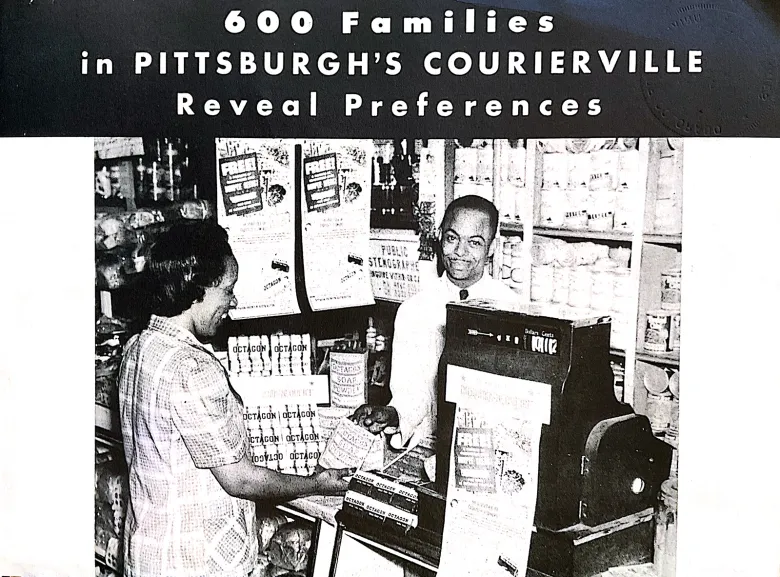 In 1946, the Pittsburgh Courier published the results of a survey documenting consumer habits in Pittsburgh’s Black neighborhoods, the paper dubbed “Courierville.” The survey documented where Black Pittsburghers bought groceries and the brands they preferred.
Ervin Dyer is a sociologist, journalist and occasional NEXTpittsburgh contributor affiliated with the August Wilson House. He collects oral histories from current and former Hill District residents — he hadn’t encountered mobile markets in his research.
“I have not heard of this,” Dyer says. “I hear people lament the disappearance of those things, because they remember clearly just being able to walk down the block and have access. But, I don’t remember anyone referencing what filled the gaps.”
Hucksters in the Hill
“Some enterprising folks carried on the huckster tradition with a ‘store bus,’” recalled historian Ralph Proctor in his 2022 book, “Song of the Hill.” “They purchased old, yellow school buses, stripped out all but the driver’s seat, and installed a countertop, a refrigerator, some bins and shelves, a meat counter and some kind of cooking device.”
Proctor connected the mobile markets to earlier hucksters who circulated throughout the city selling food and other essential items to people from horse-drawn carts.
Proctor died in 2024. He left one of the few published first-hand accounts of the mobile markets. “The drivers circulated through the housing projects, stopped at locations throughout the community and honked their horns,” he wrote.
Renee Aldrich is a writer who grew up in the Hill District in the 1950s and 1960s. She remembers the old- and new-style hucksters, the men with horse-drawn wagons and the mobile grocery trucks and buses. Her grandmother Erin Godfrey owned the Ma Pitts restaurant at the intersection of Wylie and Townsend streets. That corner gave Aldrich a vantage point in the heart of the Hill District teeming with shoppers and merchants like her grandmother.
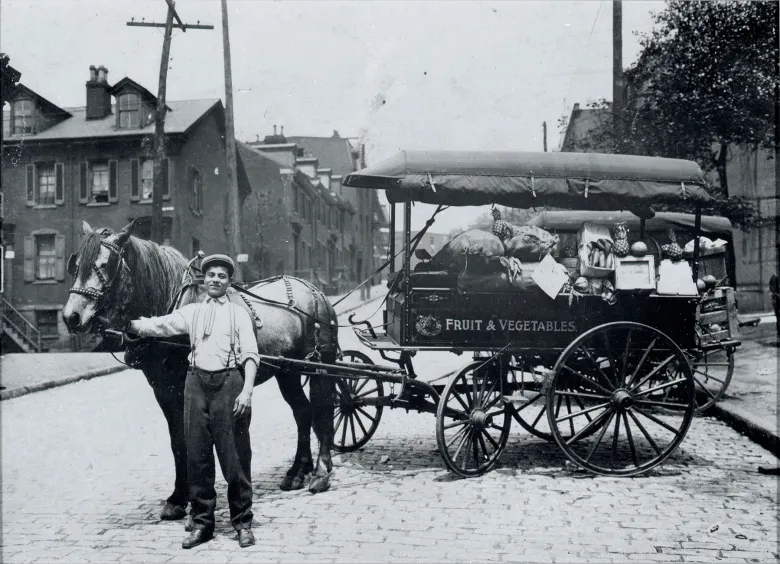 Frank Crisanti posed for a photo with his family’s huckster cart in this undated photo. The Crisantis bought produce in the Strip District and sold it in Pittsburgh neighborhoods. Photo courtesy of the Heinz History Center Detre Library & Archives.
“These hucksters, with these huge wagons and huge horses, would come up and down Wylie and Townsend,” Aldrich remembers. “They would come up and down and they would have cabbage and tomatoes and cucumbers and string beans and greens and everything, and the man would be calling out what they had: cabbage, tomatoes, greens … you know.”
The watermelon man was her favorite, she says. “They would go out on a big truck with these watermelons every day.”
Aldrich connected the hucksters of her youth to the characters in the August Wilson play, “The Piano Lesson.” “In ‘The Piano Lesson,’ it seems that Boy Willie and his partner came from down South up to Pittsburgh for the purpose of selling these watermelons,” Aldrich says.
In Wilson’s fictional take on Pittsburgh hucksters, Boy Willie and his friend Lymon drove from Mississippi with a truckload of watermelons. Throughout the first half of the play, the men sold their melons to Hill District residents and in white neighborhoods like Squirrel Hill.
“Soon as you holler ‘watermelons’ they come right out their door. Then they go and get their neighbors. Look like they having a contest to see who can buy the most,” Lymon tells Boy Willie in Wilson’s script.
Public housing creates needs for a new type of huckster
A new type of huckster plied the streets in the Hill District’s public housing communities. “They had the store buses, and those were relegated to the projects,” Aldrich says. “The projects were built as a landing place for African American families, and there was nothing near them. They would have to walk into Oakland to the grocery store, walk to South Side or get a jitney.”
People could buy vegetables, milk, ice cream, candy and cigarettes. Aldrich, who lived in Uptown, bought candy and snacks from the mobile groceries while visiting friends who lived on Bentley Street in Allequippa Terrace.
“I loved going to the store bus. I do remember that,” she says. “I looked at it as an exciting adventure.”
While a few of the mobile grocery operators were white, most of the ones Aldrich remembers were Black men.
Edwin Lee Winfield was one of the Black men who operated a mobile grocery in Allequippa Terrace during the 1950s. He owned a Wylie Avenue grocery store and lived in Shadyside.
Winfield parked his truck in the 200 block of Burrows Street between 1951 and 1953. The mobile grocery was an easy target for thieves, and frequent robberies might have compelled Winfield to sell his truck and stick to brick-and-mortar locations.
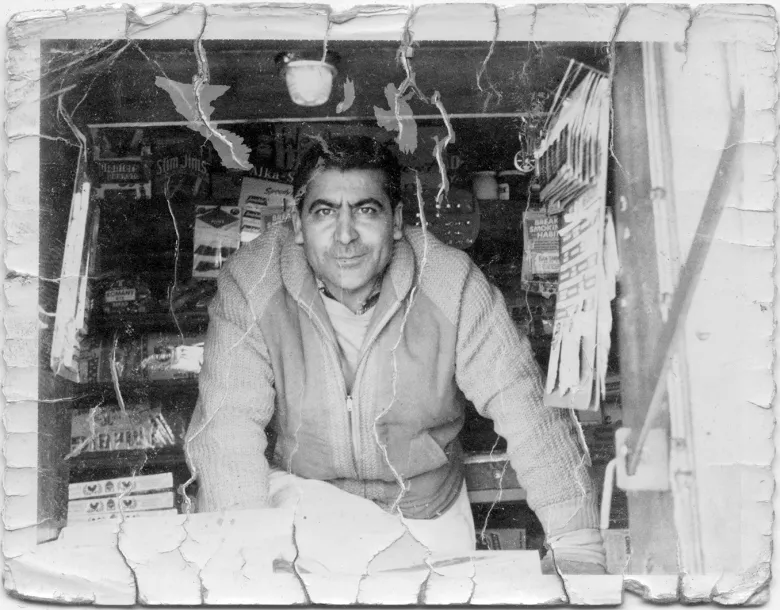 Joe Pirollo in 1959 in one of the family’s mobile grocery trucks. Photo courtesy of Chris Pirollo.
In 1958, brothers Joseph (Joe), Adolfo and Ubaldo Pirollo went into the ice cream business. They had separately come to Pittsburgh from Italy between 1951 and 1956 and moved to Lincoln-Lemington-Belmar. Their father, Crescenzo, had been living and working in Pittsburgh on and off since the 1910s.
Joe worked nights for the Pittsburgh Railways Co. Days, he began selling snow cones from a three-wheeled cart. “In the morning, he’d go home, get a little rest and get out there in the streets in the afternoon in the heat of the day and sell snow cones,” says Chris Pirollo. “He loved the idea of making all that change on the side … so he bought a dairy store on Lang Avenue in Homewood called the Penguin Dairy.”
The three brothers created two companies in 1958: Joe’s Ice Cream Service in February and Joe’s Penguin Dairy in November. Within a decade, they owned two markets, one at 1213 N. Lang and another one at the corner of Lincoln Avenue and Joshua Street.
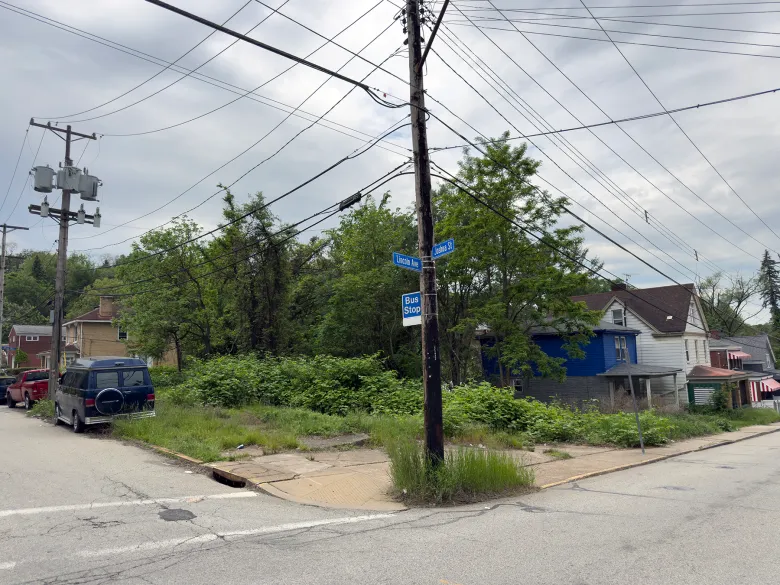 Brothers Joe, Adolfo and Ubaldo Pirollo operated a market at the corner of Lincoln Avenue and Joshua Street in Lincoln-Lemington-Belmar between the 1950s and early 1970s. The site is now a vacant lot, and the ruins of a concrete foundation are all that remain. Photo by David Rotenstein.
The brothers also bought a lot on Larimer Avenue in East Liberty with plans to build a new market. “I still have the blueprints,” Chris Pirollo says of the project that never materialized.
“They put together the partnership to work together and they bought used bread trucks,” says Chris Pirollo. “I asked around in the family here, but nobody is positive about what sparked the idea of going up into Terrace Village [and Allequippa Terrace].”
The Pirollos first used retrofitted bread trucks and then school buses to carry their goods into the Hill District from their eastside markets. The mobile grocery parked near the intersection of Wadsworth and Burrows every day but Sundays. “We had a routine, we had a specific routine. People could count on us and being there at certain times,” Chris Pirollo remembers.
“The store bus came and they’d be parked, and people could count on the store bus for pretty much everything,” says Aldrich. “These store buses, they were regular.”
Aldrich didn’t remember the Pirollos. “The one we knew was named Otto,” she told NEXTpittsburgh.
“People knew that Joe’s bringing the bus up here at 1 o’clock, 1 o’clock to 3 o’clock was their shopping time,” says Chris Pirollo.
The Pirollo mobile grocery was such a welcome sight that the residents would spread the word when the truck or bus arrived. “One of the customers, they coined this phrase, ‘here come a Joe,’” says Chris Pirollo. “They were imitating the Italian accent.”
“We pretty much confined ourselves to the center of the projects,” says Pirollo, who was a child when they were in operation. “And then the north or the southern edge of the projects — the buses and the trucks would move around. So we would make it convenient for everybody to get to us.”
His father went with the flow and had “Here Comma Joe” painted on the front of the buses and “There Goa Joe” on the back.
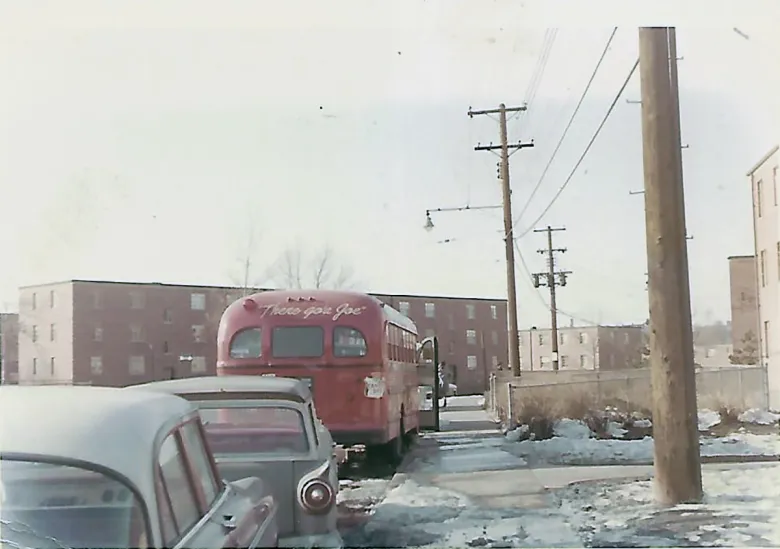 Pirollo family mobile grocery parked in the Hill District in 1964. The photo shows a Canada Dry soda logo and the Pirollo tag line, “There Goa Joe.” Photo courtesy of Chris Pirollo.
“To this day, if I ever run into anybody who was a kid and remembers that or any Italians, anybody who remembers this, that’s the first [thing they say],” Chris Pirollo says.
The mobile groceries mimicked their brick-and-mortar counterparts. They had cold cases for milk, meats, soda and ice cream. And, they carried bread, breakfast cereal, canned goods and cigarettes.
People approached the trucks and buses and placed their orders at a counter in the front or on the side, depending on the vehicle. The cold items were stored up front, along with the cigarettes and a cash box. Shelves in the back held everything else.
“They would step up one at a time and either give you a list or tell you what they needed,” Chris Pirollo explains. “We were like a rolling convenience store.”
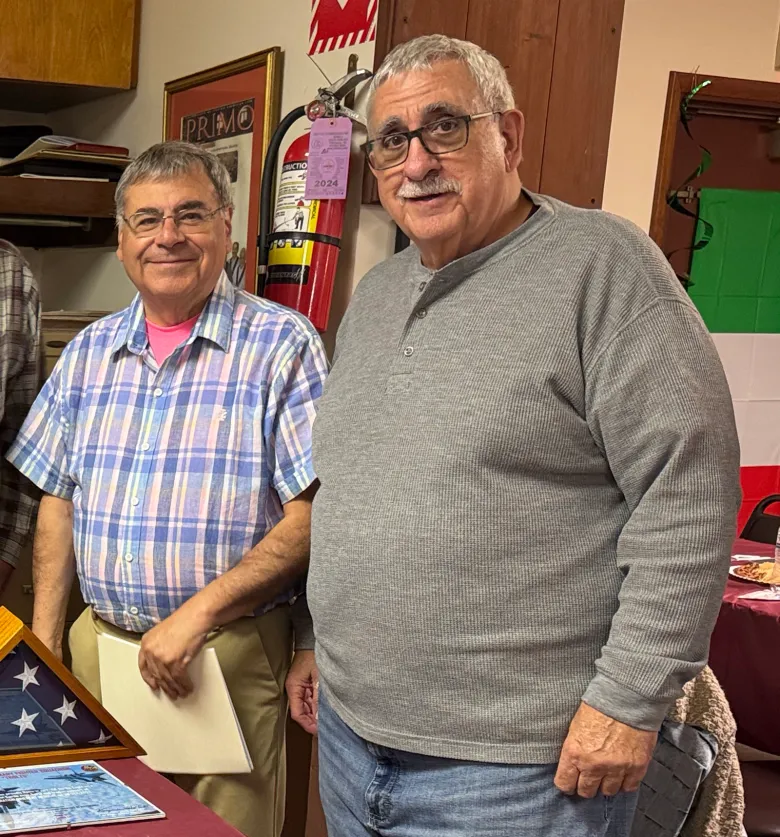 Chris Pirollo (left) and Tony Stagno at the Spigno Saturnia Italo-American Society of Pittsburgh annual Good Friday fish fry in 2025. Photo by David Rotenstein.
Though Pirollos was a family business, it employed Hill District residents. Chris Pirollo remembers his family hired them to help with cleaning and unloading the vehicles at the end of the day. After the last customer, the employees would ride back to stores with the Pirollos.
“We drove them back in the car every night,” says Chris Pirollo. “They were the manpower and it was not a big deal to drive back up there and back again to East Liberty.”
There were other mobile groceries in Pittsburgh’s public housing communities operating at the same time as the Pirollos. The Tannenbaum family, which worked in St. Clair Village, was one.
Chris Pirollo remembers some of his family’s Hill District competitors, but not the Tannenbaums. “His name was Smitty,” Chris Pirollo recalls.
The Smitty that Pirollo remembers was Luther Von Smith Sr. “He already had two brick and mortar stores and decided to get into the mobile store act too,” he says.
According to a 2016 Post-Gazette obituary for Luther Von Smith Jr., the family also operated a mobile grocery in St. Clair Village. Newspaper articles published between the 1950s and early 1970s show the Smith mobile grocery overlapping and going beyond the Pirollos’ time in the Hill District. As late as 1973, Luther Von Smith Sr. was still operating a mobile grocery in Terrace Village in the 300 block of Burrows Street.
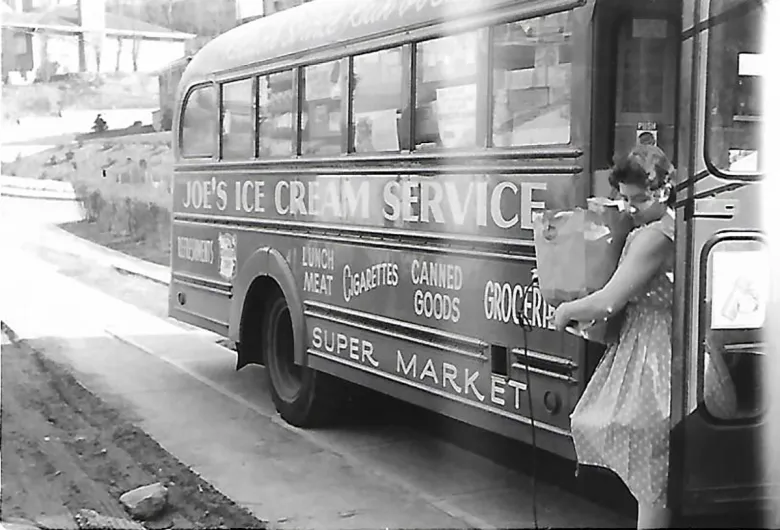 Chris Pirollo’s mother Rose Pirollo exits a Joe’s Ice Cream Service bus in a family photo taken in 1964. Photo courtesy of Chris Pirollo.
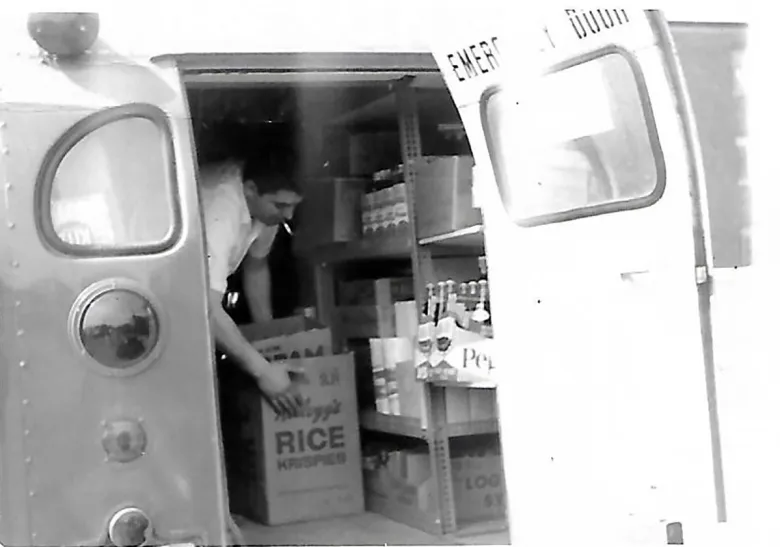 Groceries stocked in the rear of one of the Pirollo family mobile groceries. Photo courtesy of Chris Pirollo.
Changing neighborhoods
By the 1970s, Pittsburgh’s neighborhoods began to change. White flight transformed the city’s older Little Italys in East Liberty and Larimer as residents moved away to outlying neighborhoods like Brookline and suburbs like Penn Hills.
The Pirollos ended up in Penn Hills. They bought an old White Tower in Turtle Creek in 1970 and called it Pirollo’s Giant Burger. Strategically located near the gate to Westinghouse, the property was acquired by the Allegheny County Redevelopment Authority, and in 1976 the authority auctioned off the fixtures ahead of an urban renewal project.
The Pirollos also bought a Turtle Creek market and called it Pirollo’s Giant Market. The family brushed aside concerns about having a name similar to an established regional supermarket chain, Giant Eagle.
“The previous owner, he called it Giant Market, so we went ahead and tagged our name onto the front of that,” Chris Pirollo explains.
He doesn’t remember when his family discontinued the mobile groceries. His father Joe was out of the mobile business by the end of 1970 and his Uncle Ubaldo briefly continued operating the buses. By 1973, all of the Pirollo brothers had relocated and the original markets closed.
A lot has changed in the neighborhoods where the Pirollos once did business. The city began redeveloping Allequippa Terrace in the 1990s under the federal HOPE VI program, which was designed to replace distressed and disinvested public housing projects. Over the span of a decade, the city and private developers erased Allequippa Terrace and created the new Oak Hill development.
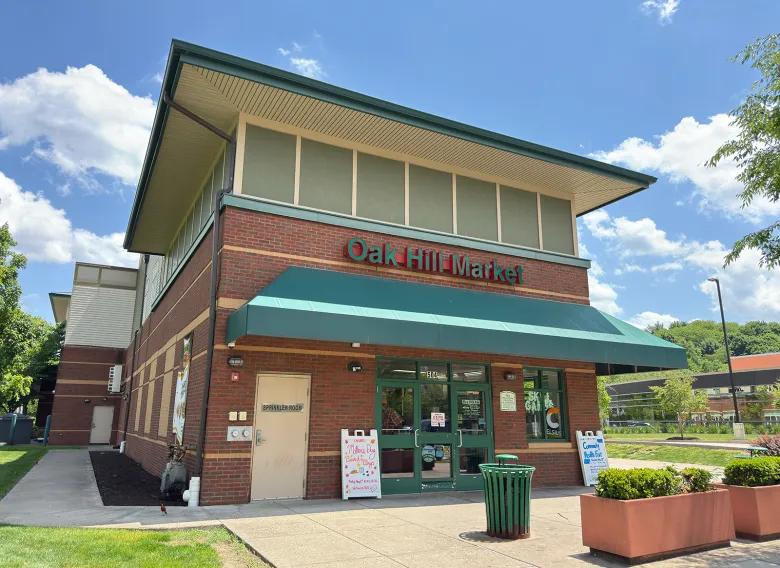 The Oak Hill Market in what used to be the Allequippa Village public housing community. Photo by David Rotenstein.
The intersection of Wadsworth and Burrows no longer exists, but nearby there’s a new market.
“Residents demanded a convenience market and the city found someone to establish this store,” Chris Spirollo says. “The whole neighborhood is rebuilt. Hard to believe it took all that time to address this problem.”
Parts of the Pirollo family story ultimately came to resemble the stories of the people they once served through the windows in their mobile groceries. The sites where their homes and markets were located either ended up overtaken by urban renewal or became abandoned and overgrown vacant lots, like the former Pirollo market at the corner of Lincoln Avenue and Joshua Street.
“I shake my head and say to myself, you know, my entire past is obliterated by time and decay, if you want to judge it by landmarks,” says Chris Pirollo. “The landmarks have all disappeared.”