
Startup profile: Pelliá
Founded by: Courtney Williamson
Year founded: 2024
Headquarters: Pittsburgh, PA
Sector: Beauty/skincare/wellness
Funding and valuation: Bootstrapped at a $2 million valuation, according to the founder
Key ecosystem partners: Gener8tor, Accion Opportunity Fund and the NASDAQ Entrepreneurial Center
The lightbulb moment for Courtney Williamson’s latest startup came when she had a migraine for a week straight.
Since 2014, Williamson had been building a medical device company, and the work was starting to catch up to her, leading to repeated, mind-splitting headaches. To decompress, she started taking nightly baths, and while the process relieved some issues, it also left her skin dry and sensitive.
“For me, the accelerator is mostly about building that product-market fit, particularly online, and they also have a huge investor pool that they’re introducing us to.”
Courtney Williamson, Pelliá
This led her down a different rabbit hole. Williamson began experimenting, trying to create her own skincare products, and through that tinkering, Pelliá was born.
“Stress is very sneaky in that it just creeps up on you day by day until you look around and realize that you’ve changed your life to accommodate the stress that you’ve built in,” Williamson told Technical.ly, “and I think that’s very, very dangerous.”
Now, Williamson’s Pelliá is the only Pittsburgh startup in the first cohort of Meta’s new statewide accelerator program, with a majority of the other companies coming from the Philadelphia area or central Pennsylvania.
The free program, gBETA Pennsylvania, is a collaboration between Meta and Gener8tor, a startup accelerator and investor with programs across the country.
Ten Pennsylvania companies were accepted into the program’s first cohort, doubling its original commitment due to high demand, “which really just goes to show the promise and the creativity and the ingenuity that’s coming out of Pennsylvania,” Diana Doukas, director of economic opportunity and small business advocacy at Meta, told Technical.ly.
Breaking into a competitive market
Since founding Pelliá in early 2024, Williamson has worked to formulate products like body washes, lotions and serums that are specifically for people with dry or sensitive skin.
In a saturated beauty and skincare market, Williamson is now focused on using her new access to gBETA’s network of mentors, customers, corporate partners and investors to build Pelliá’s online identity and aesthetic so that it can stand out from the crowd.
“I noticed that if you have dry and sensitive skin, the packaging tends to look very clinical,” she said, “and there’s actually a lot of stigma and embarrassment around issues and problems with skin.”
Pelliá’s products are intentionally designed to make people not feel “singled out,” she added.
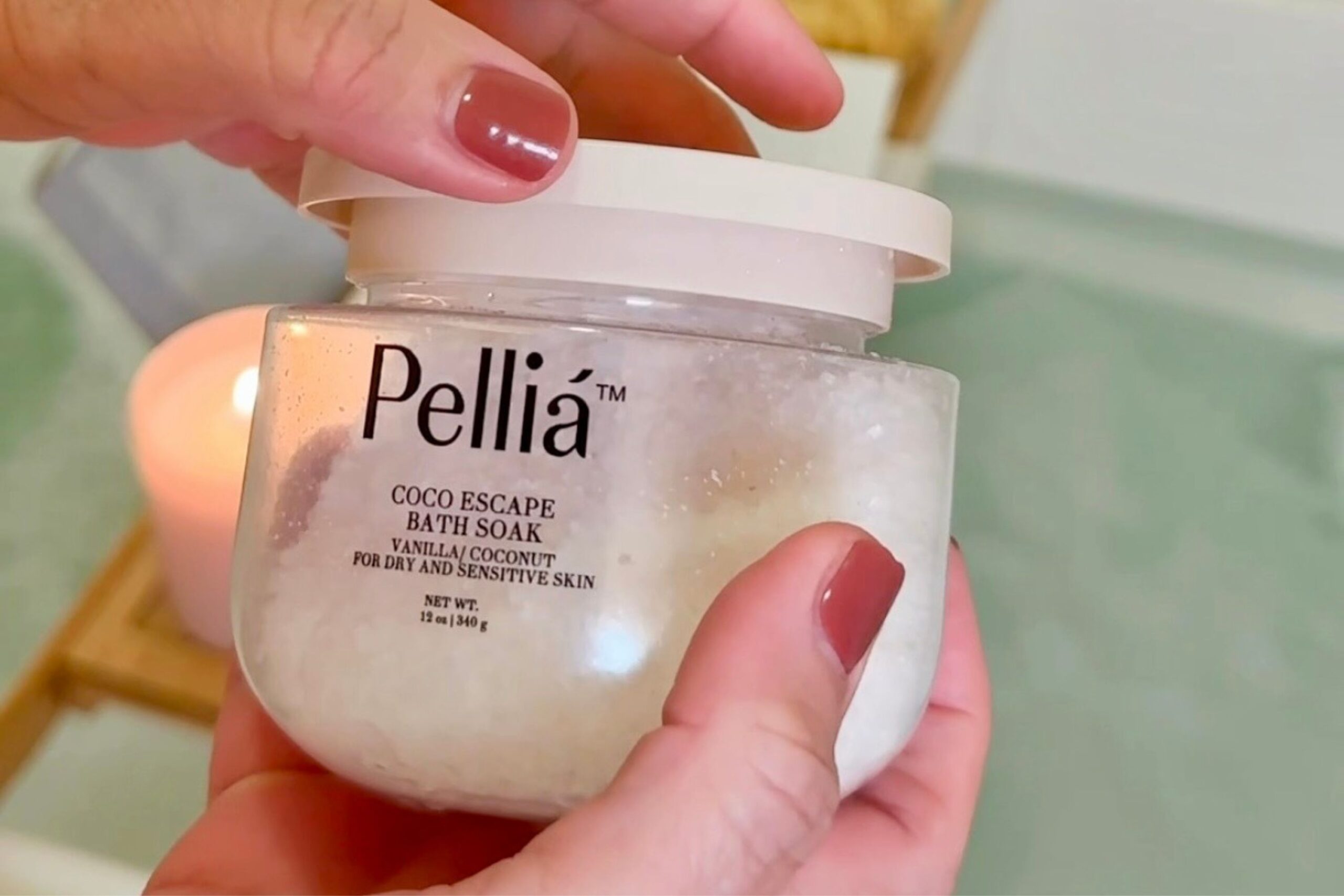 A Pelliá product (Courtesy)
Despite building a company before in the medical device space, Williamson is exploring new territory in the consumer packaged goods sector, and she’s eager to apply her experience to this new challenge.
“For me, the accelerator is mostly about building that product-market fit, particularly online, and they also have a huge investor pool that they’re introducing us to, so for me personally, I’m really curious about learning about this space on a macro level,” she said, adding, “That connection with Meta is just incredibly important because so much of people’s online experience Meta touches, whether it’s Facebook or Instagram or Threads.”
The winding road of entrepreneurship
Williamson founded her first company, AbiliLife, while completing her doctoral program at Carnegie Mellon University in the mid-2010s.
The company developed a back brace reimbursable by insurance, which sold nationwide and in parts of Canada, Williamson said. Then COVID hit and Medicare changed some of its rules around reimbursement.
“[Our customers were] such a vulnerable population. They really couldn’t afford to pay for the product out of pocket,” she said.
That, plus supply chain issues from the pandemic, flipped the economic equation for the company completely.
“Essentially, I had this product people wanted, but they couldn’t afford to pay for it out of pocket and I couldn’t get it reimbursed,” she said, “so it was a crazy experience, all these things converging that we never knew were going to converge at the same time,” she added.
 Williamson (Courtesy)
While AbiliLife ultimately had to close its doors, there’s a mountain of lessons Williamson is carrying into her new venture, from customer discovery techniques to supply chain management.
She keeps returning to entrepreneurship because it runs in her family and she likes to solve problems that she encounters in her own life. AbiliLife’s back brace was originally designed for her mother, who passed away six months after she launched the company.
Pittsburgh also seems like a perfect place to try to build something again, Williamson said, because “the ecosystem is really robust.”
“Everyone is incredibly helpful, even if you don’t ask for help, they’re always offering,” she said. “It’s a really easy and safe space to launch something because there’s always people who are down to be beta testers or connect you with folks.”
Meta’s presence in Pennsylvania
The new accelerator is one part of the pledge Meta made during the 2025 Energy and Innovation Summit, hosted at Carnegie Mellon University.
The event, organized by PA Sen. Dave McCormick, brought together high-profile politicians, like President Donald Trump, and top execs, setting a new record for private sector investment in the commonwealth at $90 billion.
“We saw this as an opportunity to really invest in the robust startup and small business ecosystem, especially as it pertains to AI,” Doukas, the small business advocate at Meta, said.
Meta’s also launched a virtual training event recently in collaboration with the Pennsylvania Chamber of Commerce to help PA businesses learn how to use Meta’s AI tools — the second part of its summit pledge.
Meta’s connection to small businesses and Pennsylvania doesn’t stop there.
In March, Mark Zuckerberg launched Meta Small Business, a companywide initiative to drive adoption of Meta’s AI tools among entrepreneurs and small businesses. It’s led by three of Meta’s top execs, including Dina Powell McCormick, president and vice chairman for the company, and the wife of Sen. McCormick.
“We’re really excited to see some of that build and come to fruition,” Doukas said about the new initiative, “and I think the programs like the ones we just talked about are really important pieces of making sure we’re part of the community we’re trying to support.”