
On the evening of April 17, 1936, President Franklin Delano Roosevelt had a particular audience for one of his famous radio broadcasts that had become known as “fireside chats.”
Roosevelt had a special message for members of the Civilian Conservation Corps, the young men who had been most vulnerable with the start of the Great Depression.

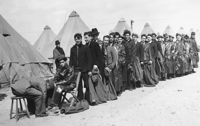
New members of the Civilian Conservation Corps waiting to be fitted for shoes at Camp Dix, New Jersey, 1935
Encyclopedia Britannica
“Idle through no fault of your own,” the familiar voice began, “you were enrolled from cities and rural homes and offered an opportunity to engage in healthful, outdoor work on forest, park and soil conservation projects of definite practical value to all the people of the nation.
The promptness with which you selected the opportunity to engage in honest work, a willingness with which you have performed your daily tasks and the fine spirit you have shown in winning the respect of the communities in which your camps have been located, merits the admiration of the entire country.
You, and the men who have guided and supervised your efforts, have cause to be proud of the record the CCC has made in the development of sturdy manhood and in the initiation and prosecution of a conservation program of unprecedented proportions.”
It is not known how many Americans listened to Roosevelt’s words that night. There were of course those like the rich folks in one of the era’s cartoons in the New Yorker, showing them urging like-minded friends to join them” “Come on, we’re going down to the Trans-Lux to hiss Roosvelt.” Critics mocked his Works Progress Administration initials as actually standing for “We Poke Along.”
But that did not include most of the population. And in 1935 when the Lehigh County Commissioners wanted to have some work done to the Trexler-Lehigh Nature Preserve they called on Washington to arrange to establish a CCC unit to help them.

Trexler Nature Preserve entrance
Jenny McCain / WFMZ
The idea of programs like the CCC had long been on FDR’s mind. He had long been interested in well-managed forests and conservation projects. The program was one of the first that he created in his famous 100 days. Frances Perkins, his Secretary of Labor, the first woman to serve in a presidential cabinet, took charge of it.
“On March 11, 1933, FDR signed the enabling legislation and a week later issued an executive order creating the agency and appointing a director,” notes the Roosvelt House Public Policy Institute at Hunter College. The four federal departments that cooperated in the supervision of the CCC were Labor, Agriculture, Interior and War, later Defense. They also worked closely with the National Park Service and the U.S. Forest Service.
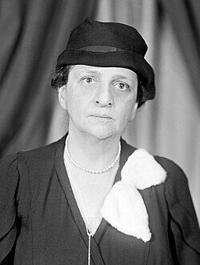
Frances Perkins, Secretary of Labor from 1933-1945
The participants were paid out of relief funds rather than a salary, for political reasons. Twenty-five out of the thirty dollars they received were automatically sent home to the participant’s parents. One source estimates the buying power of $30 as approximately $689 in 2023.
The CCC employed an estimated three million young men between the ages of 18-25. Among the projects they worked on included planting two billion trees, fighting fires and building 800 new state parks and dozens of national parks. Along with exercise programs they could take classes, write newsletters and engage in sports.
There were at least some attempts to integrate the CCC in its early days. Oscar DePriest of Chicago, a Republican and the only Black member of Congress at the time, was successful in creating a clause in the legislation that read “That in employing citizens for purpose of this Act, no discrimination shall be made on account of race, color and creed.”
But in the end, it was prejudice and political expediency that won out in both north and south. “To rectify such prejudicial treatment in this and other New Deal programs required more assertive action” than the system would take. As FDR was a Democrat and his base of votes was in the Democratic South, it was not a step he was willing to take.
Journalist John Gunther recorded a story he heard about Roosevelt’s visit to a particular powerful southern governor who complained about “outside agitators” from the north stirring up trouble with the Black population in his state. ‘Oh, you mean Eleanor,” the president said with a chuckle in reference to his liberal, socially active wife.
According to Nolan Benner, General Trexler’s aide, in his memoir “A General and His Captain,” it was a few weeks after Lehigh County received title to the Trexler-Lehigh Nature Preserve in 1935 that the idea for creating a CCC camp was first discussed. The property had been willed to the county by Trexler who had recently died following an automobile accident.
Two Lehigh County Commissioners, Donald Ruhe and Charles Kuhns, told Benner that they had been appointed by the county to discuss having a CCC camp do some work to be done on the preserve. The were going to Washington and wanted to know who they should contact there.
“I told them,” Benner recalled, “the National Park Service probably would have charge of establishing CCC camps and that Conrad L. Wirth was the supervisor of recreation and land planning for department. If they were unable to reach Wirth, they should ask for Herbert Evison.” Benner gave them a large map of the area.
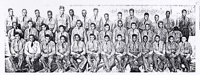
Civilian Conservpation Corps Company 2313
On May 10, 1935, Major Donald C. Donaldson arrived and went over the property and expressed satisfaction with the 25-acre site. Benner recalls that at the end of the tour Donaldson, with a smile on his face, said, “Well I can see I will be visiting this spot at least once a month for the next year or two.”
The work began with the creation of Company 2313 of the Civilian Conservation Corps that began arriving in the Lehigh Valley. Almost all of them were young Black men primarily from Philadelphia and Pittsburgh. Their primary tasks were to build roads, erect fences, and plant seedlings.
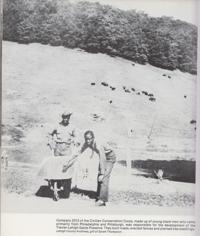
Picture showing two members of CCC 2313 at work in Lehigh County
Lehigh County Historical Society
The camp where they lived became known as Camp Buffalo, named after the nature preserve’s resident buffalo. According to one company history, at least a few men were chased by the buffalo.
Thanks to long time Allentown resident, the late Sarah Thompson, photos of the young men who were part of Company 2313 are in the Lehigh County Archives.
In October of 1939 the park was open to the public, drawing the admiration of many.
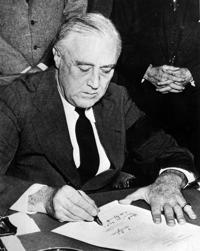
President Franklin D. Roosevelt signing the declaration of war against Japan, December 8, 1941
National Park Service
With America’s entry into World War II the Civilian Conservation Corps ended in June of 1942.
But in many places, like Trexler’s woods in Lehigh County, its work is still visible around us.