
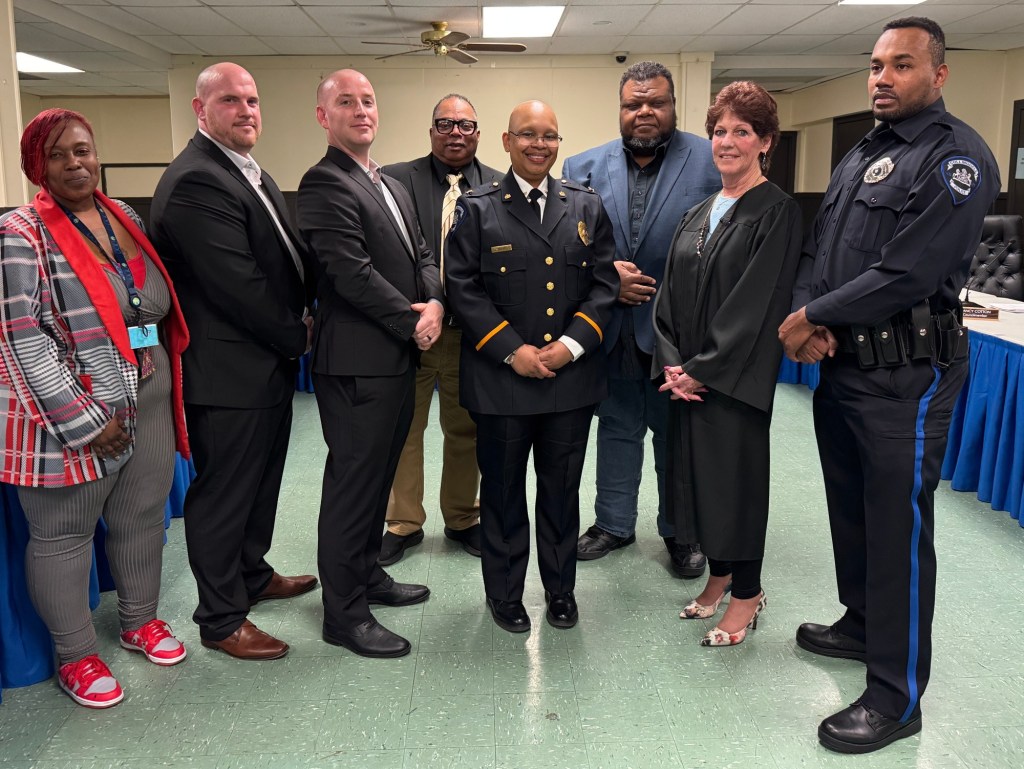
Collingdale Police Chief Shanee Mitchell, who has been on paid administrative leave since early January, has been granted the go-ahead to sue the borough by the Equal Employment Opportunity Commission.
Mitchell signaled a desire to do so in April if borough officials did not open up a dialogue. Her attorney, Mark Schwartz, said in a letter to the EEOC in late May requesting the right to sue letter that she has suffered “continued discrimination” in the form of her leave “with no apparent end in sight, each day adding to the stigma which the borough leaders’ discrimination and retaliation purposely have imposed upon her.”
The EEOC granted that request June 11. Mitchell has 90 days from that date to file suit.
Kilkenny Law attorney Deanna Williams, serving as solicitor for Collingdale, did not have a comment Monday.
Mitchell was placed on leave by borough council the day after a Jan. 5 reorganizational meeting. Schwartz said Collingdale has since refused to pay for training or conferences that she needs to keep up her certifications.
Mitchell said in a Feb. 7 statement that she was called into an unscheduled meeting with borough leadership Jan. 6 and told she was being placed on leave because she failed to report to work at 8 a.m. daily.
“The meeting was brief and offered no opportunity for meaningful discussion,” she said.
Mitchell and Schwartz have asserted Mitchell’s contract allows for flexibility on her working hours, and that the stated reason given by council for her leave was pretextual and not performance-based. Mitchell said reports of her working remotely were also false.
Former Council President Ryan Hastings said in his own statement that he had seen Mitchell go from meetings to paperwork to answering the phones to putting on a vest to go back up officers, and that she was “everything our community wants from a police chief.”
“Residents repeatedly shared experiences of feeling mistreated or marginalized by the police,” Mitchell said in her February statement. “I made it a priority to address those concerns directly. As a result, trust began to return. I received consistent feedback from community members who felt heard, respected and safer. I also received letters of support from nonresidents as far as Ardmore congratulating me on the positive changes.”
Mitchell came to Collingdale from Selinsgrove Police Department in Snyder County, where she was hired in 2022.
She told Selinsgrove residents she would be a working officer, taking shifts and planning to move to that area, which is 80 miles north of Harrisburg on the Susquehanna River south of Williamsport.
But in 2024, some in that town began questioning her running the department from her home in Montgomery County.
Others praised Mitchell for the work she had done in modernizing that department, and Schwartz said complaints about his client there were overblown and “bogus.”
“She had a broken foot that dogged her for a bit,” he said. “She has letters and texts from (Selinsgrove) that they wanted her back.”
Mitchell came into a rocky situation when she was hired in Collingdale in October 2024. Staffing was down to seven officers, then fell to three, requiring Mayor Donna Matteo-Spada to request state police to provide cover for overnight shifts. Council members were also fighting over civil service issues that slowed the hiring process.
Council did approve some new hires and other improvements in the department through July 2025, when Collingdale police were again staffed enough to handle overnight shifts.
By December 2025, Mitchell said she felt accomplished with where the department was and that it seemed to have turned a corner.
She was placed on leave the following month when a new crop of council members joined the board and has attributed the move to “political forces beyond my control.”
Schwartz said in his April 1 letter that he reached out to the borough offering to negotiate a resolution, but Collingdale decided not to engage him.
Mitchell indicated after a story about that letter ran April 5 that the borough’s labor attorney did ask for her demands.
Schwartz’s letter to the EEOC in May would indicate any further discussion on that point had been fruitless.