
For medicine to work, it needs to be able to reach its target.
For many drugs, that means injections. Blue Bell, PA-based Ladder Bio is developing molecules it hopes could lead to the ability to deliver some autoimmune and inflammatory disease treatments as pills, instead.
“No one likes to get stabbed with needles for their medicines every month,” CEO Eric Heil told Technical.ly, “and would prefer a pill.”
“No one likes to get stabbed with needles for their medicines every month.”
ERic Heil, Ladder Bio
At the center of Ladder Bio’s technology are rigid molecules — shaped like a ladder — designed with help from the company’s AI software to attach to proteins involved in inflammation, immune response and cell growth.
A drug molecule needs the right shape to attach to its target, like puzzle pieces. Small molecules can often be made into pills, but they cannot easily attach to every kind of protein. Larger medicines, including many antibody treatments, can bind to more complex targets but often have to be injected.
Ladder Bio is trying to build something in between — molecules large and structured enough to reach difficult targets, but small and stable enough to potentially be taken as pills.
The company grew out of founder and Temple University chemistry professor Christian Schafmeister’s research. It is still in the process of proving that its molecules are safe, effective and able to work when taken orally. The company is currently running preclinical studies, with data expected in the second half of this year. Heil said the company hopes to begin testing its first medicine in people in 2028.
From investor to CEO
In 2018, Schafmeister proposed scaling the modular system technology he developed to create tools that could identify emerging viruses and help prepare for future pandemics.
The US Department of Defense, he said, wanted the work housed somewhere more permanent than an academic lab.
“We want you to start a company, so you’re there for the next pandemic,” Schafmeister said they told him.
Ladder Bio was founded as ThirdLaw Molecular in 2020 before changing to its current name in 2025. The company has received $16.9 million in DoD and other government grants.
About two years ago, the company began shifting more of its attention toward therapeutics. That shift brought Schafmeister’s chemistry to the attention of Heil.
A managing partner at Medical Excellence Capital, Heil met Schafmeister about a year and a half ago.
“We got to know each other around Chris’s vision for this chemistry as medicines, not just for diagnostic applications,” Heil said. “As an investor, I saw the potential in therapeutics as well.”
Medical Excellence Capital went on to lead Ladder Bio’s seed financing. Heil then moved from backing the company to helping run it, joining as CEO to guide its push into drug development while the company builds out its leadership team.
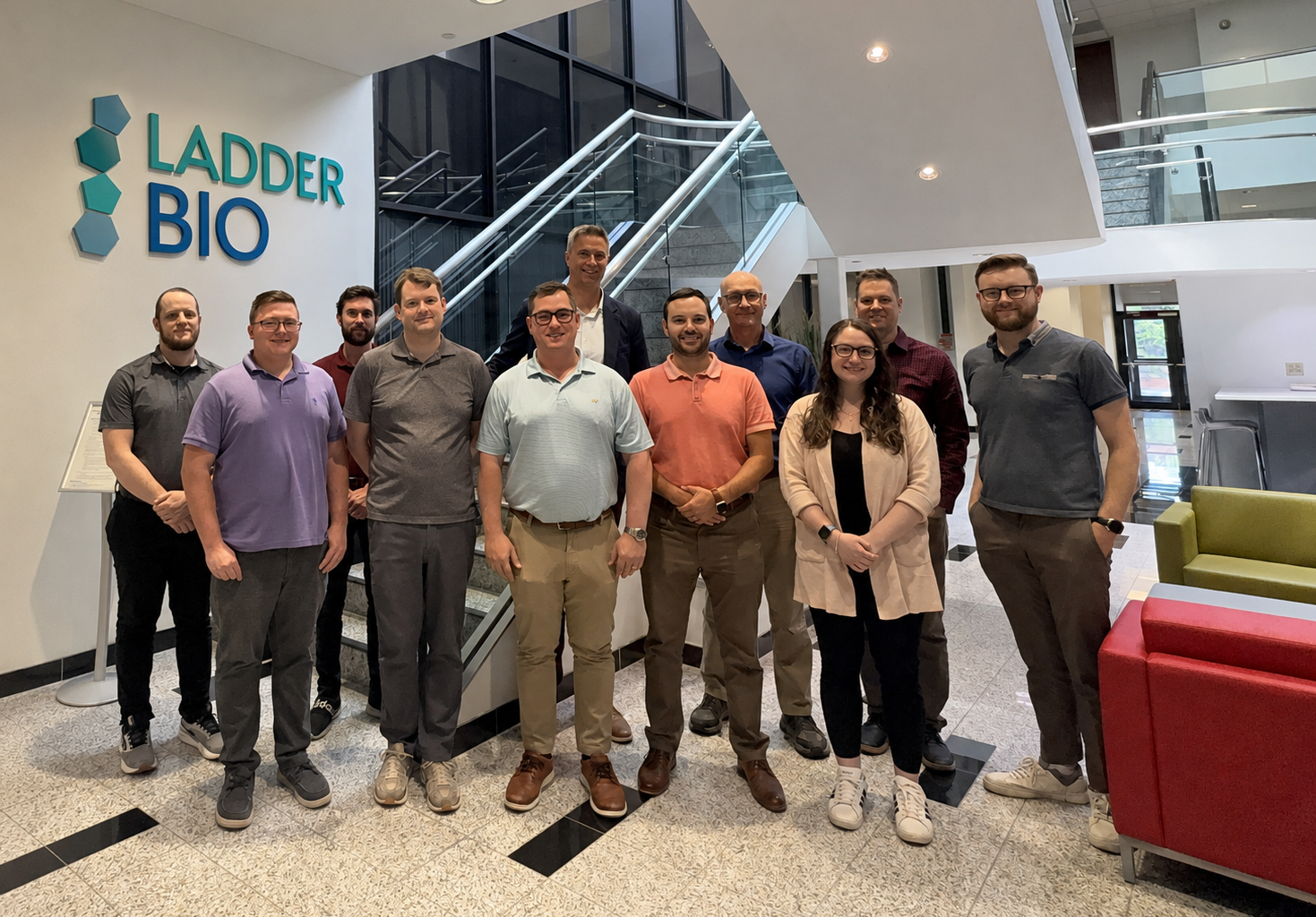
Ladder Bio has raised $6.55 million from investors to date, and currently has a 10-person team consisting mostly of chemists, along with a small biology group leading preclinical development.
Schafmeister remains the inventor and scientific force behind the platform, while Heil is focused on turning it into a business that can bring drug candidates into clinical trials.
Using software to find the right fit
Ladder Bio uses its own AI software to help decide which molecules to build.
“Chris has designed a software application called CanDo that can take that protein target and go through the building blocks to find the most optimal spot on that protein,” Heil said. The software then identifies which combination of building blocks is needed for that target.
Heil compared the process to software that designs a Lego model, then produces a list of the exact pieces needed to assemble it. Ladder Bio can snap together its chemical building blocks in different arrangements, much like Lego pieces, to produce molecules with different shapes and properties.
CanDo helps researchers narrow down which molecules are most promising to make and test. The combination of software and modular chemistry, Schafmeister said, could make that search for what he calls “Goldilocks molecules” — which occupy a middle ground between conventional small-molecule drugs and much larger biologic medicines, such as antibodies — more precise.
In addition to beginning its first human study within two years, Heil said the company plans to have several programs in clinical trials within five years and eventually develop medicines that can be prescribed to patients. The company is also in talks with pharmaceutical partners interested in applying its chemistry to their own drug programs, alongside plans to raise additional funding later this year.
He envisions Ladder Bio as someday being a Philadelphia success story.
During a recent visit to the Museum of the American Revolution, Heil walked past the former headquarters of Rohm and Haas, the Philadelphia chemical company that grew into a global business.
“I believe Ladder Bio could be the next Rohm and Haas, but for therapeutics and diagnostics using this chemistry set,” Heil said. “It is an entirely new world of chemical structures that have infinite possibilities of applications.”
This story is made possible thanks to support from Ben Franklin Technology Partners of Southeastern Pennsylvania, a nonprofit that leads the Philadelphia region’s equitable economic growth by nurturing and investing in innovative, early-stage companies, and through purposeful involvement in regional and national initiatives. All stories are independently reported, with no partner review.