
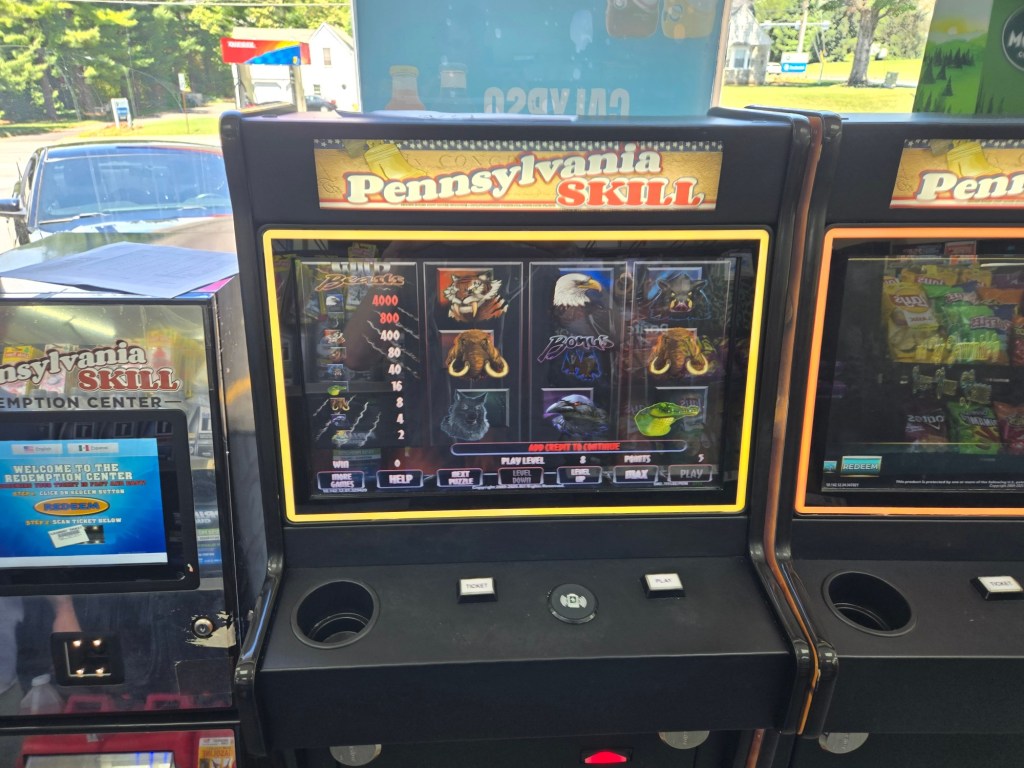
For Berks County District Attorney John T. Adams, the Pennsylvania Supreme Court’s ruling that skill games are slot machines is the right call.
Skill games, common in convenience stores, gas stations, bars and other establishments with frequent foot traffic, resemble slot machines in appearance.
The games they offer allow some form of player input beyond luck, such as solving puzzles or aiming precisely.
Game manufacturers such as Pace-O-Matic, which makes most of the state’s skill games, say that input meaningfully influences player outcomes enough to differentiate them from slot machines.
That distinction held enough weight for the Commonwealth Court to rule previously that skill games fell outside state rules regulating slot machines.
But on Monday, the state Supreme Court reversed that standard, ruling that skill games can be considered slot machines.
The new ruling gives the lower court 120 days to correct what the Supreme Court said were deficiencies with its prior rulings, during which law enforcement is to take no adverse action against the games or their owners and operators.
It also may prompt state lawmakers to regulate, and potentially tax skill games at a rate similar to slot machines.
“Hopefully, the laws will go a long way to stop the proliferation of skill games in many places where they don’t belong,” Adams said.
He said skill games have no business being in places like bodegas and gas stations, where they are completely unregulated.
“Frankly, skill games have become a magnet for crime,” Adams said.
 Berks County District Attorney John T. Adams
In a 2024 opinion piece, Adams cited cases in which theft rings targeted skill games in Pennsylvania and Virginia.
“Thieves know that these machines have cash boxes,” Adams said. “They know that, unlike highly regulated casinos, the local shops with skill games generally have few or no security procedures in place.”
He is hopeful state lawmakers will limit, tax and regulate skill games.
“Any legislation would need to address where they can be found and limit the number of machines that can be in certain places,” Adams suggested. “For instance, it (having skill machines) may be tied to having a liquor license or a social club. Where they don’t need to be is in every convenience store, every gas station.”
Skill games are a popular commodity among regulars and customers, said workers at the Sunoco at Van Reed and State Hill roads in Spring Township.
“There’s going to be a lot of upset (customers if skill games are banned),” said Eddie Maher, a manager at Sunoco in Spring Township. “A lot of people come in here just to play those games.”
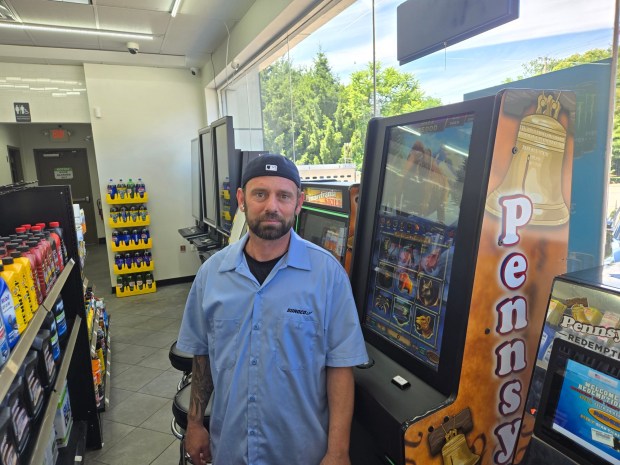 Eddie Maher, manager at Sunoco in Spring Township, said he thinks that skill games should be allowed to remain in convenience stores. (Keith Dmochowski – Reading Eagle)
He said he sees about 20 to 25 people come in and play during his shift in the morning,
Maher said he didn’t think the games should be subject to removal.
“To me, it’s like the lottery,” Maher said. “People are adults. If you don’t want to spend your money here, you go to Morgantown (casino). What’s the difference?”
He said the games are a convenient choice for adults looking to spend their money how they choose.
“It’s America, what happened to freedom?” Maher said.
Other store owners said they were planning on getting rid of their skill games if the ruling calls for it.
One worker at a Shillington store said the owner was planning to have the machines moved out as early as next week.
There are about 70,000 skill game terminals throughout Pennsylvania — a number far exceeding slot machines, according to state Attorney General Dave Sunday.
Sunday called the ruling “a significant victory for consumers, taxpayers and the rule of law in Pennsylvania.”
“The Supreme Court recognized what our office has argued from the beginning — these machines operate as gambling devices and cannot legally exist without the same oversight, regulation and accountability as other forms of legalized gaming in the commonwealth,” Sunday said.
Gov. Josh Shapiro has previously called on lawmakers to institute a 52% tax on skill games revenue — short of the 55% state tax on slot machine earnings.
His budget proposal anticipates $368.9 million from the expanded skill games tax.