

SCRANTON — Lackawanna County plans to pursue a data center health-impact study and a separate emergency response assessment related to the controversial developments and ancillary infrastructure proposed here.
Without any objection from his colleagues, Commissioner Bill Gaughan called Wednesday for the county to begin preparing a request for qualifications seeking firms for the independent health-impact assessment he publicly proposed earlier this month. Such a study would attempt to quantify the potential cumulative impact of proposed data center projects, power plants and related infrastructure on “residents, parks, schools, housing developments and other sensitive community assets,” Gaughan said June 3.
Meanwhile, county Emergency Management Agency Director Tom Taylor confirmed Thursday that officials will prepare an RFQ for a “threat assessment and emergency response assessment” related to data center development. It would specifically assess what a “worst-case scenario” would require of local first responders and EMA staff in terms of training, equipment and the response itself should an emergency occur involving critical data center infrastructure.
It would also identify potential areas where more training or resources might be required, Taylor said.
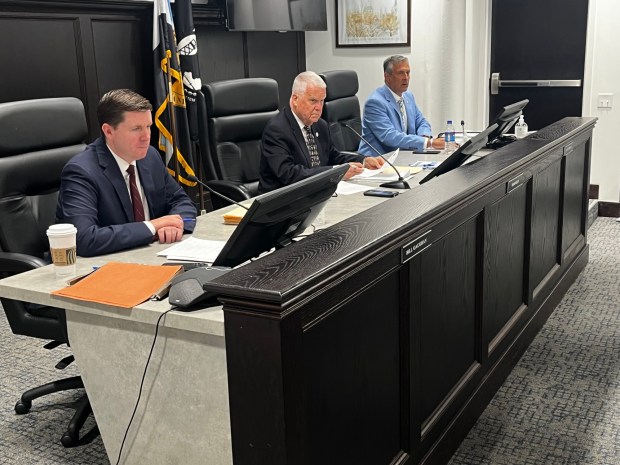 Lackawanna County Commissioners Bill Gaughan, Thom Welby and Chris Chermak participate in a meeting at the county government center in Scranton on Wednesday, June 17, 2026. (JEFF HORVATH/STAFF PHOTO)
Both potential projects come as battles over proposals to build massive data center campuses and power plants play out in the Midvalley region and elsewhere, galvanizing an unprecedentedly large and growing local opposition movement.
Gaughan, a chief elected critic of data centers and champion of that movement, endorsed the emergency response assessment at Wednesday’s commissioners meeting, warning that new and emerging technologies “bring risks and challenges that simply did not exist a generation ago.”
Among other examples, he noted incidents involving hazardous materials like ammonia used at power plants can require specialized training and equipment, while critical infrastructure facilities themselves “can become targets for physical threats, cyber disruptions and complex emergency scenarios.” Residents and local officials have also voiced concern at public meetings about potential safety risks associated with massive fields of diesel backup generators and the copious amounts of on-site fuel used to power them.
“So this isn’t about trying to scare anybody, but it is about preparation and public safety, and the responsible thing to do is ask: What don’t we know and what do we need to be ready for in the event that even one of these (projects) comes to fruition,” Gaughan said. “An independent assessment is going to help us identify vulnerabilities, determine whether additional equipment or training is needed and ensure that our emergency management professionals have every tool necessary to protect our residents.”
Those remarks came after Gaughan called on the county solicitor and other appropriate officials to prepare an RFQ for the separate health-impact assessment “examining the potential public health, environmental and quality-of-life impacts associated with not only proposed data centers, but also power generation facilities and related infrastructure” within the county.
“The RFQ should seek qualified firms or institutions with demonstrated expertise in public health, environmental science, epidemiology, air quality, noise analysis, water resources and community-impact assessments,” he said. “This RFQ obviously should anticipate any costs and outline the scope of work necessary to establish baseline conditions and evaluate cumulative impacts from all proposed data centers and power plants on county residents.”
Commissioner Thom Welby, who credited Gaughan for his proactive approach to the data center issues, said he recently spoke with a security consultant about possible hazards the county should prepare for. Welby described the pending emergency response assessment as critically important.
“And I’m glad that Commissioner Gaughan is … separating the two different studies so that we can not delay one for the other and we’ll have both of these studies done, one on the health and one on the safety,” he said. “And the EMS one covers a lot of areas that aren’t otherwise covered. We need to be sure they are covered.”
Commissioner Chris Chermak didn’t address the data center issue during Wednesday’s meeting, but endorsed the emergency response assessment in a phone interview Thursday. He described it as a “smart move” by Taylor, the EMA director, to help ensure first responders know what they might encounter should an emergency occur.
“In that world you’re training for stuff that you hope never happens,” Chermak said. “Putting a plan in place, getting to know exactly what’s in some of these buildings and then what you’re up against — I mean it’s just all part of what these guys train for all the time — but it’s definitely a necessity.”
The cost of the separate studies and how long they might take to complete is not known.
Gaughan was also quick to credit Taylor for his leadership on the emergency response assessment front.
“Tom Taylor is way ahead of the curve here,” he said. “He talked to us about this after the last meeting and … his recommendation to us really reflects foresight, professionalism and a commitment to protecting our communities.”