
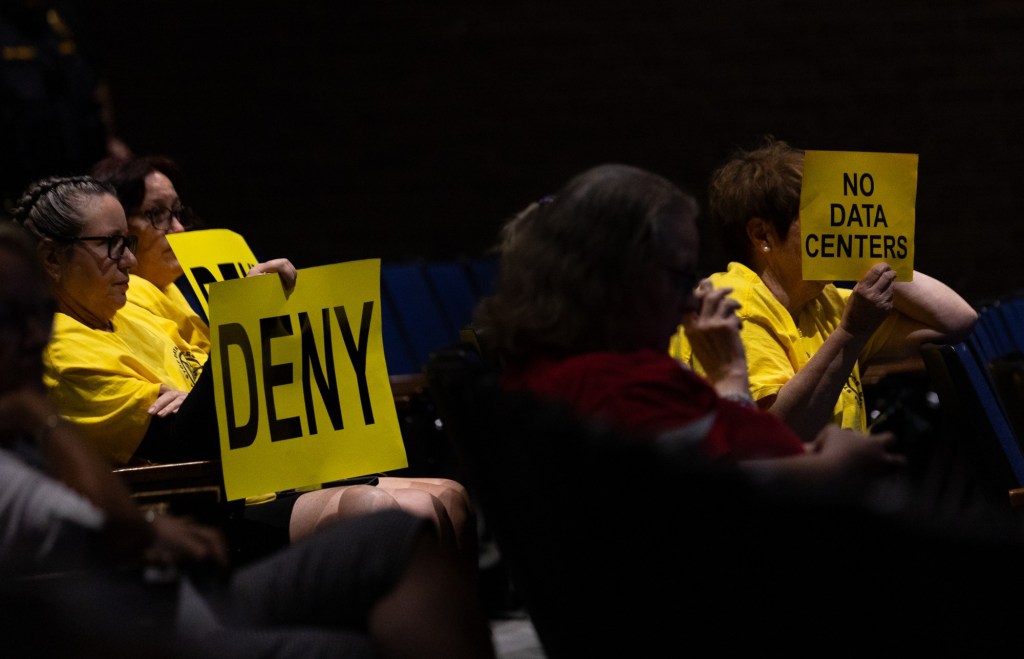
ARCHBALD — Representatives for the proposed Project Green Mountain data center campus contend their project will comply with Archbald’s noise requirements, but borough officials and industry opponents are still worried about the effects of seven data centers, raising concerns about changing equipment, vibrations and preliminary projections that leave little room for error.
Borough council listened to testimony and cross-examination about sound for more than three hours Thursday evening as they consider Project Green Mountain’s proposal to build an L-shaped data center campus east of the Casey Highway across nearly 271 acres at the Stavola Quarry. Thursday was the third conditional use hearing since March for Green Mountain 6 LLC, a limited liability company with ties to data center developer Western Hospitality Partners and its proposed Project Gravity data center campus on Eynon Jermyn Road.
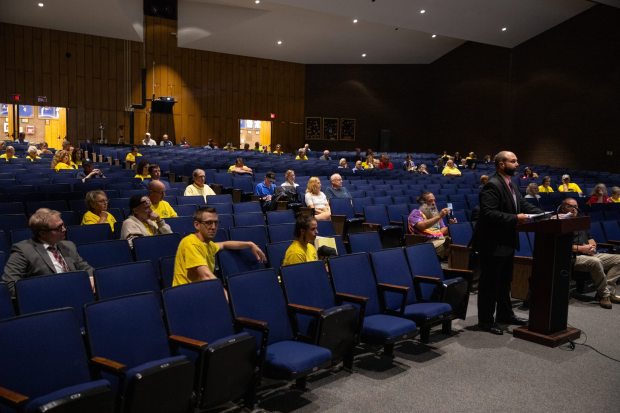
About 100 residents dotted the Valley View High School auditorium — a small turnout for Archbald, whose data center hearings regularly pack the room with hundreds of community members, local politicians and media.
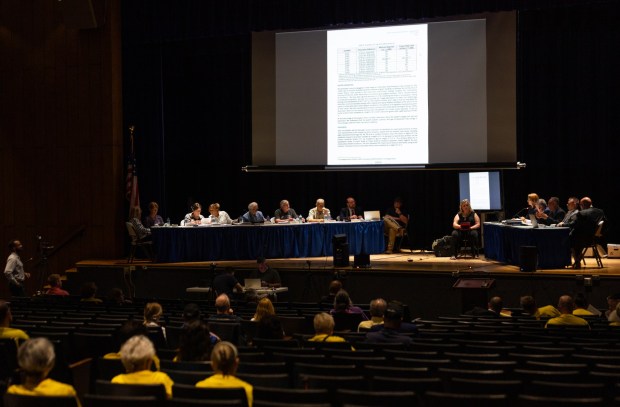 Residents gather for a conditional use hearing on the proposed Project Green Mountain data center campus at the Valley View High School auditorium in Archbald on Thursday, June 18, 2026. (FRANK WILKES LESNEFSKY / STAFF PHOTO)
The hearing focused on the findings of a preliminary sound study presented by engineer Michael Bahtiarian of Cambridge, Massachusetts-based Acentech. Project Green Mountain became Archbald’s sixth proposed data center project in January when the developer applied with the borough seeking conditional approval for seven 65-foot-tall data centers, each with a 138,000-square-foot footprint. The campus would have 196 backup diesel generators.
Archbald’s data center zoning ordinance includes restrictions for noise levels based on ambient sound at residential property lines within 2,500 feet of the site. Data centers cannot be louder than 5 decibels above background noise during normal operations, according to Archbald’s ordinance. However, those limits don’t apply during the routine testing and maintenance of backup generators, nor during power outages, when data centers will become significantly louder as fleets of bus-sized diesel generators kick on to provide hundreds of megawatts of power.
Archbald’s ordinance also requires a post-construction sound study when the campus is operational, which project representatives contended will ensure their project abides by the borough’s noise guidelines.
Bahtiarian’s projections show Project Green Mountain would meet Archbald’s noise standards during normal operation, but he faced significant scrutiny from council members and opponents. Project attorney Jeffrey Wilhelm of Pittsburgh-based Reed Smith LLP guided Bahtiarian’s testimony through questioning.
The Valley View School District also received party status from council on Thursday, giving the district legal standing in the proceedings and allowing its solicitor to cross-examine data center witnesses. The district similarly received party status Monday to challenge the proposed Wildcat Ridge Data Center Campus above Business Route 6 and Route 247.
Council did not reach a decision Thursday; testimony will resume July 13 at 5 p.m. in the Valley View High School auditorium, 1 Columbus Drive.
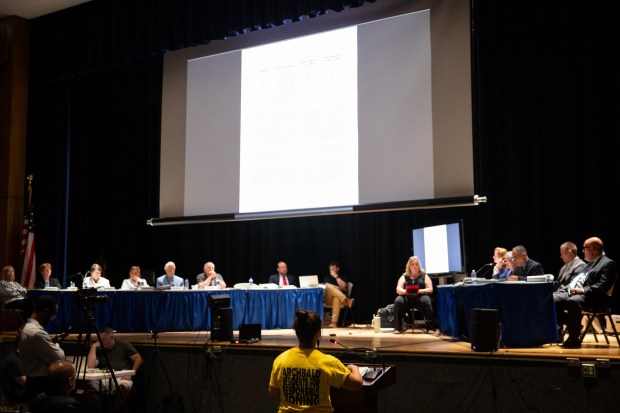 Stop Archbald Data Centers co-founder Tamara Misewicz-Healey cross-examines a data center representative during a conditional use hearing at the Valley View High School auditorium in Archbald on Thursday, June 18, 2026. (FRANK WILKES LESNEFSKY / STAFF PHOTO)
‘Would be compliant’
Acentech placed nine sound monitors at properties surrounding the proposed campus: eight residential properties and one outdoor recreation site, capturing ambient sound for 48 hours and then selecting the lowest levels from the two days of data, according to Bahtiarian and the study.
The developer then added 5 decibels, measured using the dBA scale, to determine its maximum permitted noise levels.
The predicted sound levels during normal operations range from 17 to 35 decibels, increasing to 28 to 42 decibels during maintenance of its generators and further rising to between 39 and 52 decibels in the event of an emergency when nearly 200 backup generators would power the campus. According to the American Academy of Audiology, 20 decibels is equivalent to leaves rustling, 30 decibels is a whisper, 40 a quiet library, 50 moderate rainfall and 60 for normal conversations or a dishwasher.
With all generators running, the maximum sound would remain below Archbald’s 55 decibel residential daytime limit, Bahtiarian said.
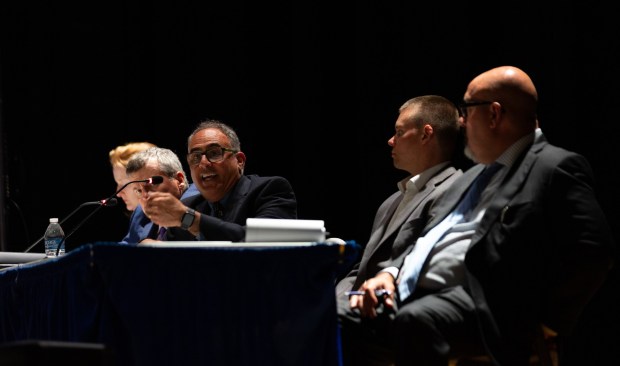 Michael Bahtiarian of Cambridge, Massachusetts-based Acentech, representing Project Green Mountain, answers a question during a conditional use hearing at the Valley View High School auditorium in Archbald on Thursday, June 18, 2026. (FRANK WILKES LESNEFSKY / STAFF PHOTO)
The campus’s air-cooled chillers would have internal sound quieting built into them, the roof of every building would have a 20-foot sound barrier on its northwestern side facing residents, and the site’s substation transformer would be surrounded by a 3.5-meter sound barrier, Bahtiarian said.
“Our opinion is that the project would be compliant with the Archbald standard noise limits, and the data center overlay noise limit,” he said.
‘How to fix it’
Although Archbald’s zoning ordinance does not govern decibels using a lower scale that better accounts for vibrations like some municipalities do, Councilman Larry Marchetti questioned whether the project could abide by the noise standards while still creating a nuisance.
Bahtiarian contended it would not because it is too far from residences to transmit vibrations, and the sound levels are too low.
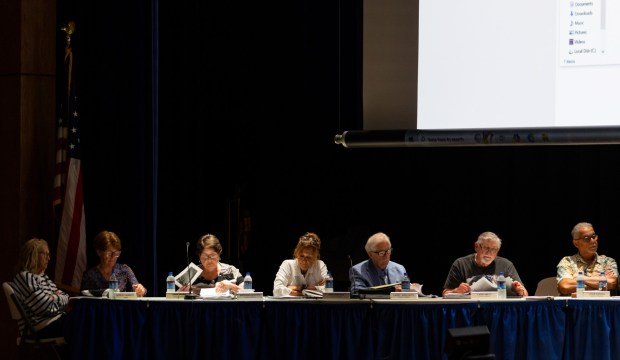 Archbald officials listen to testimony during a conditional use hearing at the Valley View High School auditorium in Archbald on Thursday, June 18, 2026. (FRANK WILKES LESNEFSKY / STAFF PHOTO)
Addressing the mandatory post-construction sound study, Marchetti wanted to know what the developer would do if they found they exceeded noise levels in their models and predictions.
Bahtiarian acknowledged it’d take some work, and Wilhelm stepped in, saying, “You’re going to have some dialog back and forth, and depending upon what the problem is, you’re going to have to figure out how to fix it and how to ameliorate it.”
“It may not simply be fixing it at the industry site, either, if it’s an individual complaint,” Wilhelm continued.
Councilwoman Lisa Osborne’s questioning triggered one of the loudest outbursts of the night from a more subdued crowd than usual. The councilwoman asked the developer if they have any finished data center campuses with a completed postconstruction sound study to provide additional insight.
“I’m going to have to defer to — many of these projects, we have nondisclosures, unfortunately,” Bahtiarian said. “As far as I know, nothing we have done this process for has been constructed.”
Wilhelm again intervened, telling Osborne it was a good question, and they will come back with an answer at another hearing.
Following the overview of the project’s preliminary sound study, council President Louis Rapoch asked the crowd, “I have one question for the audience: Does anybody understand anything that they’re saying?”
He received a chorus of “no’s” before holding a brief recess.
‘At the very margin’
In addition to council members, Bahtiarian faced a slew of questions from attorney Justin Richards of Elliott Greenleaf PC, who represents residents opposing data centers; Tamara Misewicz-Healey, the co-founder of the grassroots Stop Archbald Data Centers movement; and attorney Brett C. Flower, Archbald’s special counsel.
Misewicz-Healey, an industrial hygenist, posed questions to Bahtiarian focusing on low-frequency sounds.
“Research shows some impacts, such as cardiovascular effects; stress hormone and nervous system activation; mental health impacts, such as anxiety, depression and behavioral effects; cognitive impairment; sleep disruption; vibroacoustic disease; and among any others that you could … look into published research on,” she said.
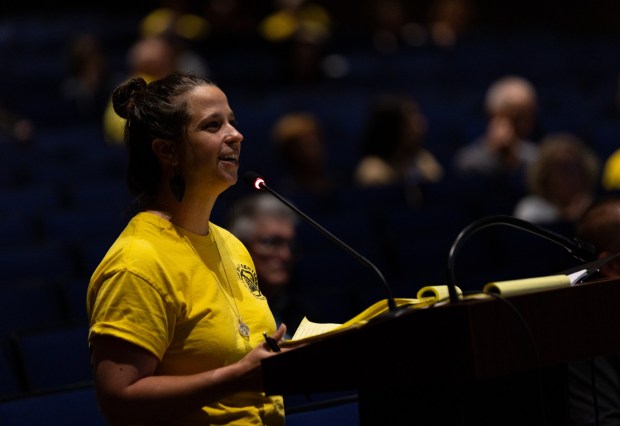 Stop Archbald Data Centers co-founder Tamara Misewicz-Healey cross-examines a data center representative during a conditional use hearing at the Valley View High School auditorium in Archbald on Thursday, June 18, 2026. (FRANK WILKES LESNEFSKY / STAFF PHOTO)
Wilhelm interrupted, “Miss Healey, this witness is here to (answer) questions, not to have you educate him. Please ask questions in his profession.”
Jeers erupted from the crowd.
“Get out of our valley!” a man shouted.
Misewicz-Healey also inquired whether Bahtiarian believes the valley topography focuses and amplifies sounds.
Possibly, but it depends on many factors, the engineer replied, citing elements like trees absorbing sounds versus a rock wall.
Her questioning on sound enclosures for generators prompted Wilhelm to offer the borough that his client would accept as a condition that it has to use a specific decibel-limiting enclosure for its generators.
Flower’s line of questioning focused on the noise impacts from even a relatively small increase in decibels, pointing out Archbald’s ambient sound represents a typical quiet residential community, that a 3-decibel increase is considered perceptible, 5-decibel increases are considered readily perceptible, and a 10-decibel increase is considered approximately twice as loud.
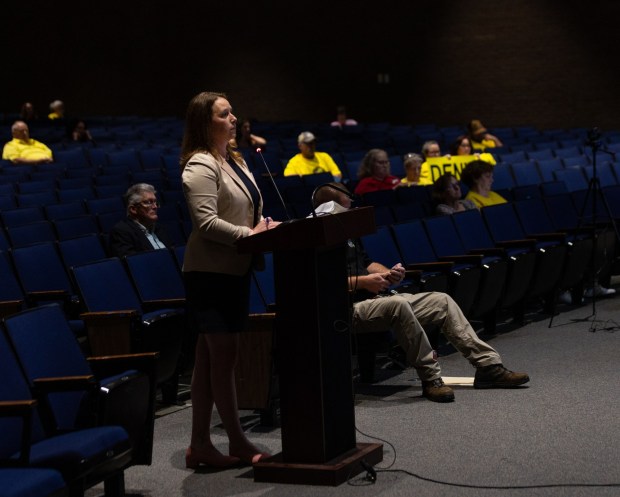 Attorney Brett C. Flower, Archbald’s special counsel, questions Project Green Mountain representatives during a conditional use hearing at the Valley View High School auditorium in Archbald on Thursday, June 18, 2026. (FRANK WILKES LESNEFSKY / STAFF PHOTO)
Bahtiarian agreed on each point.
“You would agree that in quiet residential environments, even relatively small increases could be noticeable then, correct?” Flower asked.
“That’s just dependent on a lot of factors, so I don’t know if I’d agree so readily as the other statements,” Bahtiarian said.
She also raised questions on the noise levels caused by generator maintenance, which are predicted to be as high as 12 decibels over ambient sound at a residential property line.
“So therefore the generator testing would be audible at numerous residences throughout the adjacent community, correct?” Flower asked.
“Maybe not,” Bahtiarian replied, contending his firm selected the quietest results, most of which were around 3 a.m. where ambient sound was at its lowest without daytime noise. “I can’t say that it’s a definite horrible situation.”
Richards pointed out the lack of leeway the campus has at some residential properties, where its predicted sound levels are equal to its maximum permitted sound levels. He also asked Bahtiarian to acknowledge there is a margin of error in the sound measurements, which Bahtiarian did, while maintaining his firm used conservative figures.
“We’re talking about uncertainty here, where you’re at the very margin,” Richards said.
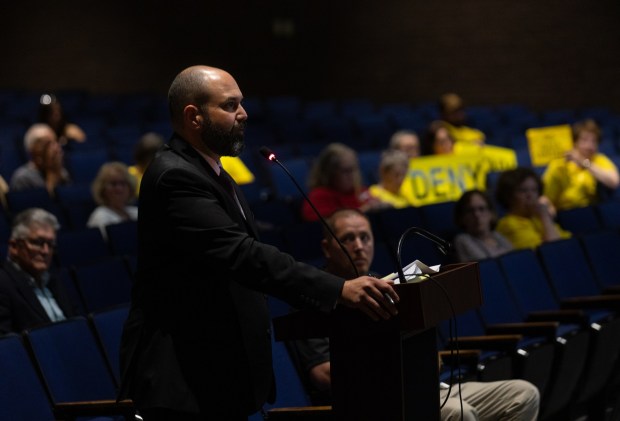 Attorney Justin Richards, who represents Archbald residents opposing data centers, questions a data center representative during a conditional use hearing at the Valley View High School auditorium in Archbald on Thursday, June 18, 2026. (FRANK WILKES LESNEFSKY / STAFF PHOTO)
Richards also highlighted a portion of the sound study’s conclusion, reading from the document, “At this early stage of the project, there is limited information about the project’s design and planned equipment. We understand that the specific location, quantity and type of equipment may change in future designs, and the model may require updating.”
Bahtiarian confirmed the language.
“So that’s like saying, ‘If we store gasoline in an approved container, we are confident that the risk of fire will be minimized, but at this time, we don’t have enough information to understand whether we will store gasoline in a bucket,’” Richards said.
Wilhelm objected. The crowd applauded.
 Attorney Justin Richards, who represents Archbald residents opposing data centers, questions a data center representative during a conditional use hearing at the Valley View High School auditorium in Archbald on Thursday, June 18, 2026. (FRANK WILKES LESNEFSKY / STAFF PHOTO)