
This is WESA Politics, a weekly newsletter by our political reporters providing analysis about Pittsburgh and state politics. If you want it earlier — we’ll deliver it to your inbox on Thursday afternoon — sign up here.
With a crucial gubernatorial election this fall and the deadline for a state budget less than two weeks away, it’s not like we lacked excitement in Harrisburg. But the state Supreme Court managed to stir up some drama this week anyway, with a ruling that could complicate both of those battles, and a lot more besides.
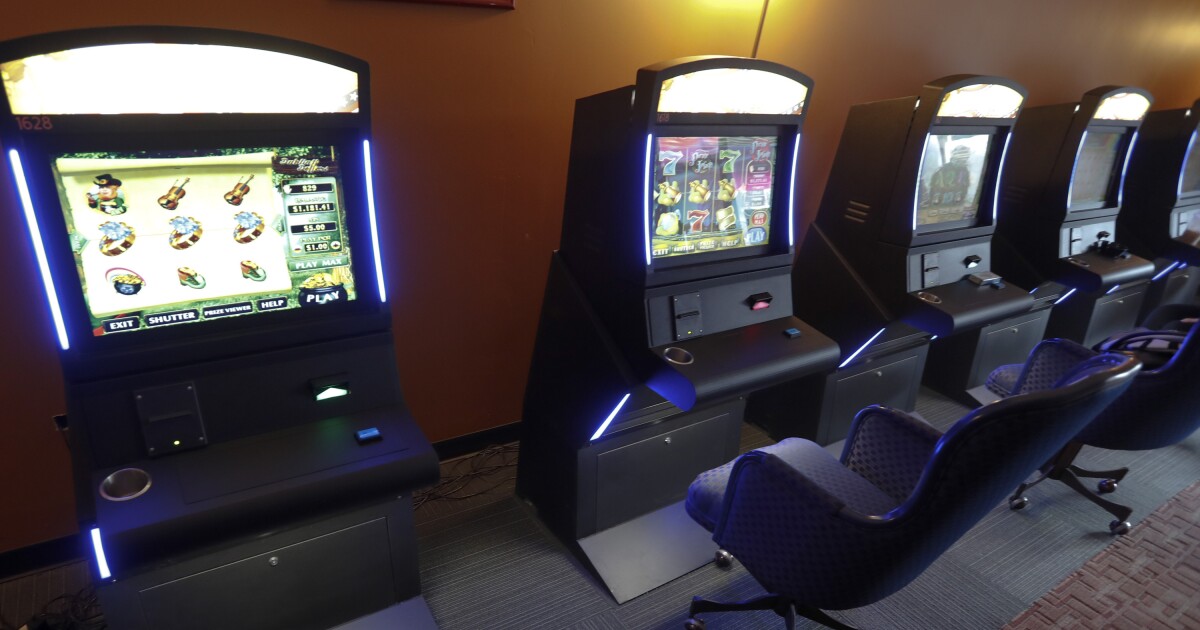
The ruling involves “skill games” — slot machine-like gaming devices that in recent years have proliferated all over Pennsylvania. There are probably some of these machines operating at a gas station, social club, or convenience store near you.
Even so, you may barely have noticed, because readers of this newsletter spend most of their discretionary income on WESA pledge drives. So we asked Harrisburg reporter Tom Riese to discuss what’s at stake in this debate — other than the money the players pump into the machines.
How many skill games are out there, and if they are like slots, where does the “skill” part come in?
Most estimates are that there are around 70,000 skill games in the state, and while they look like slots, developers argue that the skill factor comes into play after you lose a spin of the wheel. You have the option to play a game such as “Simon,” where you can earn your money back by memorizing and matching a series of colored circles.
That side game slows down the whole spin-and-win part of the machine, but up until this week, it provided the basis for a key legal exemption. Earlier court rulings said that a gaming machine was subject to state gambling regulations only if the outcome was driven mostly by luck. But this week, the state Supreme Court said the “skill” part of the game wasn’t as prominent as the chance-driven slot-machine-like aspect. The court said that means “skill games” are actually just illegal slot machines.
How did these machines become so common?
Business owners who install the machines split the proceeds with the manufacturers, and that can boost their margins in other ways. For example, I spoke to a convenience-store owner out here in south-central Pennsylvania, Priyank Gosai, who told me the games bring in a few more customers to his shop.
He argued that playing skill games is less hazardous than using your phone to bet on sports. No one is stopping you from blowing thousands of dollars from your couch, after all, but Gosai told me he’s booted players who seemed to be getting sucked in. He told me that most of the players he sees are retirees and working-class people who “need something to do” but are “not just blowing all their money away.”
So what will this court ruling mean for a business owner who offers the machines?
Nothing at first. The Supreme Court ruled that lower courts were wrong to exempt the machines from state regulation, but it also acknowledged that business owners installed the machines believing they were legal. So the court put a hold on its ruling for four months to give Harrisburg time to amend the law. If Harrisburg can’t figure out a solution by then, it could be open season for law enforcement to seize the machines.
Is Harrisburg likely to meet that deadline?
Well, the Republicans who control the state Senate put out a statement saying they think skill games can be a part of this year’s budget. And Gov. Josh Shapiro has long wanted to regulate the machines and tax them at over 50% — the same rate as the traditional slot machines you find in casinos.
A poll just out this week from Franklin & Marshall College shows that 7 in 10 Pennsylvania voters favor regulating and taxing the games. On top of that, the state budget is due at the end of the month, and it has a big deficit. Shapiro’s other idea for raising revenue has been to legalize marijuana, but there’s really been no movement there.
Not everyone is optimistic that a long-running debate in Harrisburg could be wrapped up in just a week or two. Some officials want much lower tax rates than Shapiro: One idea would be a monthly fee of a couple hundred bucks for each machine. Another idea would be to tax them at around 30% instead of 50%.
But state Senate Democratic leader Jay Costa told me after the court ruling that skill-games policy proposals have been passed around Harrisburg for years, so a resolution might come together quickly.
“We’ve had stops and starts with respect to skill game regulations and rates … so I think we’re well-poised to be able to close this discussion out,” Costa said.
So is the dispute just about how much money to extract from the machines?
No, other issues are also coming up. Philadelphia Mayor Cherelle Parker has expressed concern that the machines end up “in our most vulnerable communities,” and not wealthier neighborhoods. She said that is “predatory” and that there should be limits on where the machines are available.
State Sen. Camera Bartolotta of Washington County, whose reelection bid was attacked by skill-game supporters this spring, sounded a similar note.
“You don’t find these skill game parlors in Fox Chapel, shall we say, do you?” she said. “I think there’s a reason for that.”
Some lawmakers want to cap the number of machines statewide, or prohibit them in such places as corner stores where kids could get access. Or the state could crack down on skill-games parlors that aren’t attached to another business. I was at one last week — a restaurant that had closed and become a mini skill-game casino. It felt strange not to be ID’ed.
Do local officials like Parker have a role to play?
Maybe. The city of Pittsburgh, which has its own financial headaches, just began weighing a tax on the skill games and other mechanical amusements. City Councilor Anthony Coghill, who proposed the idea, told my colleague Julia Maruca, “We’ve decided to just proceed as if nothing’s changed.”
Coghill pointed out that other local communities already charge similar fees. And he said he sees the machines all over the place, including one location that is “basically a garage filled with skills games, it almost looks like a mini casino of sorts. And that’s part of why I’m pursuing this legislation — because it needs regulation.”