
The “Ner Tamid” or “everlasting light” has burned at Pittsburgh’s Temple Sinai synagogue since its founding in 1946, representing the eternal presence of God in both the temple and people’s lives.
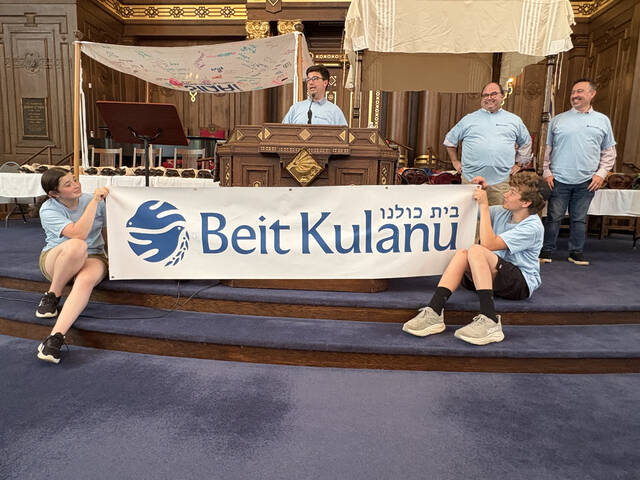
On Sunday the light winked out as Temple Sinai’s congregation merged with Rodef Shalom’s to form a new Reform Jewish synagogue in Shadyside — Beit Kulanu, Hebrew for or “a house for all of us.”
Drew Barkley, executive director of Beit Kulanu, said that while ceremoniously extinguishing the Ner Tamid felt “weird and emotional,” he was excited for the future of this new community.
“To feel and be a part of an actual transition as you’re walking to a new future…” Barkley said Monday, pausing to reflect. “In my 20 years of doing this for work I have never experienced that before.”
Hundreds of Jewish community members from each congregation met at Carnegie Mellon University’s Tepper School of Business on Forbes Avenue, lining up to recieve matching Beit Kulanu T-shirts before walking back together to the former Rodef Shalom synagogue on Fifth Avenue — now their new home.
The unification, which includes almost 1,300 households, has been in the works for over two years. Leaders said Sunday’s procession is the product of a combined effort on the part of the community and the joint congregation to breathe new life into the Reform synagogue model in Pittsburgh.
Marcie Solomon, president of Beit Kulanu and former president of Temple Sinai, said this merger is an effort to determine the future rather than react to it.
“Too often, a merger is a last-ditch attempt at survival,” Solomon said. “For us, unification right now isn’t a business necessity. It’s a choice to build something fresh.”
Barkley said Beit Kulanu will offer new programs centered on inclusion which cater to interfaith couples, members of the LGBTQ+ community, people with disabilities, children and more.
“We don’t want to neglect anybody,” Barkley said.
Rabbi Daniel Fellman of Beit Kulanu said Reform Judaism is about carrying out this mission.
‘A synagogue for the 21st century’
According to Fellman, Reform Judaism calls for the reimagination of Jewish life to fit the needs of the people, wherever they are.
While orthodox Jewish ceremonies would have called for a more formal audtorium style and separated men and women, Reform ceremonies allow for the merging of all members of the congregation, music alongside prayer, and shorter services that can include teaching sermons.
Reform practices also allow Jews to pick and choose which parts of traditional Judaism they align with, whether it be following traditional dietary laws or celebrating certain holidays.
“What Reform Judaism really tries to do is say, ‘Look, we want to make Judaism meaningful and accessible for somebody living in the modern world,’” Fellman said. “Our goal at Beit Kulanu is to create a synagogue for the 21st century that recognizes all of the blessings and challenges of life.”
In the wake of COVID-19, the 2018 Tree of Life shooting in which 11 worshippers were killed in a Squirrel Hill synagogue, and a polarized political atmosphere, leaders at Beit Kulanu feel this change is coming at a time when the Pittsburgh Jewish community needs it most.
“The rise of the far right and the far left have made the Jewish situation in America much more precarious,” Fellman said. “We have a golden opportunity to reimagine all of this, and to be creative — to take chances, and to try new things.”
Meaningful moments
The merger was its own experiment, Barkley said, as the two synagogues discussed how they would keep their individual traditions alive while creating a new place for everyone, bearing in mind even the small things that made their communities unique.
Barkley cited a humorous debate over whether the new temple would offer regular or peanut M&M’s to its congregation.
“We’ve taken a lot of time and we have done a lot of work, and while that’s still going on with staff and congregants, we are so far from where we were 2½ years ago,” he said.
For Matthew Falcone, former president of Rodef Shalom and what he called a “legacy member” of the congregation, Sunday’s procession represented a satisfying and meaningful resolution to several discussions.
“It’s such a joyous occasion that we’re able to kind of come together in this way,” he said.
Falcone’s husband and two daughters were members of the Rodef Shalom congregation alongside him and will follow the hundreds of other families into the merger.
“We’re very mindful of being able to celebrate and honor those traditions and ensure that all of us at Rodef and Sinai have a place in… the new congregation.”
For Solomon, carrying a banner with Beit Kulanu’s name on it alongside her daughter was the most meaningful moment.
“There’s been a lot of work that’s gone into the unification to the merger from a business standpoint,” Solomon said. “What was so special about yesterday, is yesterday was about everything else. It was about the community, it was about faith, it was about religion, and it was about being together.”
For many, the merger is a step into a brighter tomorrow.
When Barkley looked at the new Ner Tamid in Beit Kulanu after Sunday’s procession, he envisioned “a home where the new future is healthy, viable, creative, and life-giving.”