
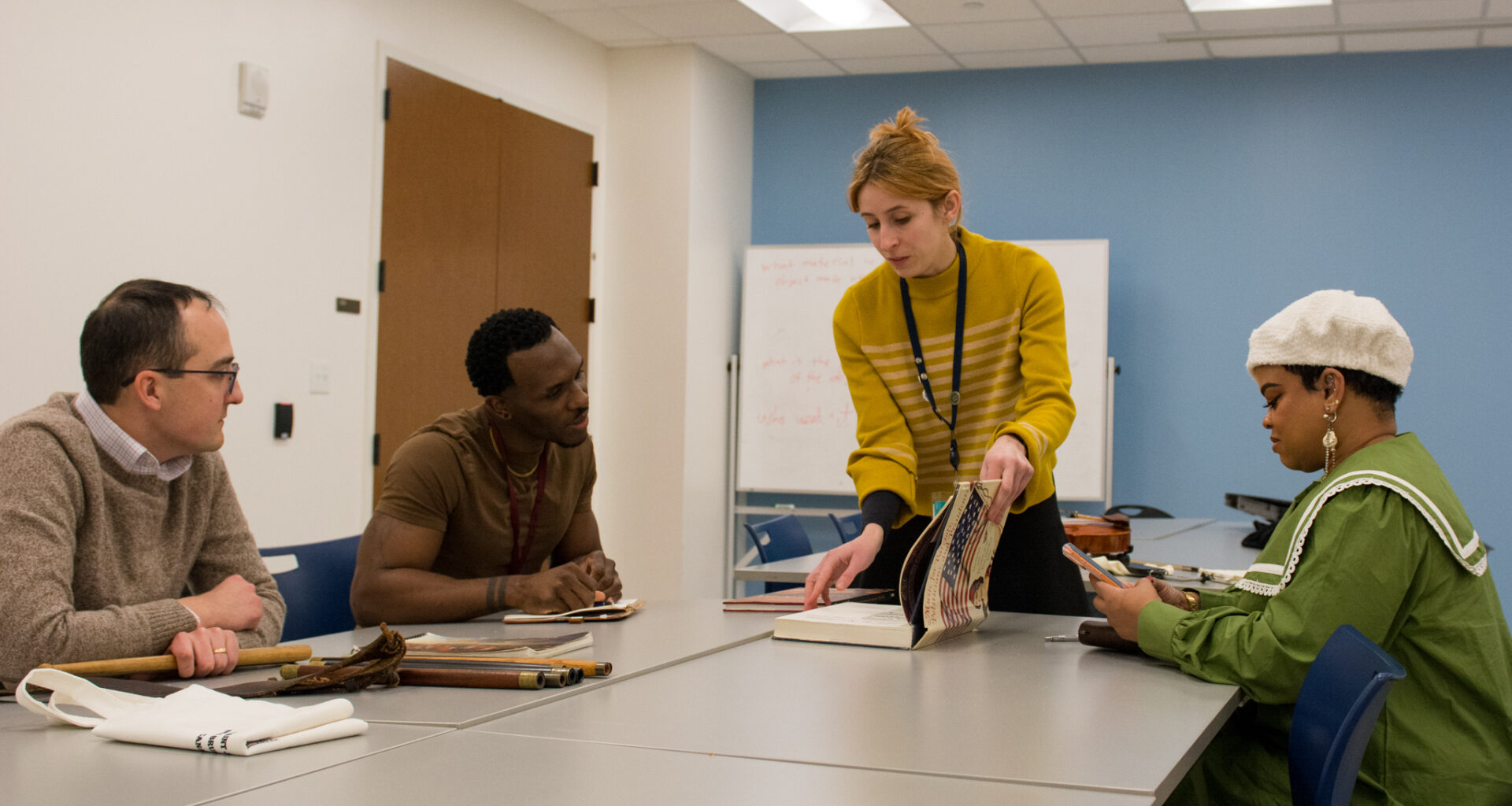
From left: Matthew Skic, director of collections and exhibitions; Zeek Burse; Alexandra Cade, the Museum’s assistant curator and Laurin Talese. Talese and Burse studied their residences at the Museum of the American Revolution to learn how to merge their music’s past with the present, in their new album. ‘Sound of History’.
Photo courtesy: Museum of the American Revolution
By Constance Garcia-Barrio
Laurin Talese and Zeek Burse, internationally acclaimed singers and songwriters, took a deep dive into the archives of the Museum of the American Revolution during residencies this winter and emerged with dazzling original music. The two Philadelphia-based artists wowed the audience with their new songs, “Sound of History,” at a sold-out concert on June 19 at the museum.
The concert, part of “What Now: 2026,” a city-wide festival held through July 4, 2026, challenges Philadelphians to imagine the future.
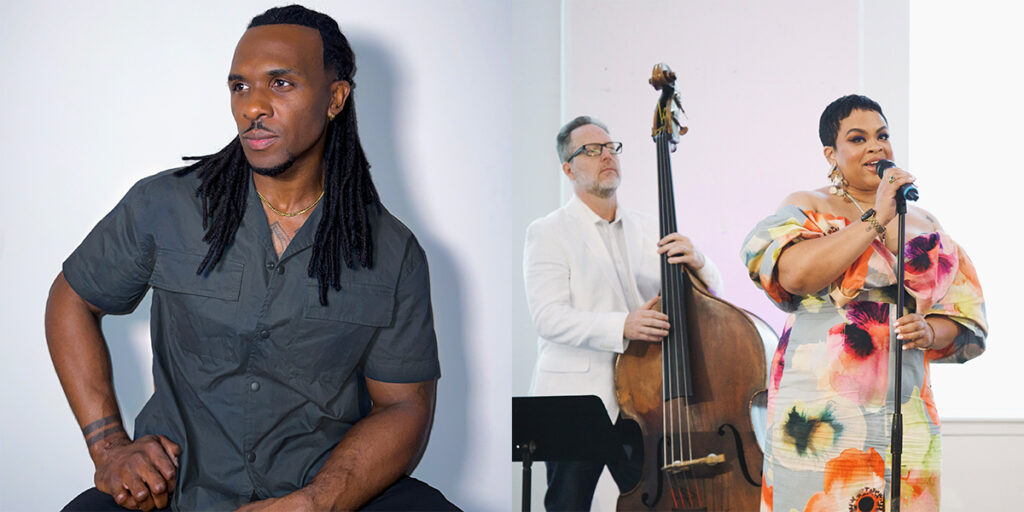
Photo: ArtPhilly.org
The museum, Black Music City — a grant program that honors the city’s African American music heritage — and ArtPhilly, a city-wide collaborative of arts organizations, jointly commissioned “Sound of History.”
“At ArtPhilly, we amplify Philadelphia as a unique crucible for the arts,” said Roger LaMay, general manager of the University of Pennsylvania’s WXPN-FM, a non-commercial radio station that often collaborates with ArtPhilly. “We felt that these two gifted artists deserved more exposure.”
The artists’ residencies grew from a roundtable discussion, said Adrienne Whaley, director of education and community engagement at the Museum of the American Revolution.
“Representatives from ArtPhilly, WRTI-FM, and WXPN-FM came together to imagine what it would look like if you embedded musicians at the museum,” Whaley said.
The group liked the idea that music could bridge a seeming chasm between past and present. The American Revolution may have taken place 250 years ago, but then, as now, people had dreams and struggles, Whaley pointed out. Talese’s and Burse’s songs emphasize the Revolution’s human dimension.
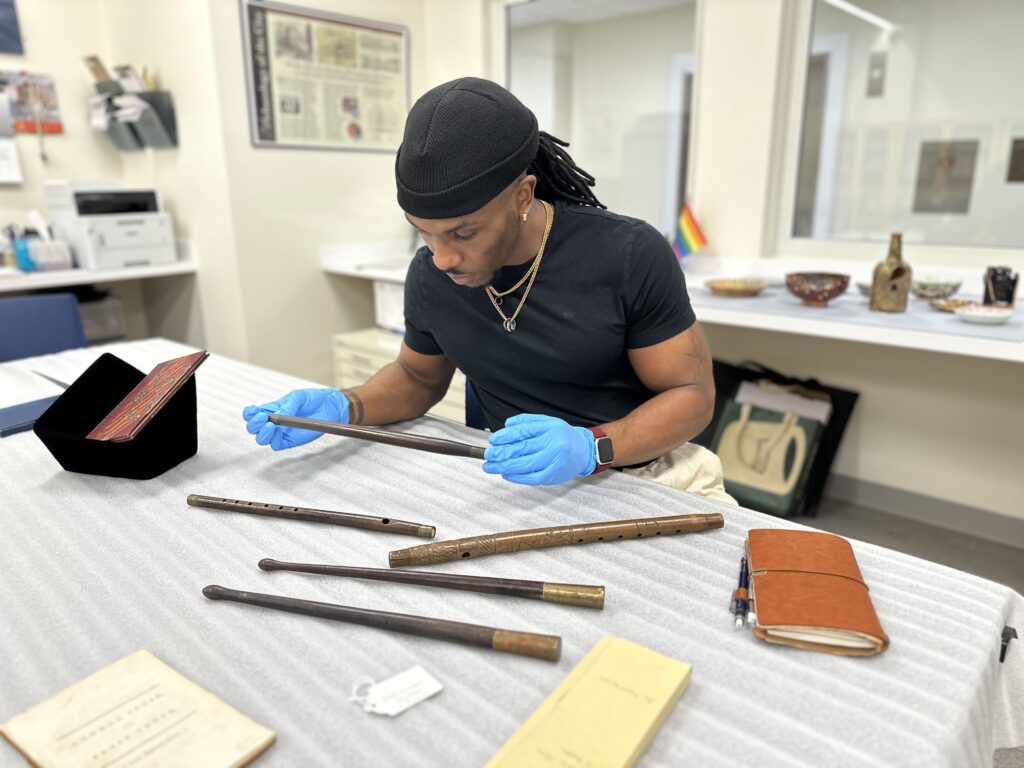
Talese and Burse attended staff meetings and events such as holiday programs to immerse themselves in the life of the museum. However, their focus remained on the archives. They had a superb guide to documents and artifacts in Matthew Skic, the director of collections and exhibitions.
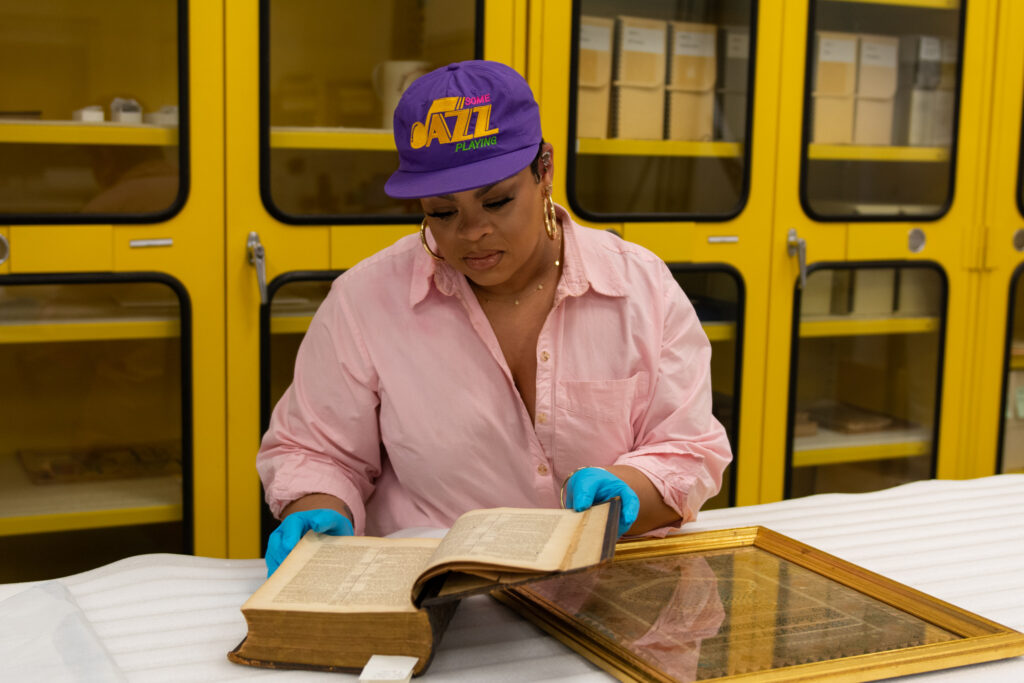
Laurin Talese (above photo) and Zeek Burse (top) look through historical artifacts for inspiration to produce their music.
Photos courtesy: Museum of the American Revolution
Skic, who plays the fife and drum, also gave them a crash course in eighteenth-century music. Ryan Bott, the museum’s audiovisual manager, provided a tutorial on the sounds of Revolutionary times. Bott creates soundscapes for different exhibits. For example, in some dioramas, the clop of hooves on cobbles deepens the feel of the past.
Learning specifics of the eighteenth century proved essential, Talese and Burse said, but both artists have long claimed music as their homeland. “My father came from a large family,” Talese, who was born in Cleveland, said. “He and his brothers would get together in the dining room after dinner and sing. I would sneak in and listen, but they would throw me out.
“One of my father’s brothers, Fletcher, would drift into someone else’s part when he sang,” Talese continued.
One evening, when Talese was about seven, she showed her father that she could sing a part faithfully.
“After that, he let me stay,” Talese, an actor, composer and vocalist who sings jazz, pop, folk, and soul, said.
At 14, Talese won a scholarship to study at the Cleveland Institute of Music. That training proved a stepping stone to Philadelphia’s old University of the Arts, where she majored in vocal performance.
“I graduated in 2004,” said Talese, winner of a Sarah Vaughan International Jazz Vocal Competition. Talese, whose favorite singers include Shirley Bassey, Anita Baker, Sarah Vaughan and Peabo Bryson — “for the clarity and precision of his voice” — has also performed with Patti Labelle.
In mining the archives, Talese found herself intrigued by historic figures like Elizabeth Freeman, also known as “Mumbet” — an enslaved woman who sued, and won, her freedom.
Ona Judge, who escaped from then- President George Washington’s house on the night of May 21, 1796, inspired Talese to write a hymn telling Judge’s story:
I left my home
I left my kin
I did not know
How it would end.
Talese worked snippets into the lyrics from an interview of Judge published in “The Granite Freeman,” a New Hampshire newspaper, in May of 1845.
Though she sang about hard lives, Talese ended the performance with an upbeat message.
“There is redemption for everyone,” she said of her songs. “Everyone gets a second chance.”
Like Talese, Burse grew up steeped in music.
“My family was deeply involved in the church,” Burse, who sang in the choir, said.
Burse was supposed to listen only to religious music, but he found a way around that household rule.
“I would go down to the cellar, turn my music on low, then listen and sing along,” Burse, who is a multi-genre singer, songwriter, producer, and model, said. “I studied Michael Jackson and Prince.”
Burse’s home life encouraged his curiosity.
“My family didn’t come from money by any means, but my parents bought the kind of encyclopedia once sold door to door,” he said. “I would ask my father a question, and he would say, ‘Look it up.’ Later, he would ask me, ‘What did you learn?’”
Burse’s experiments with genre-bending sounds may have begun by nurturing his inquisitiveness early.
In the archives, Burse gravitated toward documents, especially Thomas Paine’s best-selling pamphlet “Common Sense.”
Burse consulted the museum’s copy of the document, first published in Philadelphia in January 1776. “It went viral,” Burse said of the pamphlet, which argued for independence from England.
Burse’s music reflects the era’s deep hypocrisy, the idea of demanding freedom while continuing to enslave Black people.
“I chose the key of F,” Burse, who has performed in not only in the U.S. but also in London, Paris, and Milan, said. “It’s warm, optimistic. But there is dissonance, because the lyrics speak of freedom only for some.”
Burse, who has studied graphic design, added a spectacular visual element to his performance. While he sang off to one side, a big-screen image of a man made of parchment appeared. At first, the parchment man stands in a magnificent marble hall, a document in his hands. As Burse sings, the man moves through time and eye-popping settings. There are moments of Afrofuturism, suggesting that the moment will come when everyone is free.
“I am an optimist,” Burse said.
“The Revolution is a work in progress,” he added. “I want the audience to feel that they have the power and responsibility to shape American history.”
Another free performance of “Sound of History” will take place on June 25 at Germantown’s Awbury Arboretum. For information, please see ArtPhilly https://www.artphilly.org/projects/sound-of-history. Get tickets for the June 25 performance at: https://www.showpass.com/sound-of-history-at-awbury-arboretum/.