
A research group at the University of Scranton has ambitions to study the weather and how it impacts global communications.
SCRANTON, Pa. — A team of researchers at the University of Scranton has its eyes high in the atmosphere.
Kornyanat Hozumi and Dr. Nathaniel Frissell are studying the ionosphere, which is about 50 miles up in space, and how the weather up there impacts communication signals across the world.
“It seems so far away, but it’s connected to our daily lives,” said Kornyanat Hozumi.
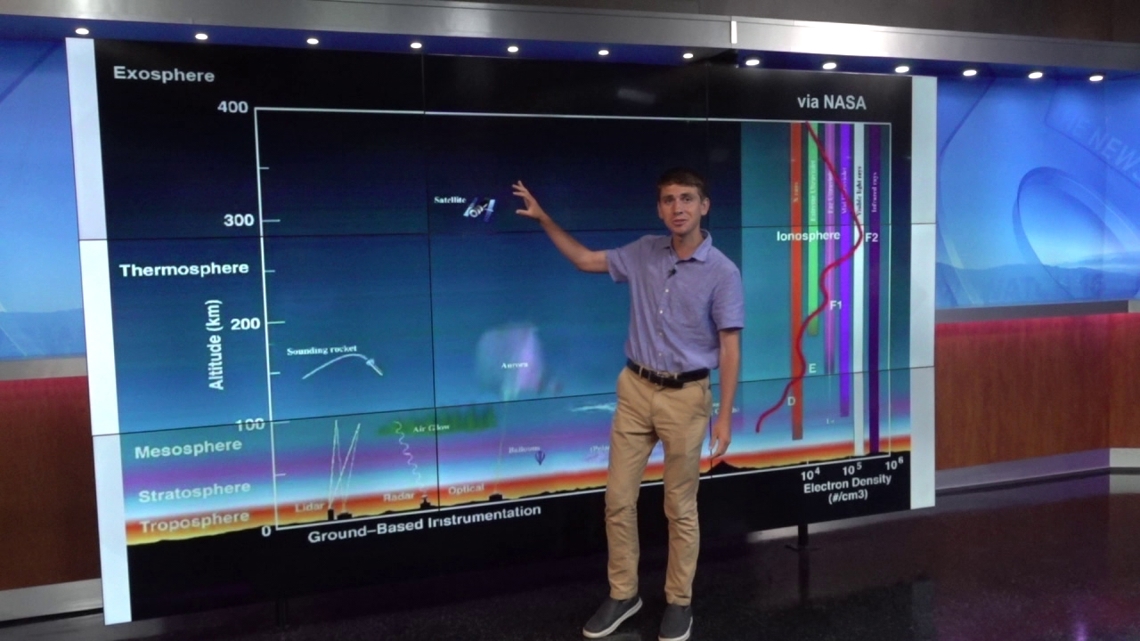
To put it in perspective, we live in the troposphere. This is where the weather we live in every day happens. It extends 5 to 10 miles high. They are studying the ionosphere. It goes from 50 miles up to hundreds of miles up.
Frissel and Hozumi will be taking data from ham radio and GPS signals to make better models of the upper atmosphere. They say right now the observations don’t connect well with models.
“We need ways of comparing the data that we can receive, like this ham radio data, with actual models,” said Dr. Nathaniel Frissell.
It is actually very similar to what the Stormtracker 16 Team uses at WNEP. We have observations like temperature and wind. Those observations are put into models that show potential weather patterns.
The researchers will use a process called Ray Tracing to show how radio signals travel. The type of stuff we use daily.
“So if you have a GPS signal going through the ionosphere. Any sort of variation in the sphere will create a delay with signals going from the satellite to the ground,” said Dr. Frissell.
The team received two grants for their project, each totaling about $600,000.
The newest grant will enable the team to study how signals travel through what are called plasma bubbles. Hozumi says the bubbles are a disturbance, like solar flares from the sun.
“Inside the bubble it’s just not empty space. There are fluctuations in plasma density, and this kind of fluctuation causes a lot of irregularity,” said Hozumi.
The projects are expected to last through 2029.