
BETHLEHEM, Pa. – For more than 65 years, the international Summer Science Program has challenged top young minds.
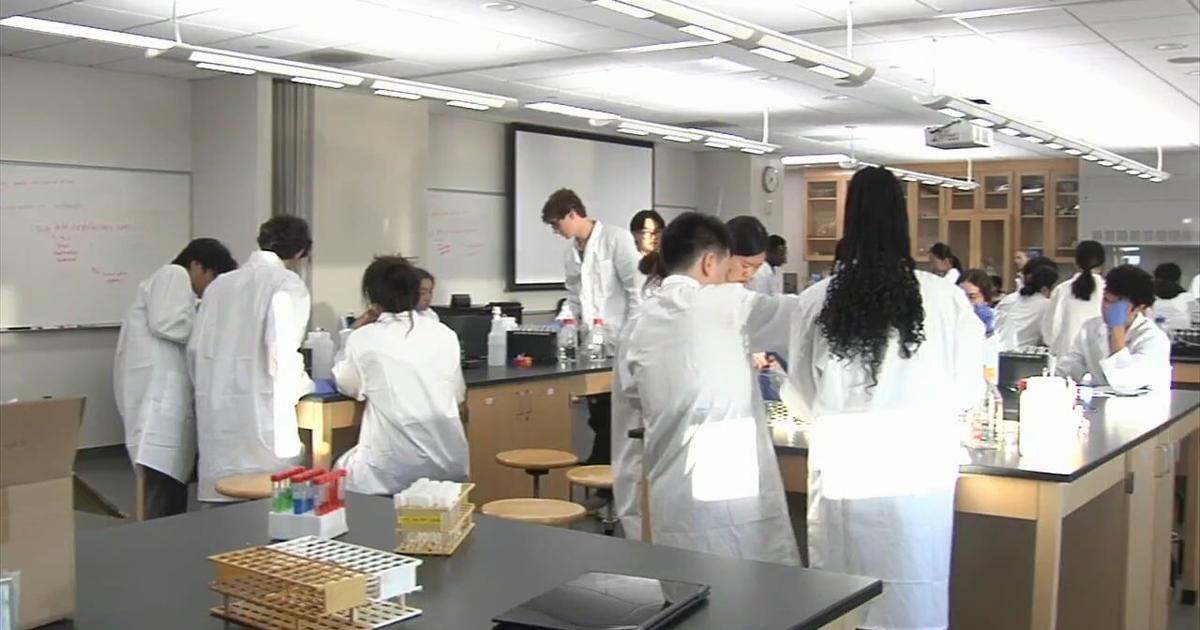
This week, 72 high school students from across the globe took over the research labs at Lehigh University.
“They’re here for the next five weeks doing research, attending lectures and getting college level content,” said Emily Wollmuth, the academic director of the Bacterial Genomics program. “So, it’s a very intensive program, but a lot of fun.”
In the biology lab, 36 students are studying bacterial antibiotic resistance to help combat global public health threats.
“Today what we’re doing is we’re preparing media cultures,” said Abdullah Al Jaberi, a rising senior from Delaware. “So, what we’re doing is we’re transferring the bacteria into antibiotics and we’re preparing them for our research.”
Because the program mimics real-world research, directors say the goal is teaching teenagers how to handle the realities of science.
“In the lab, at some point there will almost certainly be a failure that arises,” Wollmuth said. “Something is going to go wrong. And so, we want them to learn how to work through that with their team and troubleshoot.”
“I think this is a really great opportunity to experience that and explore these topics of genomics and bacteria and antibiotics,” added Audrey Vachon, a student from Rhode Island.
A few buildings away, a separate cohort of 36 students is working in teams of three to calculate the orbits of real asteroids.
“They work for five weeks trying to image an asteroid for three different nights and then use those observations together with methods developed in the 19th century and computational tools that are current to figure out the orbit,” said Jose Manuel Zorrilla Matilla, academic director of the Astrophysics program.
“In school you are used to having your textbook and then you go, you turn the page and there’s a solution,” Zorrilla Matilla added. “And this is for many of the participants; this is the first time where they have to face an open-ended problem. They don’t know the solution and they have to figure it out.”
For students like Shyla Agrawal from Washington, the program is a rare chance to bridge her favorite subjects using high-level tech.
“I had a lot of interest in both physics and comp sci,” Agrawal said. “High schools themselves don’t really have the funding to provide something like this. So, this is a great opportunity to actually use real equipment that I don’t think I’d ever get to use until a college research experience.”
The heavy workload also came with a perfect view on just her second night in Bethlehem.
“We saw the moon and three other planets just in the same frame of sky,” Agrawal said. “And so, it was really cool to see all the stars align literally on our second night here.”
Directors say the five-week immersion program doesn’t just build future scientists; it builds resilience, teamwork, and a lifelong global network of peers.