
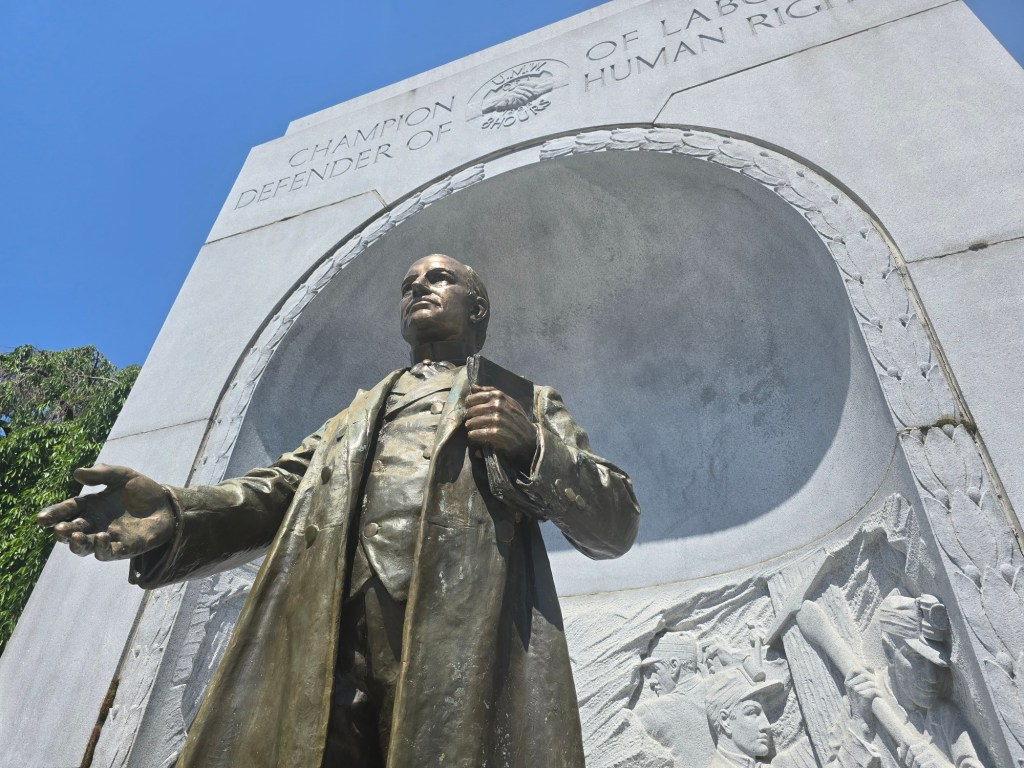
On a Courthouse Square dotted with monuments to local legends stands a champion of the working man.
Staring across Adams Avenue in Scranton’s bustling downtown, John Mitchell’s statue is a testament to hard work, fairness, community and unity. His work as the president of the United Mine Workers in the late 1800s and early 1900s left a legacy deeply felt by Northeast Pennsylvania families who toiled in the region’s coal mines generations ago.
It resonates, still.
National ripple
In the early 1900s, the region’s mine workers were mostly a collection of immigrants with diverse backgrounds but little power. Mine operators, for their part, weaponized that diversity and the language barriers that came with it to stoke divisions and isolation, allowing them to break strikes and suppress wages, according to Department of Labor accounts
But when the 1902 Anthracite Coal Strike, centered in Scranton, shut down the nation’s heating supply, Scranton and Mitchell became the epicenter of a lasting labor movement.
Mitchell stressed the struggles of the working man were shared, regardless of language, religion or country of origin. Mitchell organized, printed union literature in nearly a dozen languages, and ensured that local leadership reflected the diverse ethnic makeup of the patches, fostering an unprecedented sense of solidarity.
The work was so successful, the Anthracite Coal Commission established by President Theodore Roosevelt held hearings at the Lackawanna County Courthouse. Eventually, its work resulted in shorter hours and better wages for miners.
It marked the first time the federal government acted not to bust a strike, but to mediate a fair resolution.
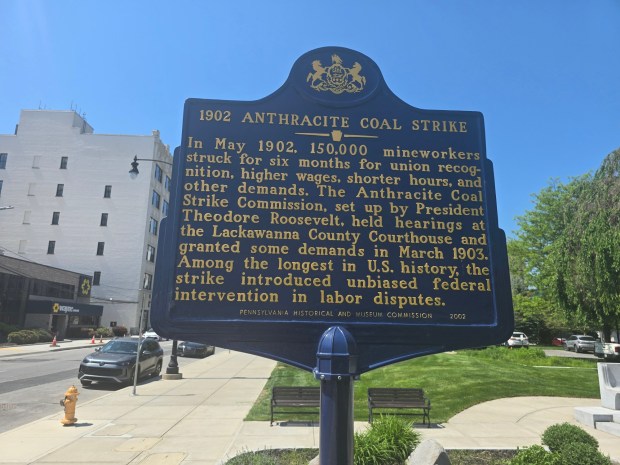 A historical marker on Courthouse Square in Scranton details the Anthracite Coal Strike. (CHAD SEBRING/STAFF PHOTO)
Living legacy
Even beyond netting better wages and shorter hours, Mitchell’s triumph in Scranton had a profound cultural impact.
By organizing miners under a single banner, he essentially created a national working-class model. In the coal patches, hardship and victory forged a unified American identity from diverse cultures. Today, the statue of John Mitchell on the grounds of the Lackawanna County Courthouse remains a powerful testament to a leader who looked past the barriers to prove solidarity could triumph over division.
Sidelight
Samuel Gompers, founder of the American Federation of Labor, said in his autobiography, “Seventy Years of Life and Labor,” about the 1902 strike and subsequent deal, “Several times I have been asked what in my opinion was the most important single incident in the labor movement in the United States and I have invariably replied: the strike of the anthracite miners in Pennsylvania … from then on the miners became not merely human machines to produce coal but men and citizens. … The strike was evidence of the effectiveness of trade unions.”
About the series
No. 9: As the nation approaches America250, we are counting down ways NEPA has powered American history. Missed a day? Read the full countdown as it unfolds at citizensvoice.com.