
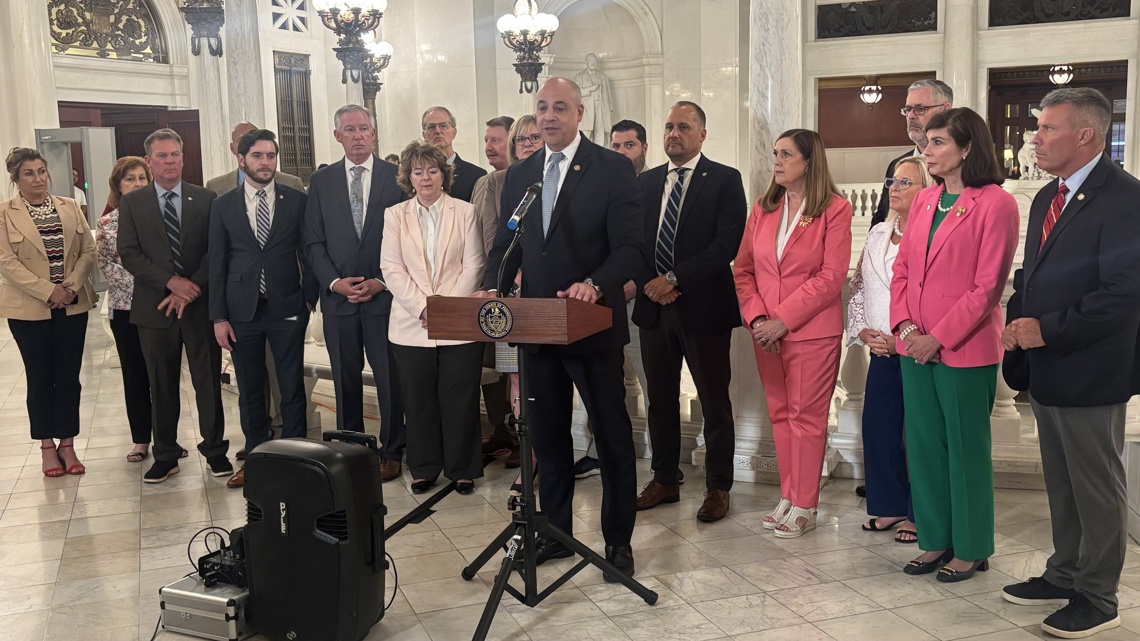
Senate Bill 1400 passed 31-19, with five Democrats voting yes and one Republican voting no.
HARRISBURG, Pa. — The Pennsylvania Senate on Thursday passed a bill establishing a new sentencing framework for second-degree murder convictions following a Pennsylvania Supreme Court ruling that found the state’s mandatory life-without-parole sentence for felony murder unconstitutional.
Senate Bill 1400 passed with a 31-19 vote, with Democrats James Malone, Lisa Boscola, Marty Flynn, Nick Miller and Anthony Williams voting yes. Republican Jarrett Coleman was the only GOP member to vote no.

This story continues below.
The bill, which is sponsored by Sens. Lisa Baker (R-Luzerne) and Wayne Langerholc (R-Cambria), would create a sentencing range of 35 years to life with the possibility of parole for most second-degree murder convictions.
The bill was introduced in response to the Pennsylvania Supreme Court’s decision in Commonwealth v. Lee, which struck down the state’s longstanding mandatory life-without-parole sentence for second-degree murder and gave lawmakers 120 days to enact a new sentencing scheme before its order takes effect on July 24.
Pennsylvania Attorney General Dave Sunday praised the Senate’s action.
“Today’s vote on SB 1400 is absolutely critical to ensure that these victims are not forgotten, and that appropriate sentences are in place based on an individual assessment of their culpability,” Sunday said.
Senate Republicans argued the legislation balances accountability for serious crimes with the court’s requirement that sentencing takes individual culpability into account.
“Through this bill, we keep faith with the families who saw the sentences properly imposed under the prevailing rules that were deemed commensurate with the criminal offense,” Baker said following the vote.
The Supreme Court’s ruling centered on defendants convicted of second-degree murder as participants in another felony during which a killing occurred. In some cases, defendants did not directly commit the homicide or know a weapon was present.
Democrats who opposed the bill argued the legislation does not go far enough in providing individualized reviews for people already serving life sentences under the old law.
“It doesn’t give every single one of those folks an opportunity to have their level of culpability in the crime that they were convicted of reviewed,” said Sen. Maria Collett (D-Montgomery). “That’s what the court wants. That’s what the court says is constitutional, and it’s what every single defendant deserves.”
Under SB 1400, people currently serving life sentences for second-degree murder would become eligible for parole after serving 35 years in prison.
The bill also includes a parole pathway for some older inmates and directs the parole board to consider specific factors when deciding whether to grant release. Victims and their families would be notified and allowed to participate in parole proceedings.
The legislation also gives judges discretion to impose lower minimum sentences of ten years in limited cases involving defendants with minimal culpability, while preserving the possibility of life without parole in certain aggravated cases.
Collett said lawmakers can protect victims’ interests while also complying with the court’s ruling.
“We absolutely can honor the experience of those victims, and we can honor the rights of the people incarcerated here in Pennsylvania, pursuant to the Lee decision,” she said.
Both supporters and opponents of the bill agreed on the urgency of both the Senate and House acting before July 24, when the Supreme Court’s order takes effect.
If lawmakers fail to enact a new sentencing structure before then, prosecutors have warned that courts across Pennsylvania’s 67 counties could be left to develop their own standards for handling second-degree murder cases, potentially creating inconsistent sentencing practices statewide.