
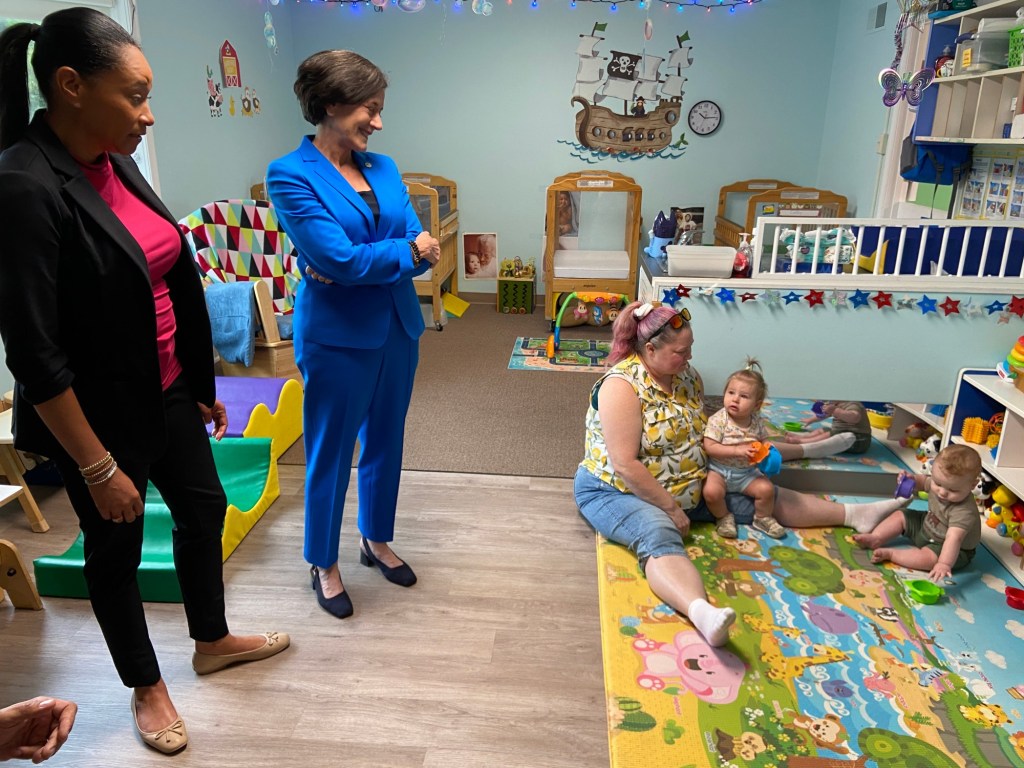
DOUGLASS (Mont.) — With more than 40 children enrolled at the Boyertown Children’s Center and parents looking for quality child care knocking on the door, Director Angie Miller said her facility is still not at full capacity.
Her business is a four-star Keystone STARS child care center serving approximately 63 children year-round and employing up to 18 full-time staff members. The center’s curriculum includes literacy, math, science, art, music, fitness, and social-emotional development integrated throughout the day, utilizing a play-based, child-centered learning model, but her center is still not full.
“I would have to hire at least four more staff to be fully enrolled,” explained Miller, who, before coming to the Boyertown facility, spent 35 years working with Warwick Child Care.
But hiring four more staff is not as easy as it sounds.
That’s because, despite their importance in caring for the next generation and keeping parents at work and not at home, child care workers are among the lowest-paid workers in America. That’s why Miller was happy to welcome Pennsylvania Human Services Secretary Valerie Arkoosh to her school.
Arkoosh was there as part of the administration’s budget push to increase the investment made last year to provide recruiting and retaining bonuses for child care workers, along with a series of tax breaks for parents and employers.
That bonus “helped us to hire one more,” said Miller. Boyertown Children’s Center has received $10,320 in staff retention and recruitment bonuses.
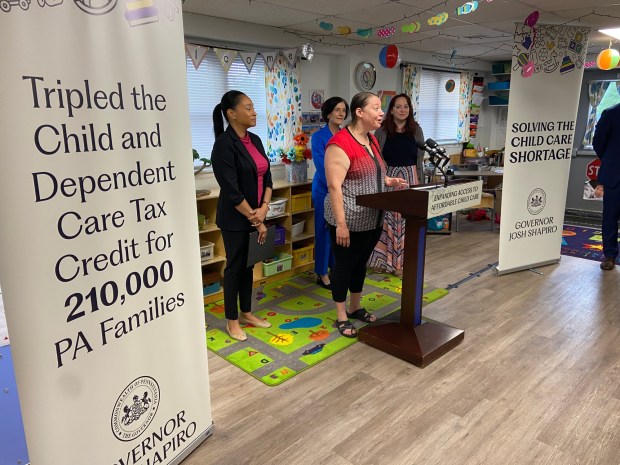 Angie Miller, director of Boyertown Children’s Center, said programs like the one included in last year’s state budget, helped her attract one more worker of the four more she needs. (Evan Brandt — MediaNews Group)
“Children learn more skills from birth through 5 than they do their entire lives — and we are the ones who teach them these skills, but we cannot teach them these skills without quality teachers and staff,” said Miller.
“Early learning and child care programs like Boyertown Children’s Center are the workforce behind our Commonwealth’s workforce — a catalyst for a healthy, vibrant economy while fostering educational and social development for our youngest Pennsylvanians,” said Arkoosh. “Our dedicated, passionate child care workers are the ones who make that possible.”
Pennsylvania’s child care industry has 2,600 unfilled jobs — openings that, if filled, would allow providers to serve nearly 22,000 more children. Providers continue to struggle with low wages that make it hard to hire and retain qualified staff, forcing them to close classrooms and turn families away.
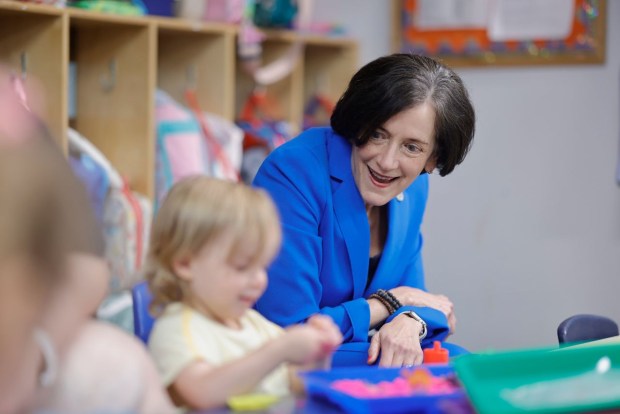 Valeria Arkoosh, Pennsylvania secretary of Human Services, visits with some children at the Boyertown Children’s Center on Tuesday. (Image via office of Valerie Arkoosh)
The 2025-26 budget secured a new $25 million investment in recruitment and retention grants, providing nearly 39,000 child care employees across the Commonwealth with up to $645 in retention bonuses, supporting nearly 39,000 child care workers throughout Pennsylvania, according to Arkoosh’s office.
Additional increased investments in early childhood education in the last budget included an additional $7.5 million for Pre-K Counts to help providers raise wages and stabilize the early educator workforce, and a $10 million increase for Early Intervention services to support families with children experiencing developmental delays.
The Governor’s 2026-27 proposed budget proposes investing an additional $10 million in retention and recruitment bonuses to support employees at licensed child care centers in the federal Child Care Works program, bringing the total state investment to $35 million.
Arkoosh said Pennsylvania loses about $6.5 billion in productivity every year due to the child care shortage. “Child care is a critical part of our economy,” she said.
“We’re here so parents can work. They rely on us every day,” added Miller.
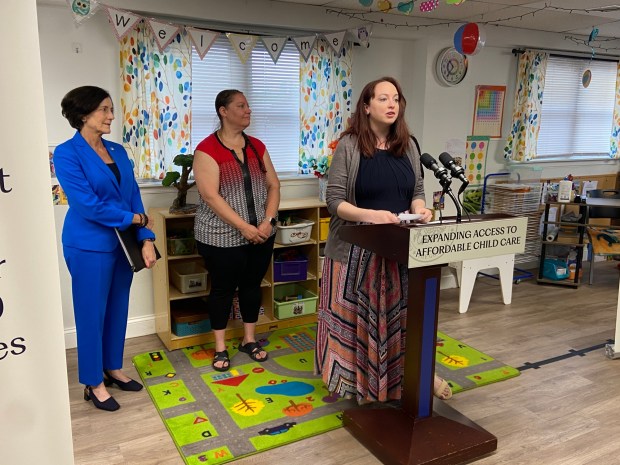 Caitlin Williams, a registered nurse, said she would not be able to do her essential work if it were not for affordable childcare, as she receives at Boyertown Child Care. (Evan Brandt — MediaNews Group)
One of those parents is Caitlin Williams, who works as a registered nurse at Penn State St. Joseph’s Hospital in Reading. She has two daughters, Juliana, 6, and Clara, who is just two months.
“I need affordable child care,” said Williams. “Inflation continues to be a challenge, and we seem to have instability and challenges coming at us from all directions, especially D.C.,” Williams said. “Hospitals need more nurses and nurses’ families need child care like Boyertown Child Center.”
“Child care is not a luxury; it is essential to working families and to our economy. In Montgomery County, we’ve seen how investments in the childcare workforce keep centers open, support parents, and give children a strong start,” said Montgomery County Commissioner’s Chairwoman Jamila Winder.
Arkoosh touted the administration’s childcare record by pointing to:
• Expanded the Child and Dependent Care Enhancement Tax Credit: In December 2023, Gov. Shapiro signed into law a major expansion of the credit, increasing Pennsylvania’s match from 30 percent to 100 percent of the federal credit. The maximum benefit rose from $630 to $2,100 per family — and last year, this expansion delivered $139 million to nearly 222,000 working families.
• Created the Employer Child Care Contribution Tax Credit: In the FY2024-25 budget, the Governor secured a new credit encouraging employers to contribute to workers’ child care expenses. Employers can claim a tax credit for up to 30 percent of eligible contributions, capped at $500 per employee — helping businesses support working parents and strengthening the workforce.
• Secured nearly $117 million across his first two budgets for Child Care Works, helping up to 80,000 low-income families access subsidized care each year.