
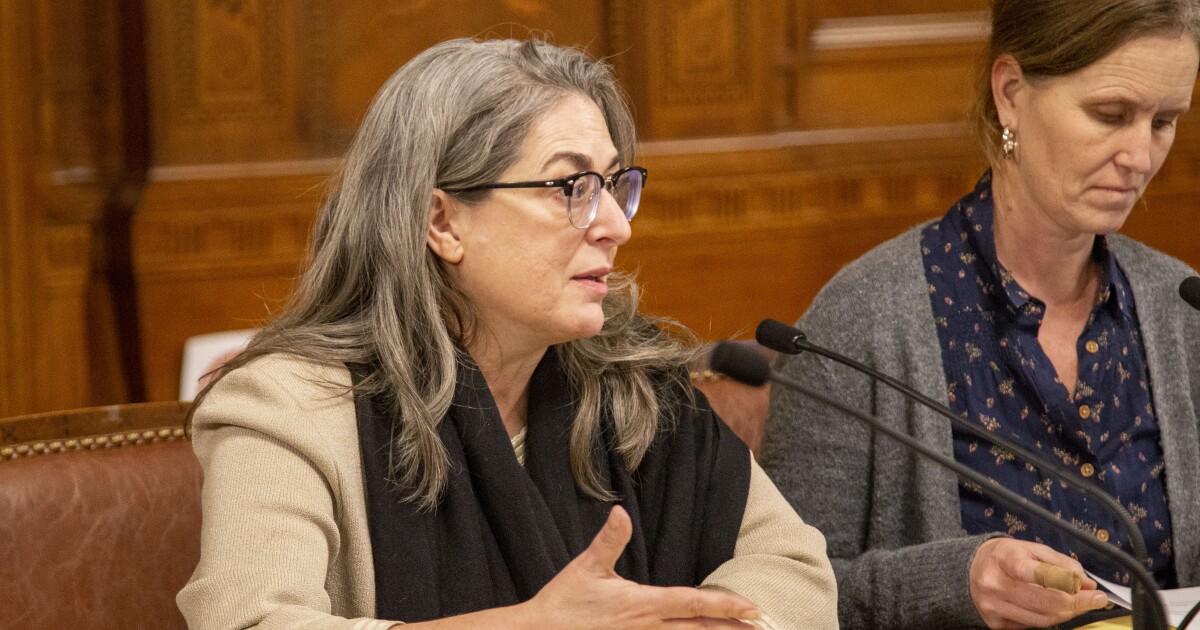
After a long pause, Pittsburgh City Council this week took another step in its effort to regulate short-term rental properties, particularly in residential areas. It proposed an amended set of proposed rules that seek to make it harder for anyone who doesn’t live in a residential property from renting out rooms there, though it may be months before council takes a final vote.
“It was our goal to make sure that there was a much more difficult path for people who are trying to treat our neighborhoods like they are commercial areas,” said Councilor Deb Gross, who introduced the latest iteration of the bill at the tail end of council’s meeting Wednesday. “Because they aren’t. They’re neighborhoods for homes where we need people to be able to live.”
The new version of the bill comes amid criticism that officials have done too little to protect residential neighborhoods from the disruptions that sometimes come with the properties. Concerns about short-term rentals spiked after a 2022 fatal shooting at one such property in the North Side, but legislation has been a long time coming.
The proposal Gross and councilors Bobby Wilson and Anthony Coghill put forward Wednesday updates a measure introduced this past winter — which was itself a reboot of legislation that died after the previous council session ended last year.
In the earlier version of the bill, a property owner could get approval for a short-term rental in a residential area by seeking a “special exception” from city zoning authorities. The newer version of the bill, however, appears to close off that possibility for anyone who doesn’t reside at the property themselves.
Residents who do live at the property, meanwhile, would have a legal right to rent out one unit for short-term stays, either within their own home or as a separate structure on the property.
Gross and Wilson said they wanted to protect the ability of owner-occupants to supplement their income: Wilson said his own grandparents once relied on the income they earned from renting out a room.
But he said that there were mounting concerns that, in residential communities, “We could get an applicant who wanted a special exception [and] the zoning board would have to approve it, as long as it met the criteria of being just one short-term rental. That gave us pause to say, ‘We need to be more direct and just remove any permitted use of this if it’s not your primary home.’”
In theory, a rejected would-be rental operator could still ask the city for a variance that would essentially rezone the property in question. But that would be a much tougher standard to meet.
That’s as it should be, said Gross: “We don’t want you — if you are a speculator, an LLC — to buy up one, five, 10, a dozen houses on residential streets and be renting them out. If you want to run a business, go into one of the business districts.”
Rental advocates say they were ‘blindsided’
Supporters of short-term rentals said they were blindsided by Wednesday’s move (which some city officials also privately said they didn’t expect).
“We’ve reached out to council multiple times, and no one has responded,” said Jake Tovey, a board member of Steel City Short-Term Rental Alliance, an advocacy group. “We were very surprised.”
Tovey said of the new version of the bill, “I don’t think it changes things much,” because “if they were this intent on killing [short-term rentals], it felt like requiring the special exception would be enough.”
Still, he said getting the variance “would be very difficult.” The new language, he said, “makes things stricter [and] moves in the wrong direction.”
Tovey said it was likely that zoning changes would have to “grandfather” existing rentals, allowing them to continue to operate. That, he said, would be “the bare minimum for it not to be catastrophic.” But he said he couldn’t be sure of that: “It’s stressful.”
The new version of the bill leaves intact other provisions in the original, especially when it comes to short-term rentals in non-residential areas.
It continues to limit the number of short-term rental units that can be offered in multi-unit properties. No more than two such rentals are allowed in properties with 20 or fewer units, and no more than five short-term units in larger properties. The bill still prohibits guests from hosting parties or other group gatherings in the unit.
And a city-issued license will still be needed to offer a short-term rental, for example, even in residential areas.
Tovey said he understood the need to treat residential areas sensitively. “I don’t think it’s problematic to have more focus on low-density residential areas” and the impact of rentals, he said. “I don’t think that’s unreasonable. I just think it’s wrong to kill it.”
Instead of bans and zoning changes, he said, “We’re hoping to just work through licensing [operators] and enforcement. For years we’ve wanted a licensing process, and the sooner that is implemented, the better.”
Operators prefer regulations to focus on the behavior of individual rental proprietors, rather than drawing whole communities out of bounds. Doing otherwise, they contend, punishes responsible operators for the problems of a few.
And backers say the rentals are a boon to local residents. Airbnb, the largest player in the industry, says survey data suggest that 38 percent of Pittsburgh hosts have used the rental income to defray their own rising costs of living: More than a quarter say that money has helped them remain in their own homes.
The company and supporters like Tovey also say they take pains to enforce rules that limit disruptive behavior at their properties.
But concerns about the rentals go beyond noisy visitors. As bill co-sponsor Anthony Coghill said in council Wednesday, homes set aside for short-term rentals might otherwise be occupied by more permanent residents — a key concern precisely because housing prices are on the rise.
And having too many such properties “really tears apart the fabric of the neighborhood,” he said. “You no longer have any neighbors; you have people flying in from different parts of the country every week.”
The new language will be reviewed by the city’s planning commission, which will produce a report and recommendation for council to consider. Council would then hold its own discussion before voting on the measure.
Gross said that process, combined with council’s annual late-summer recess, means “I’m looking at the fall, after recess” for a final vote.
In the meantime, she said, “If you live in Georgia or Florida, don’t be scarfing up houses in Pittsburgh to try to profit from them.”