

From Philly and the Pa. suburbs to South Jersey and Delaware, what would you like WHYY News to cover? Let us know!
Janaylon Wright had just turned 29 years old when she started having a persistent pain in her lower abdomen. It was concerning enough that she went to a hospital emergency department close to where she lived in Philadelphia.
“At the time, they were like, ‘Well, we don’t see anything that’s wrong. You know, if it continues, just come back,’” she said.
The pain not only continued, but it got worse, so she went to a different emergency room.
“They were like, ‘Oh, well, maybe it’s, you know, woman stuff,’” said Wright, who had a history of ovarian cysts. “‘So, maybe it’s just that.’”
But the pain eventually became so severe that she could barely manage to stand upright at her job as a supervisor within the city’s Department of Public Health.
This time, she tried urgent care, but health providers there told her they didn’t have the right tools or resources to properly diagnose her symptoms. They suggested she should go to a hospital.
Wright then visited a third emergency department, which was crowded and busy. She was put in a bed in the hallway and never made it to a room. Doctors there told her she had fibroids on her uterus, which were causing constipation and abdominal pain.
“They’re like, ‘If you treat your constipation, everything will be fine, that’s why you’re having all the pain,’” she said.
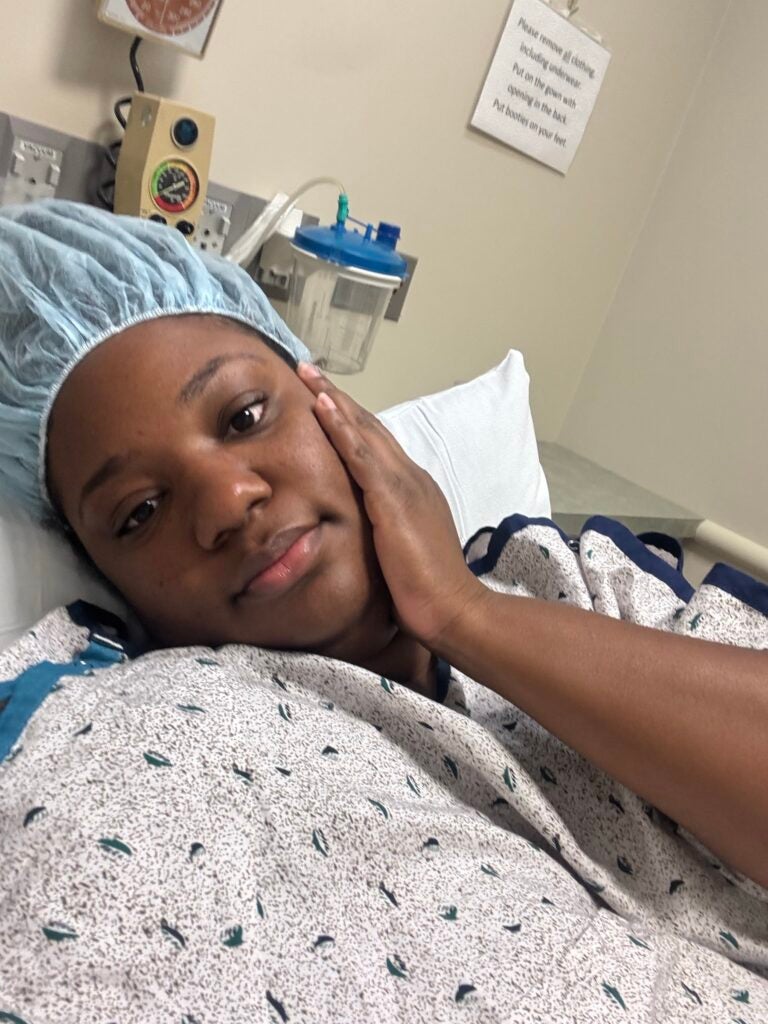 Janaylon Wright, of Philadelphia, had visited three emergency departments and an urgent care in 2022 before she was correctly diagnosed with Stage 3 colorectal cancer at age 29. (Courtesy of Janaylon Wright)
Wright tried all sorts of medications and home remedies to alleviate the problem, but nothing worked. Meanwhile, nearly five months had passed since she first felt the pain in her lower abdomen.
When she began to vomit water, which can be a sign of a serious bowel obstruction, Wright went to a fourth hospital. Accompanied by her grandmother and aunt, they were determined to not leave without answers.
Doctors at Jefferson Einstein Medical Center Elkins Park, which closed as a general hospital in 2023, ran a gamut of medical tests and imaging to rule out other causes before confirming a blockage in her colon.
“I was just honestly elated,” Wright said. “I was happy to feel like a person and get a real-life conversation about what is wrong with me.”
But that elation was short-lived. After a colonoscopy, a biopsy revealed that the blockage was actually a tumor. Specifically, adenocarcinoma, a common type of colorectal cancer. Doctors told Wright it was Stage 3, meaning that it was advanced.
“That was the moment when, I was in the car with my aunt, I cried like a baby,” she said. “Because there’s only four [stages]. There’s only four. And when you hear three, you feel like it’s the end.”
But Wright survived the horrible diagnosis, with the support of her boyfriend and family. After surgery to remove the tumor and six rounds of chemotherapy infusions, she was declared disease free. Four years later at 33 years old, she remains in remission.
However, she can’t help but wonder if her cancer could have been caught earlier, which may have saved her from time spent in pain and from invasive cancer treatment.
Did her young age lead doctors to discount the possibility of cancer prematurely? Was her pain too quickly attributed to reproductive health issues because she was a woman? Was her pain downplayed because she was a Black woman? These are the questions Wright asks herself when she looks back on her experience.
“These are all the things that I feel like not even just for myself, but for other people, can cause gaps in care,” Wright said.