
By Steve Jeffries
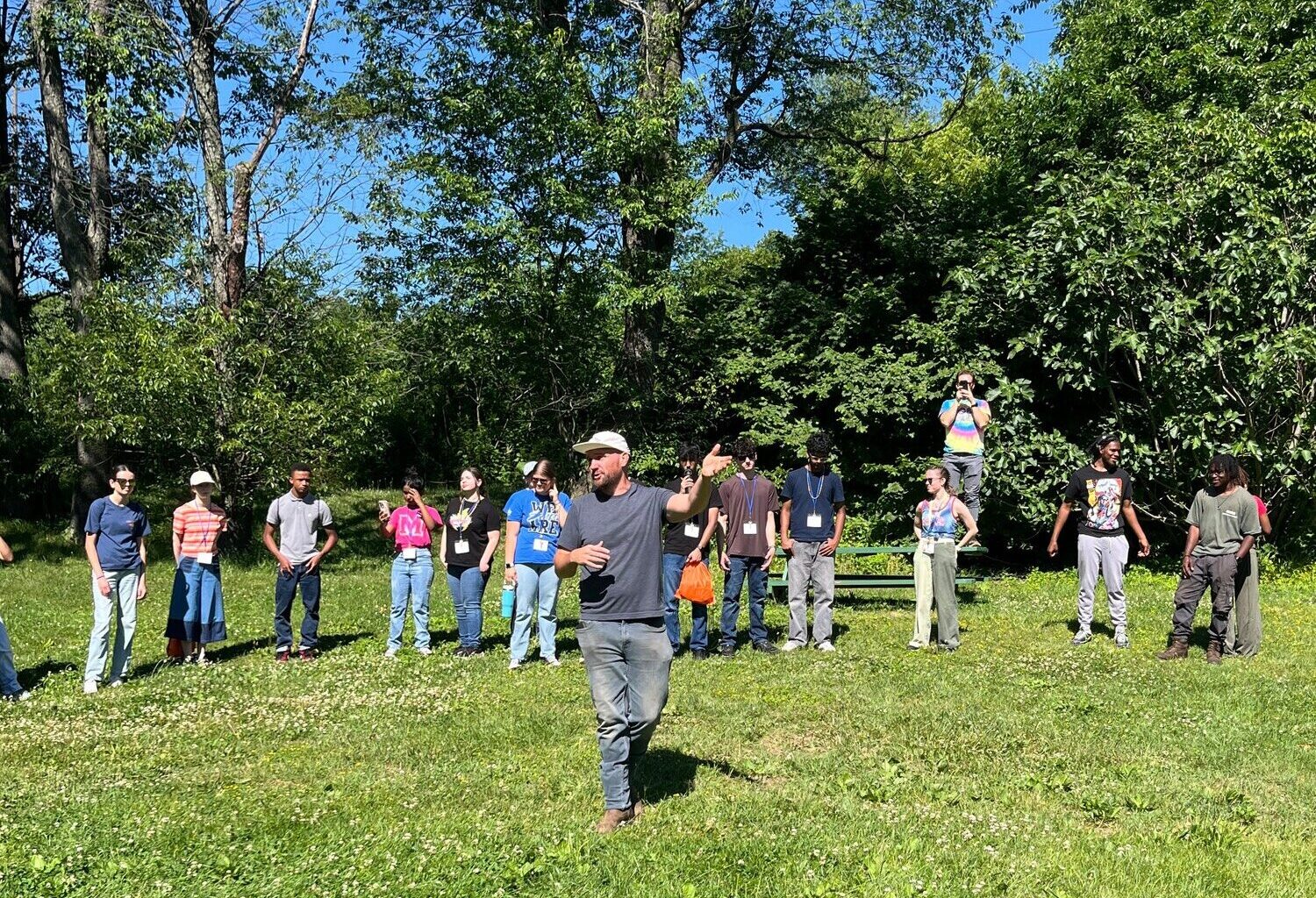
On the morning of June 15, Sankofa Community Farm in Southwest Philadelphia was alive with activity as farm staff, dozens of Hoby Youth Leadership students, and local volunteers prepared for a day of planting, cultivating, and maintaining the farm.
While the Hoby students joined for the day as part of their summer leadership program, Sankofa Farm regularly hosts workdays where the public can join the farm’s staff.
Sankofa Farm started as a partnership between the University of Pennsylvania, Philadelphia Horticulture Society (PHS), Bartram’s Garden, and the City of Philadelphia, and was founded by co-directors Chris Bolden-Newsome and Ty Holmberg.
Holmberg says the farm was first inspired when participants of the Agatston Urban Nutrition Initiative (AUNI), an organization that works with school groups in West Philadelphia to promote nutrition and food access, visited The Food Project in Boston, where 14 acres had been cultivated to make a youth-run farm.
“We started looking to see if we could do that here,” said Holmberg. “We had a meeting up here at Bartram’s for something else, but we saw this property was right on the trolley line. So we just cold called the executive director of Bartram’s at the time and made a proposal. And it just snowballed from there.”
PHS and Sankofa partner to maintain the farm’s greenhouse space. As part of the City Harvest initiative, seedlings and supplies are distributed to over 200 participating community gardens across the city.
Sankofa is nestled into the larger Bartram’s Garden space, which has a larger full-time staff that can focus on long-term development and funding. As employees of Bartram’s Gardens, Holmberg says Sankofa works hand-in-hand with the larger garden.
“They’re part of the community here,” said Holmberg. “Their partnership allows us to be talented and spend our time building relationships and not in payroll or writing grants all the time. It’s a really beautiful situation.”
Five elements make up Sankofa Farm — an education center, an orchard, community garden plots, the greenhouse and nursery space, and then the farm itself.
Three pillars of focus
The name Sankofa is derived from a saying from the Akan people in West Africa, loosely translating to the garden’s saying, “Go back and get it,” a call to reconnect with the land and culture. To this end, the garden is built upon its principles of being spiritually rooted, intergenerational, and connected to the African diaspora community.
“Education is built into everything we do,” said Holmberg. “We want that education to be around building self-reliance and community-reliant skills, so people can go and do for themselves — space for people to develop tools for self-reliance and food sovereignty.”
A foundation of self-reliance, according to Holmberg, is promoting local food sovereignty. Food sovereignty is when people have control over their food system and have agency and accessibility over the food that is within their community.
Accessibility is not only measured by the ability to find fresh, locally grown food — often difficult in Southwest Philadelphia — but also the cost of the food and its culinary and cultural accessibility. This means that food grown in the garden is part of the food traditions and diets of the neighborhood’s residents, many of whom are from Southern Black communities or from West Africa, the Caribbean, and Southeast Asia.
Holmberg says the focus on being culturally relevant means the garden stays responsive to what food people in the community are asking for and responding.
“Good partnership starts with authentic listening,” explains Holmberg. “So we listen to what food folks want to see. We’re one of the few places where people have access to their cultural crops like fresh black eyed peas or butterbeans or okra that’s grown right around the corner and not sprayed with chemicals.”
Additionally, Holmberg says that Sankofa offers a place for people to reconnect and rebuild their relation to the land.
“This is a space to come and work alongside people and understand and know your history, learn more about your cultural crops, and connect with people around you,” Holmberg says.
Volunteers
Sankofa is maintained and cared for by a combination of its full-time staff, student interns, community members, and other organizations like PHS and the Philadelphia Orchard Project. However, they also offer opportunities for the public to learn and help to keep the garden flourishing.
Andrew Toon and Kris Cardwell, originally from Texas but now living in South Philadelphia, both grew up helping relatives keep up their gardens. Toon says he found out about Sankofa from volunteering at the People’s Kitchen of Philadelphia.
“Someone that I was working with mentioned Sankofa Farms and volunteering,” said Toon. “I’ve wanted to come here for a while. I’m interested in people growing their own food and doing stuff that’s good for people and good for the environment.”
“I also wanted to learn how to garden and grow my own food,” added Cardwell. “But it’s also just important to get back to the roots of the community.”
Sarah Miller, from West Philadelphia, had been volunteering at Bartram’s Garden at the boathouse before she started helping at Sankofa. She said the commitment and dedication of the garden staff and student interns impressed her.
“What they do here is so life affirming and positive compared to everything else,” said Miller. “This was just so overwhelmingly hopeful and positive.”
Interns to teachers
Nia Shields is a former Sankofa intern, and started working at the farm when she was 14. Now having graduated high school, she is a staff member on the farm crew.
Sankofa’s internship program is highly selective and pulls many of its participants from Southwest Philadelphia and Bartram High School. Shields says applicants are interviewed and chosen very intentionally before being brought into the community.
“We think about how they’ll affect the group and about how each person will grow,” said Shields. “We think about whether each person is someone who is interested and open to learning.”
Sankofa organizes its interns into four groups tackling farming, market, cooking and special projects, each a core part of the garden’s operation. Interns rotate to each group to gain experience, before choosing a specialization, and eventually stepping into teacher roles.
Shields says for her, it was the farm crew that inspired her the most. In the fall, She’ll be attending Delaware Valley University to study plant and environmental science. She says the science lessons during her internship were what sparked her interest in restoring and protecting plants.
“There was a woman we called teacher Lex who ran farm crew,” Shields recalls. “She would always do science lessons and I was always so into it. I never realized how much I love science until I began working here. I learned that I loved learning. It pushed me to go where I wanted to go, and to go into environmental science and to study plant science.”
Through her years as an intern, then a teacher, and now a staff member, Shields says that her experience at Sankofa “changed me in every way,” from cultivating a new relationship to the natural world to overcoming anxiety of public speaking by pushing her out of her comfort zone.
“Not only did they teach me how to manage my emotions,” said Shields, “but they taught me how to understand what I wanted to do with my life, what I want my life to look like.”
As the volunteer day came to a close, the farm staff reconvened the day’s unusually large volunteer force. Holmberg encouraged them to stay connected and cognisant of the food they eat and the labor that goes into growing it, and to try and remain connected to their own food, family recipes and traditions.
“We say at the garden ‘as with the land, so with the people,’” said Holmberg. “There are lessons in the soil that we can also apply to life.”
MORE: Nonprofit aims to grow community through gardening in Kingsessing