
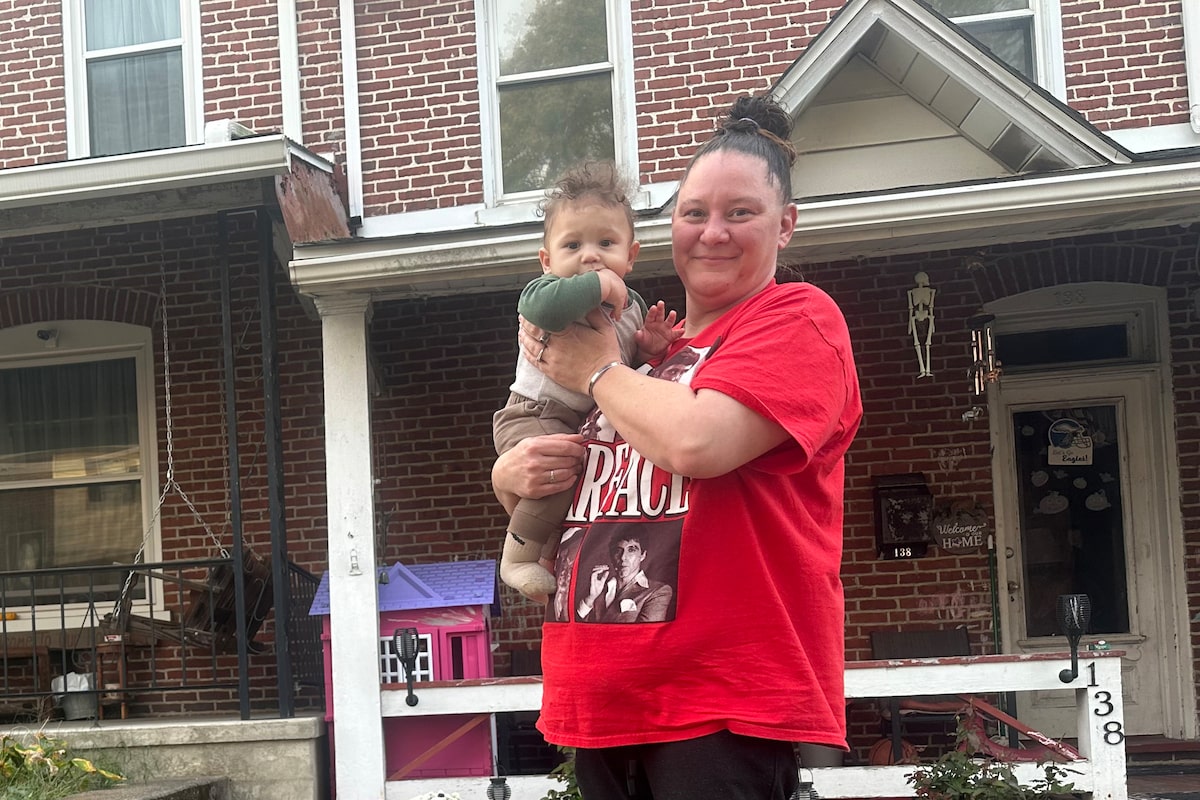
Last year, for the first time, Kerri Ketchledge voted for Donald Trump.
The 43-year-old in Birdsboro, Pa., could certainly use the cost-of-living decreases that the once and future president promised on the campaign trail.
A personal care aide, she is currently out of work and looking for a job. Her partner’s pay as a cook in a retirement home is the only income for her household, which includes two of their children and a grandson. She’s also helping her father, who is battling cancer, navigate the medical system.
Kerri Ketchledge, with her seven-month-old grandson, worries that cutbacks in the second Trump administration are ‘going to hurt a lot of people.’Adrian Morrow/The Globe and Mail
But since Mr. Trump returned to office, not only have prices not improved much, Ms. Ketchledge says the President is making them worse.
His signature One Big Beautiful Bill Act takes away US$930-billion from Medicaid, the government health insurance program for low-income Americans, and US$285-billion from food stamps.
His international trade wars, meanwhile, are expected to make a range of goods more expensive.
“The first time he was in office, he wasn’t bad. Now, he wants to cut everything,” she said as she sat on the front porch of her red-brick rowhouse, bouncing her seven-month-old grandson on her knee. “That’s going to hurt a lot of people.”
As she spoke, her son threw a football around with the boy next door. Neighbours gathered on the sidewalks to chat. A golden autumn sunset illuminated the hillside street.
“The prices were supposed to go down and instead it seems like they’re going up,” said David Hampton, a 67-year-old retired truck driver who also voted for Mr. Trump for the first time in 2024, as he leaned on the low wooden fence separating his front yard from Ms. Ketchledge’s.
“The rich get richer and the poor get poorer.”
Berks County, where you can find this Pennsylvania town, is one of the places that helped Mr. Trump return to the White House last Nov. 5. It gave him more than 55 per cent of its vote as he captured the country’s most populous swing state after losing it four years earlier.
A year after that victory, the people who supported him here evince a broad continuum of views. Some, such as Ms. Ketchledge and Mr. Hampton, feel the President is failing to live up to his promises. Many others cheer the speed with which he is implementing his sprawling agenda, particularly closing the border to migrants and launching a global trade war.
Still others – especially among the growing Latino community in Reading, the county’s largest city – are conflicted, backing Mr. Trump overall but uneasy with parts of his agenda, such as rounding up and deporting undocumented immigrants who have put down U.S. roots, worked hard and paid taxes.
A place of about 430,000 people nestled between steep hills and deciduous forests, Berks County has long navigated the vagaries of the changing industrial economy, the sort of location the President references when he talks about restoring American greatness.
In recent decades, it has also become a magnet for Latino immigration, a poster child for revitalization by people born elsewhere.
A world away from the country’s power centres, the confluence of these two currents places this county somewhere near the heart of the American experience.
The patrons of Homer’s Bar and Grill in Fleetwood were not shy about their support for Mr. Trump. They included retiree Jeff Ehret, at far right, and dental hygienist Sharon Wechezak, beside him.
Adrian Morrow/The Globe and Mail
On the main drag of Fleetwood, a 4,000-strong town in Berks County’s northeast, sits Homer’s, a smoky tavern whose dark, cozy interior is lit with strings of orange, green and blue LEDs. Along the bar one recent Monday, patrons expressed unmitigated support for the President.
“He’s kicking out all the people bringing drugs into the country. And he’s stopped all the wars, too,” said Mark Schwartz, a 58-year-old heating and air conditioning technician, referring to the U.S.-brokered ceasefire between Israel and Hamas, as he sipped a Modelo Especial. “He gets things done,” added Hope Schwartz, 53, an IT worker. “He’s not a politician.”
YMCA – Mr. Trump’s signature song – came on the jukebox. Local news played on the television. A young couple squeezed past to shoot billiards at the back.
Mitch Comes, 26, said he had seen the effect of Mr. Trump’s steel tariffs at the industrial parts company where he works. The price of a ball-bearing, for instance, has gone up by 70 per cent, he said. But to him, it’s worth it if it drives smelters to relocate to the U.S. “At the end of the day, the price increase has to happen to show that you can’t use foreign steel. You have to make your stuff here,” he said.
Jeff Ehret, a tall, broad-shouldered 65-year-old retired New York City firefighter with a grey flat-top crewcut added: “People gotta learn to buy things made in this country.”
The popularity of the President’s protectionism is easy to understand in Berks County. This place was built by Industrial Revolution prosperity in railroads, coal and manufacturing. It suffered a prolonged decline in the latter half of the 20th century, in part because of foreign competition. Today, long-abandoned factories dot the area – the Birdsboro steel foundry, the Reading Hardware Company, the Berkshire Boiler House.
Open this photo in gallery:Open this photo in gallery:
Pennsylvania’s steel makers are one of the constituencies Mr. Trump courted to return to power in 2024.MICHAEL MATHES/AFP via Getty Images
Mr. Trump’s clampdown on undocumented immigration is the other issue that comes up most readily.
“It had to be dealt with. It was horrible before – to bring millions of people into this country when you have our war vets living in the streets, and those are our people,” said Sharon Wechezak.
The 64-year-old dental hygienist is also concerned about affordability. She says she pays US$640 a month for her health insurance plan, which would be US$1,500 were it not for tax credits.
It’s the sort of thing that might put her on the same page as the Democrats. They are demanding that Mr. Trump’s Republicans agree to extend Obamacare credits due to expire at the end of this year as a condition for ending the federal government shutdown.
Ms. Wechezak, however, is certain that if the opposition party had its way, they would give money to undocumented immigrants. “Too many Democrats like too many wacky things.”
Nor does she have time for the argument that Mr. Trump, with his use of the Department of Justice to prosecute perceived enemies and his deployment of federal forces to major cities, is taking the country down the road to authoritarianism.
“The other side has a lot of nerve saying that after what they drug him through,” she said, referring to the four criminal prosecutions against Mr. Trump. “In Chicago, you see how much crime there is. The National Guard needs to go to these places.”
Gene Schlegel of Lyons turned away from the Democrats in the Obama era.Adrian Morrow/The Globe and Mail
Ms. Wechezak says she voted for Barack Obama in 2008 but was ultimately put off the Democrats by him. It’s a common refrain among Trump voters around the county.
Gene Schlegel, 69, grew up a Democrat and voted for the party for decades. “They were always known for being on the side of the people,” he said, standing on the back patio of his house in Lyons, the next town over from Fleetwood.
He was rankled, however, that Mr. Obama framed his presidency in racial terms as the first Black person to win the office. “It was this whole thing about the Black population and all he did was, ‘This is racist, that’s racist,’” said Mr. Schlegel, a retired cleaning company owner, who is white. It was enough to push him to the Republicans.
Today, he sees the continuation of the Obama era in diversity, equity and inclusion programs – the ones that Mr. Trump is now dismantling throughout the federal government.
More tangibly, he says, he’s happy that the prices of both gasoline and the oil he uses to heat his home have gone down over the past year. The proximate cause is OPEC increasing supply. But he and many others here relate it to Mr. Trump’s full-throated endorsement of drilling for oil.
“He’s trying to make things better for the people,” Mr. Schlegel said.
Reading is on the other end of Pennsylvania from Butler, where a would-be assassin grazed Mr. Trump’s ear last July. Memories of that event were fresh when Mr. Trump came to Reading a few months later, and his supporters faced off against Ms. Harris’s.
Jeenah Moon/Reuters
Feelings about Mr. Trump are more mixed in Pennsylvania’s big cities. Thousands came to Philadelphia’s ‘No Kings’ protests this past June and October.
Yuki Iwamura/AP; Matthew Hatcher/AFP via Getty Images
Since Mr. Trump returned to office, Raymundo Torres’s business has fallen by half at the Ave Maria taqueria in Reading. The threat of getting grabbed off the street by masked agents from Immigration and Customs Enforcement has many Latinos spending as little time as possible outside their homes.
“We’re shutting down Hispanic businesses because our customers are immigrants,” said Mr. Torres, 60, as he sat on a stoop in his north Reading neighbourhood, a dense grid of red-brick commercial buildings and rowhouses that wouldn’t look out of place in Brooklyn.
The restaurateur voted for Mr. Trump in 2024 after previously supporting the Democrats. For one thing, he liked Mr. Trump’s opposition to abortion. He also thought Mr. Trump’s experience as a businessman would be good for the economy. The potential effect of the promised mass deportations didn’t really factor in.
“I didn’t think about that,” said Mr. Torres, who immigrated from Mexico in 1984 and moved to Reading from New Jersey eight years ago. “He was talking about how the country was going to be good. He promised many things on the economy.”
Open this photo in gallery:Open this photo in gallery:
Raymundo Torres, top, gets fewer customers at Ave Maria taqueria in Reading. Many immigrant communities are warier of going out as ICE crackdowns escalate across the country.Adrian Morrow/The Globe and Mail
While Berks as a whole is more than two-thirds white, Reading, the county seat, is one of the most Latino towns in the U.S. Nearly 70 per cent of its 95,000 residents identify as such.
And they have revived the place. After losing population from the 1940s to the 1990s, Reading has grown again in the 21st century thanks to this influx, mostly driven by people leaving New York and other major East Coast population centres in search of a lower cost of living.
Despite losing Reading last year, Mr. Trump nonetheless improved on his 2020 performance by nine per centage points, mirroring his inroads with traditionally-Democratic Latino communities across the country.
Tony Pérez, the pastor at Iglesia Betania, a Hispanic Baptist church here, cites two reasons so many Latinos went over to Mr. Trump.
One was cultural conservatism, including opposition to what he terms “the gender ideology cult.” The other was the economy. “The Democrats kept saying ‘It’s not as bad as you think. Your eyes are lying to you.’ But we knew how it was.”
Mr. Pérez has his reservations about Mr. Trump – he doesn’t like the President’s penchant for insulting people, for example – but voted for him three times. “I’m not electing a pastor, I’m electing a president.”
GOP organizers set up a ‘Latino Americans for Trump’ office in Reading in June of 2024. Juan Ojeda, a Puerto Rican, was one of those who came to its grand opening.Joe Lamberti/The Associated Press
Pennsylvania is far away from the U.S.-Mexico border, and the U.S. Army vehicles that now patrol it, but immigration issues are still very present there.Jose Luis Gonzalez/Reuters
One of Mr. Pérez’s congregants, Samuel Gutierrez, recalled watching demand for his services as a trucker drop off and the price of diesel rise during Joe Biden’s presidency. The second problem has eased over the past year, he said, but he’s still waiting for the first to resolve.
An immigrant from the Dominican Republic who experienced the glacial pace of the family reunification green card system, it also rankled him to see crowds of people jumping the Rio Grande.
“We waited 14 years to get here,” the 33-year-old said. “So how does it feel when someone crosses the border without waiting in line?”
Ana Dole, a fellow Dominican immigrant, said she is “in the middle” on Mr. Trump after voting for him. The waves of people who entered under Mr. Biden caused “a huge crisis with resources,” she said, pointing to the funds New York City spent to house many of them.
Still, she feels Mr. Trump’s deportation campaign has gone too far. “Trump is focusing on the immigrant workers rather than focusing on the criminals like he promised,” said Ms. Dole, a 39-year-old human resources manager. She also knows U.S. citizens who have been detained by the immigration authorities.
Her husband, Frank Dole, doesn’t share their pastor’s discomfort with the President’s communications style. “That’s what makes him genuine. He doesn’t speak politically correctly, but he’s listening to the things we care about.”
The 40-year-old, who immigrated from Cuba 20 years ago, is also unconcerned that prices are still high. “You can’t magically fix things in a few months when it was in shambles.”
Mr. Torres was significantly less optimistic.
“The economy is bad,” he said on a sunny, dusky, Sunday late afternoon, as neighbours gathered on the sidewalk to play dominoes and a group queued to buy coconuts from a corner stand. “Is Trump going to fix it? No.”
Open this photo in gallery:The Trump era: More from The Globe and MailThe Decibel podcast
The killing of Trump ally Charlie Kirk supercharged a debate about American political extremism and free speech, and some young people in red states are eager to keep it going. How does U.S. law differ from Canada’s on those issues? The Decibel spoke with James L. Turk from the Centre for Free Expression to learn more. Subscribe for more episodes.
David Shribman on U.S. politics
Trump’s seizure of powers meets little pushback from Congress
In Israel, Trump is transformed from angry political combatant to happy warrior for peace
Donald Trump has done everything except unite Americans
Commentary on Trump’s trade feud with Canada
Shannon Proudfoot: What really enrages Trump in that Ronald Reagan ad he doesn’t want anyone to see
Stewart Beck: How Canada can use China as a hedge against Trump
Andrew Coyne: Canada’s only winning move with Trump is not to play