
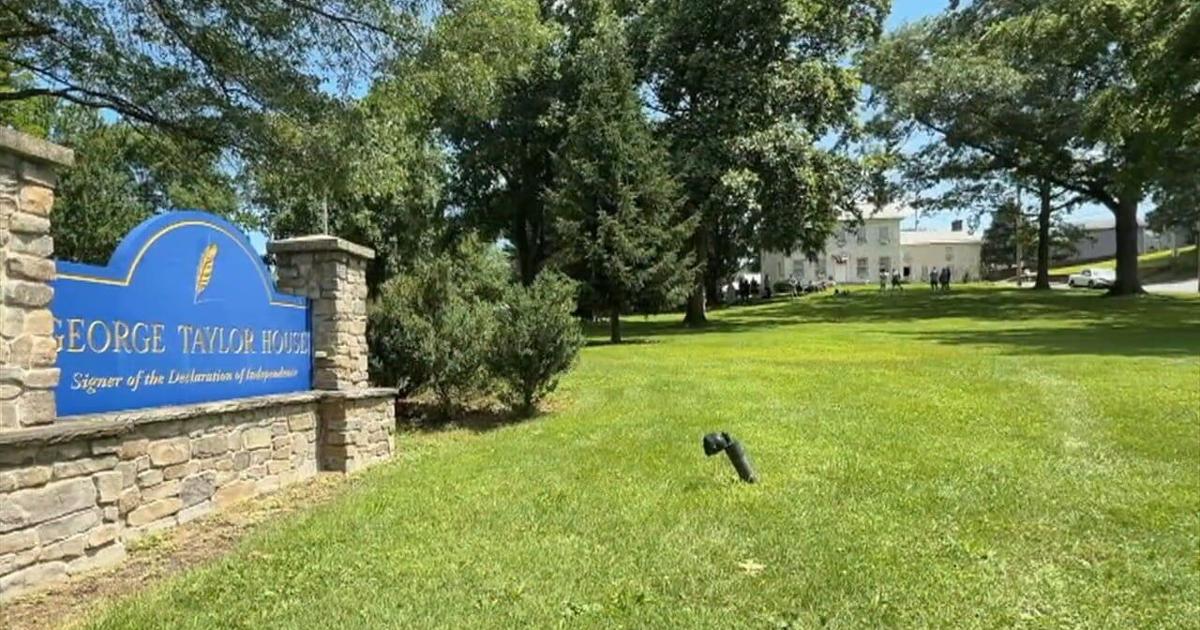
Every 4th of July at the historic home of Catasauqua’s George Taylor, people gather to hear a reading of the Declaration of Independence.
In 1776, it was formally adopted by most of the Continental Congress.
Delegates who didn’t agree were removed, including five from Pennsylvania.
Taylor was chosen as a replacement.
“George Taylor was our local patriot and also very integral to the Revolutionary War,” said Jill Youngken, Assistant Director and Chief Curator of the Lehigh Valley Heritage Museum.
Taylor came to Pennsylvania as an indentured servant from Ireland.
He rose to prominence as the iron master at Durham Furnace in Upper Bucks County before becoming a judge.
“He also provided the militia with gunshot and some cannon fodder, things that they needed as well. In fact, he pretty much went broke because of his contributions to the war,” said Youngken.
July 20, 1776, Taylor was sent to Philadelphia. Less than 2 weeks later, he became one of eight immigrants to sign the Declaration of Independence.
Today, Taylor’s home is open to visitors.
Volunteers keep Taylor’s legacy and heritage surrounding his home alive.
While most people who lived in the Lehigh Valley supported independence, one prominent figure did not.
William Allen, the founder of Allentown, was a loyalist.
“His views on the revolution were definitely, at first, sort of like his sons, which were, we don’t want to pay high taxes,” said Historian Frank Whelan.
But William Allen did believe the colonies should be represented in Parliament.
Allen pleaded with Parliament members to include the colonies, or there could be trouble.
His warnings were ignored, and when the war started, the Allen family sided with the crown.
William Allen left for England.
His son, James, stayed behind at Trout Hall.
James was outspoken about his views and met with a British Prisoner of war, which raised the ire of local patriots.
“He heard a knock on his door. This was in December of 1776 and the militia had surrounded all of Trout Hall, and they arrested him, and he had to go to Philadelphia and explain himself in front of revolutionary Council of safety,” said Youngken.
James Allen was forced to swear an oath of allegiance to the United States.
Today, Allen’s Trout Hall and the George Taylor house welcome a bounty of visitors who are all eager to learn about the role the Lehigh Valley played in Revolutionary War history.
Find out more about Allen and Taylor and the role the area played in the Revolutionary War by watching the WFMZ documentary of Lehigh Valley 1776 Saturday, July 4th at 6:30 on WFMZ TV.