
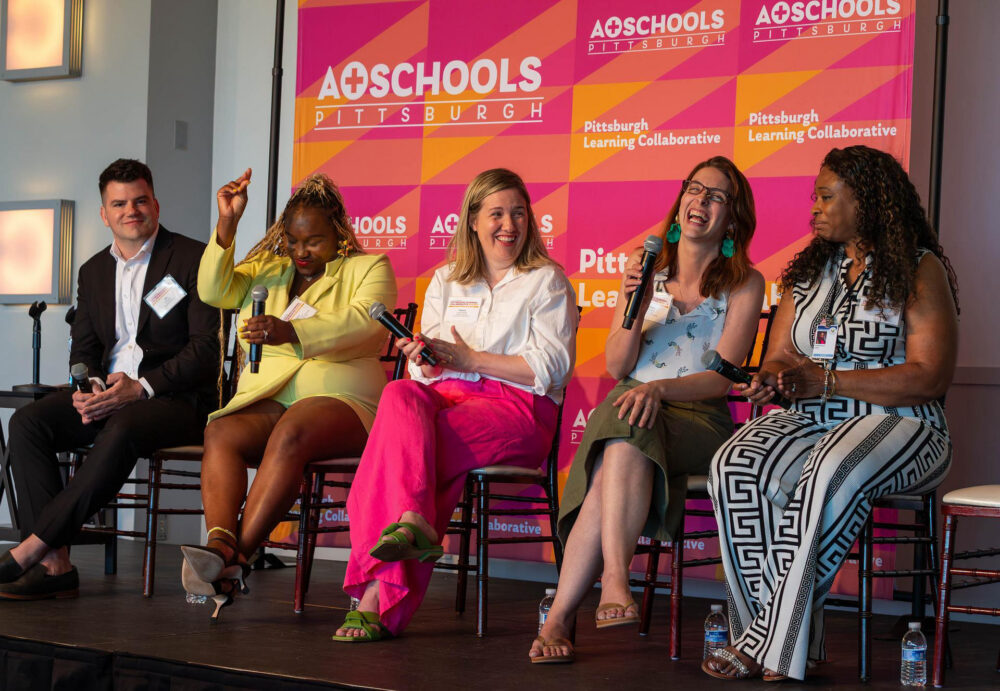
As the school year was ending in May, the team at A+ Schools hosted their fourth-annual Pittsburgh Learning Collaborative Summit. A group of elected officials, school community members and many other folks from the 130+ member Pittsburgh Learning Collaborative convened that day with a shared priority: Continuing the work of making sure every student in Pittsburgh gets to school every day.
Gathering together face-to-face gave these stakeholders a chance to connect, assess and plan for further progress in the battle against chronic absenteeism.
“One thing we have learned from convening the PLC for the past six years is that Pittsburgh is resource-rich — and we are stronger together than when we work in silos,” the PLC team said in an announcement about the summit. “This year’s Summit theme, Pathways Forward, was focused on how this Collaborative can move from shared understanding to coordinated action — aligning efforts across education, nonprofit, government and community sectors to better support students and families across Pittsburgh.”

Officials, including Congresswoman Summer Lee and her chief of staff, Wasi Mohommad, along with State Representative Lindsay Powell and Mayor Corey O’Connor, joined the group to explore solutions that tackle the root causes that prevent children from getting to school each day.
To help attendees drill down into that subject, the summit’s “Show Up for Schools” panel explored the coordinated, cross-sector approach that A+ Schools and its partners have been using to address chronic absenteeism. Panelists, including Councilperson Bob Charland, Pittsburgh Arlington Pre-K Principal Crystal Caldwell, Community Schools Coordinator Danielle Gill, parent Imari Payne-Ford, and Meghan Larsen-Reidy from Mary Queen of Peace Parish, looked at Arlington as an example of a school where progress is being made.
The key has been collaboration: With schools, families and community-based organizations communicating with each other about absenteeism and student needs, and then aligning their efforts to remove the barriers that get in the way of attendance for some kids, more of Arlington’s students made it to class each day last year.
The panelists shared good news about how this ecosystem approach is working, and they also spoke honestly about where challenges remain, and what it takes to sustain and scale positive impact.
 Conference participants had the chance to connect face-to-face, sharing ideas and inspiration. Photo courtesy of A+ Schools.
Visitors also had the chance to attend two breakout sessions. One, hosted by the Cincinnati-based organization All Children Thrive, explored key components of their successes and demonstrated their Social Ecological Model as a way to apply systems thinking to the challenge of chronic absenteeism.
Another, led by Carlow University, looked at ways to support students who have behaviors that interfere with their learning and attendance. Session participants spoke about culturally responsive PBIS approaches, which many school districts have begun embracing.
Again, the conversation was all about collaboration.
The consensus was clear: When students, educators, caregivers and support staff are all working together to create consistent, supportive environments, they see positive student growth and long-term school engagement. Looking ahead to the new school year, that collaborative work continues throughout the Pittsburgh region.