
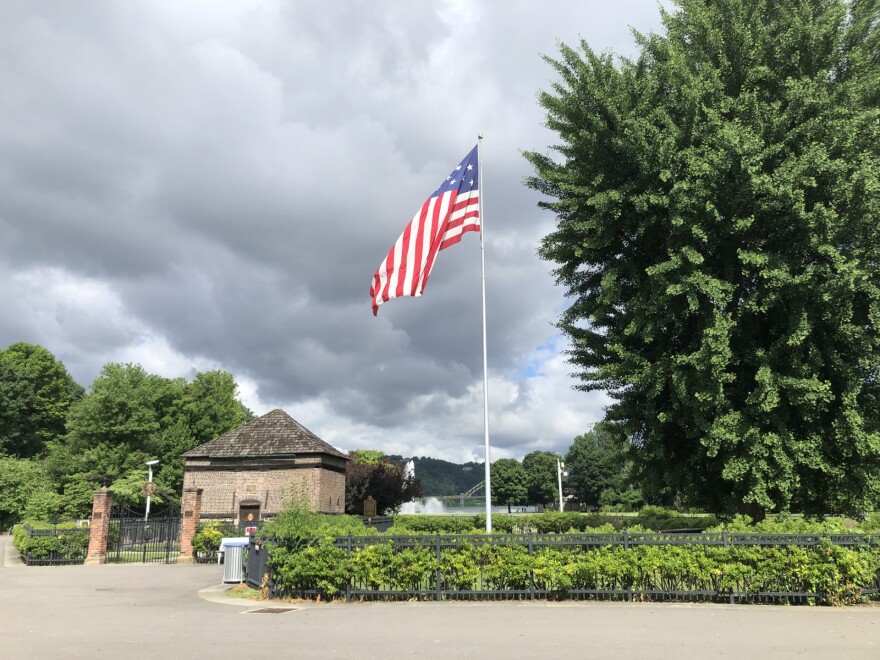
The Fort Pitt Block House, as many Pittsburghers know, is the oldest building in town. With this week’s 250th anniversary of the signing of the Declaration of Independence, it’s also worth noting it is the only extant structure standing when that auspicious document was signed on July 4, 1776.
It turns out the Block House, now located in Point State Park and owned by the Daughters of the American Revolution, is also a good place to recall what Pittsburgh was like at that time — even though, with 300 miles of dirt road between here and Philadelphia’s Independence Hall, folks at the forks of the Ohio likely wouldn’t have learned of the big signing party for a couple of weeks.
Last stop before wilderness
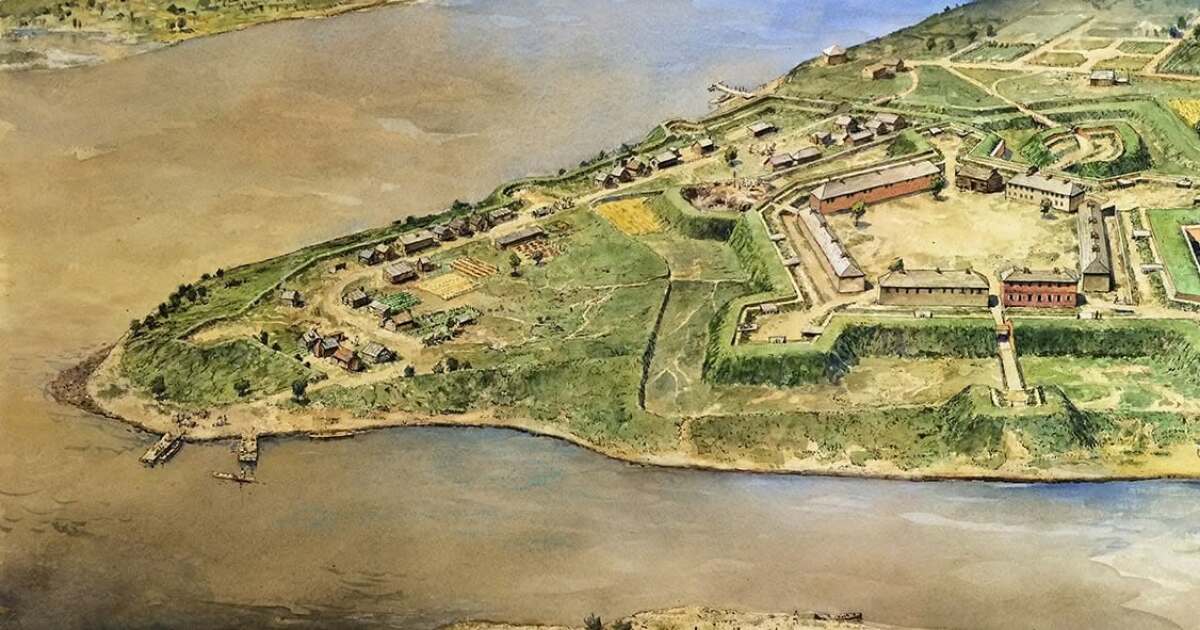
The Block House was built in 1764, a few years after the British constructed Fort Pitt as a garrison during the French and Indian War, a battle for control of the North American continent. It was the same year as the first lot map of what’s now Downtown was drawn.
Bill O’Driscoll
/
90.5 WESA
The Fort Pitt Block House as it appears today in Point State Park.
Both Fort Pitt and Pittsburgh were named for British statesman William Pitt the Elder. Pittsburgh was a big fur-trading post; the French and Indian war ended with King George III prohibiting settlement west of the Allegheny Mountains.
Native Americans in the region were a complex mix of peoples, many of them Eastern tribes, like the Shawnee and Lenape, earlier driven west by colonizers. But royal proclamations notwithstanding, settlers kept coming, and during Pontiac’s War, Shawnee and Lenape, seeking to drive out Europeans, besieged Fort Pitt.
Though they failed to take it, conflicts between white settlers hungry for new lands and Natives desperate to keep theirs remained a key backdrop to the Revolutionary War and its aftermath, said Mike Burke, assistant director of the Fort Pitt Museum, which sits on the old fort site.
At the time the war’s first shots were fired — in April 1775 in Lexington, Mass. — Pittsburgh consisted mainly of the remnants of Fort Pitt, which the British had abandoned in 1772, and a nearby village of a few hundred souls centered near the Monongahela River between modern-day Market and Stanwix streets from Fort Pitt Boulevard to the Boulevard of the Allies.
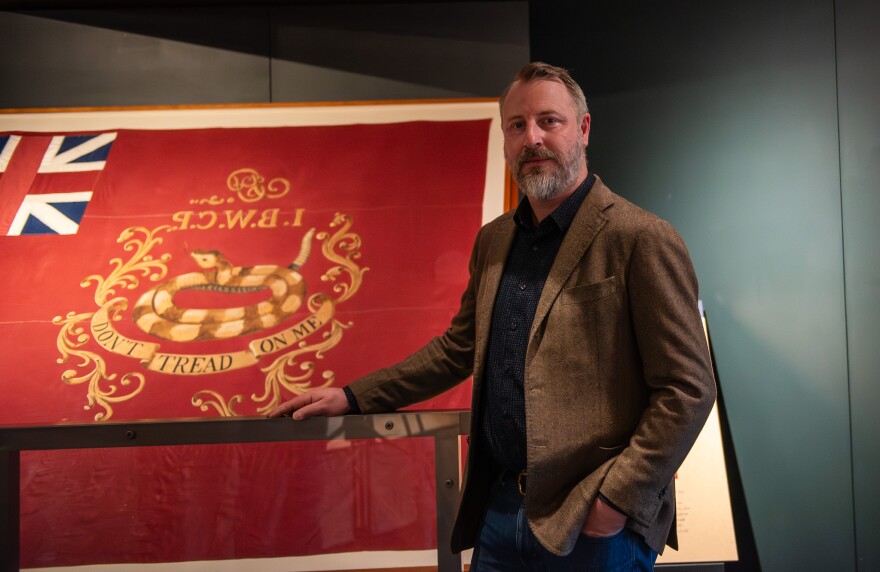
Mike Burke, assistant director of the Fort Pitt Museum, stands with a Revolutionary War battalion flag from Westmoreland County.
In those days before the Industrial Revolution, the small wooden homes were lit by hearth and candlelight. People fed themselves by hunting, raising livestock and growing produce, though Burke said they had to import anything manufactured, from iron tools to cotton cloth. Travel was by foot, horse, horse-drawn carriage and raft. The main gathering place was Semple’s Tavern, which George Washington had visited in 1770.
“It’s a pretty, you know, frontier town, but a kinda hopping, happening little place,” Burke said.
Most colonists in those days traced their ancestry to England or Scotland, though Pittsburgh in 1776 was likely also home to some Black people, both free and enslaved. The town was a fairly isolated outpost on the eastern edge of a huge swath of territory claimed by the Brits, but still largely inhabited by Native people.
“Here at Fort Pitt, it was, like, the last stop before you start getting out into the wilderness,” said D.J. Huff, a cultural consultant on the Fort Pitt Museum’s board of advisers whose ancestors include the great Seneca leader Cornplanter. (He is also related to Guyasuta, the Seneca leader whose likeness shares a sculpture with that of George Washington up on Mt. Washington.)
Native Americans, with villages up and down the rivers, frequented Pittsburgh too, trading deer and beaver skins for metal goods and cloth.
In those days, said Huff, “I think the trade between the Native people and the Europeans was at an all-time high.”
After the war broke out, some tribes were courted by the British. But most, as pro-independence factions preferred, remained neutral.
“I think the Iroquois Confederacy also probably thought that, you know, staying neutral would be beneficial to them because the way that it was looked at, it was kind of like a family quarrel, you know, like a father and son arguing,” said Huff. “Like, ‘That’s really none of my business.’”
Burke notes that white colonists were not unified on the issue, either. Pittsburgh was heavily pro-independence, he said: Battalions in nearby Hannastown were among the first to be raised against the British in 1775, and Pennsylvania and Virginia temporarily set aside a boundary dispute about who controlled these lands. (Pennsylvania claimed it for good in 1780.)
But some in the area remained loyalists. And, added Burke, “I think there’s a large swath of people in the middle who are just kind of waiting to see which direction the winds are gonna blow, and kind of hedging their bets and not being very vocal about one side or the other.”
Pittsburgh forever altered
Though most of the military action was far from here, Pittsburgh did play a role in the Revolutionary War. And the war permanently changed Pittsburgh.
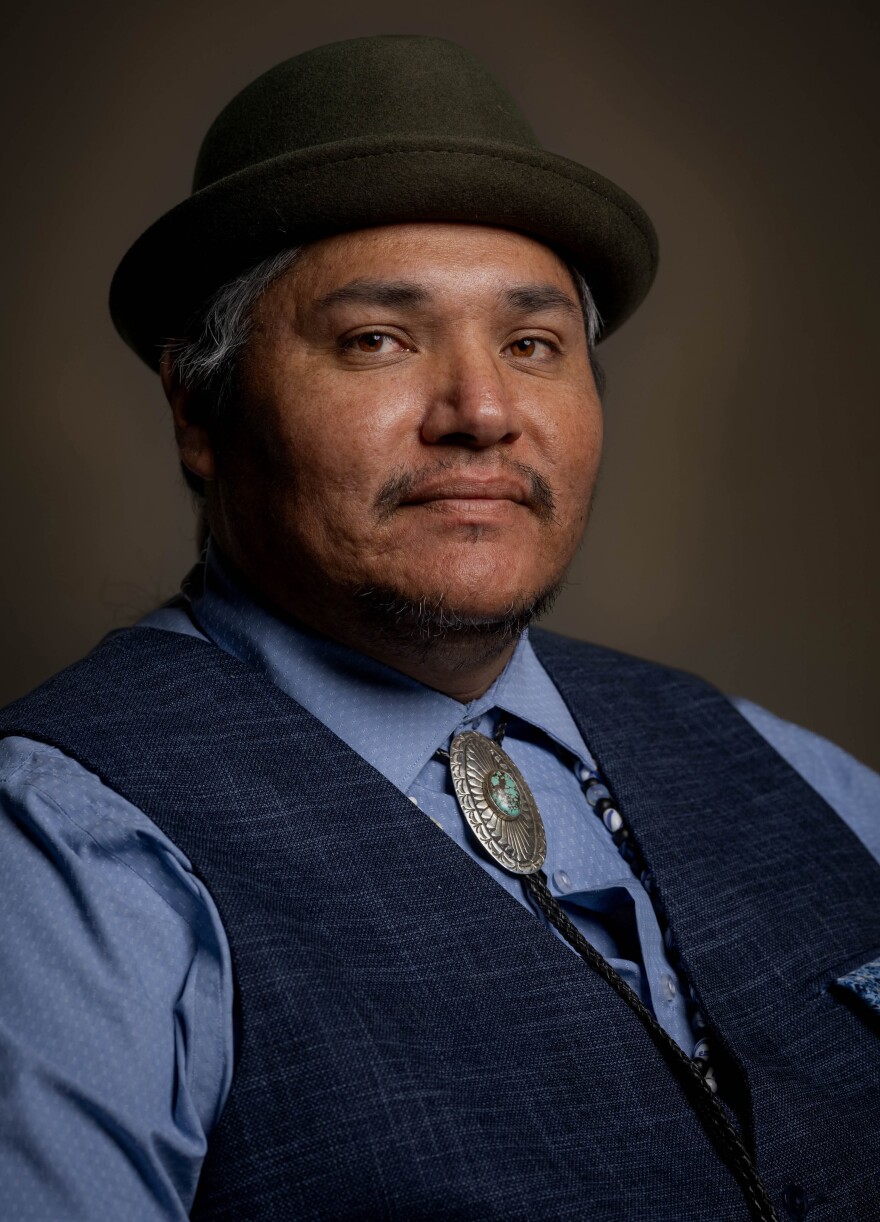
D.J. Huff is a cultural consultant and a direct descendant of Seneca leader Chief Cornplanter.
Fort Pitt, so recently abandoned by the British, became what Burke calls “the command center for the war west of the colonies.” Among the highlights of the museum’s new permanent exhibit, “Pittsburgh’s Revolution,” is a wall-sized reproduction of an astonishingly detailed 1770s British map that depicts the terrain. It ranges north to Lake Michigan, west to St. Louis, about 1,000 miles down the Ohio River and 1,000 miles more to New Orleans.
They weren’t kidding about New Orleans. The exhibit notes Fort Pitt as the launching point for two military expeditions to the Mississippi delta, then still under French control. One, in 1775, brought back 9,000 pounds of gunpowder. And in 1777, another was led by a naval captain named James Willing.
“They go down the Mississippi, they raid loyalist plantations, they capture lots of goods,” Burke said. “They capture enslaved people down there, not to liberate them, but to sell them in New Orleans. And so they just, you know, kind of leave this trail of chaos down the Mississippi.”
“If they weren’t in government service, we’d probably call them pirates,” he added.
Other campaigns today appear similarly ignoble. Continental Army forces repeatedly sought to drive Native people from the region. Among the most infamous attempts was a 1779 campaign led by Brigadier Gen. Daniel Broadhead that destroyed Seneca villages up the Allegheny valley.
The military actions echoed the will of many settlers, Burke said.
“They’re looking to the West, and they are very much interested in settlement, and the outcome of this war is going to determine exactly the shape of that settlement for the decades to come,” he said.
In 1778, Fort Pitt was the site of the signing of the Treaty of Fort Pitt, the first ever such agreement between the new Continental Congress and a native nation, the Lenape. But the colonists violated it “almost immediately,” said University of Pittsburgh history professor James Hill.
Hill said years of settler expansion into what’s now Ohio, Kentucky, Virginia and West Virginia had set a pattern. “By this point it’s kind of hard to put the genie back in the bottle, so to speak, with regard to colonial incursions on Native peoples and attacks on Native peoples,” he said.
Huff said to this day, Native people sometimes refer to the U.S. president — any U.S. president — as “Destroystown,” a name they first bestowed on Gen. George Washington.
‘A firmly American settlement’
The Declaration of Independence proclaimed “all Men are created equal.” But the fact that it didn’t mention Natives except to demonize them as “merciless Indian savages” was ominous. By war’s end, Burke said, hardly any Natives remained in Pennsylvania.
Bill O’Driscoll
/
90.5 WESA
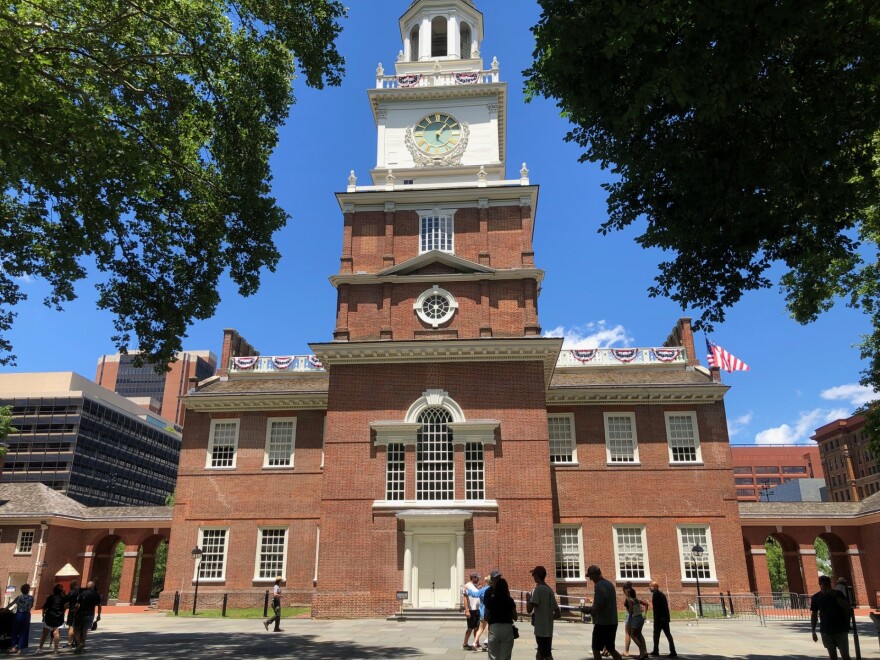
Independence Hall, in Philadelphia
“This becomes a firmly American settlement, and native people are pushed kind of far to the north and west as a result of the Revolution,” Burke said.
“There were stories that we have back home about this area in the 18th century, and none of it was good for us,” says Fort Pitt Museum cultural consultant Huff, who lives on the Cattaraugus Reservation in upstate New York, south of Buffalo.
Huff is a direct descendant of Chief Cornplanter, who in 1796 was granted 1,500 acres of former Seneca territory some 140 miles north of Pittsburgh. But even that was taken away in the 1960s, when the U.S. government flooded the land after opening of the Kinzua Dam.
Likewise, history tends to elide the role of Black Americans in early Pittsburgh. While the Declaration similarly did not address the estimated half-million enslaved Black people who made up about 20% of the colonial population, thousands of free Black people fought for the colonists.
Burke said one free Black Pittsburgher was on a militia roster at Fort Pitt in 1778. His name was Charles Richards, and Burke said he was a manager and seller of livestock who “later becomes a prominent tavern owner along with his son, and becomes one of the kind of key pillars of the early Black community here in Pittsburgh.”
Richards was also among the signatories of the 1787 petition to create Allegheny County.
“And so he’s right there with all the other community leaders, you know, who are kind of helping to move Pittsburgh forward after the war,” he said.
On Saturday, July 4, the Fort Pitt Museum hosts “Fourth at the Fort” events. On Saturday, July 11, the museum convenes the “1776 Symposium: The Revolution in the West,” a day-long program of presentations by historians, authors and historical interpreters.