
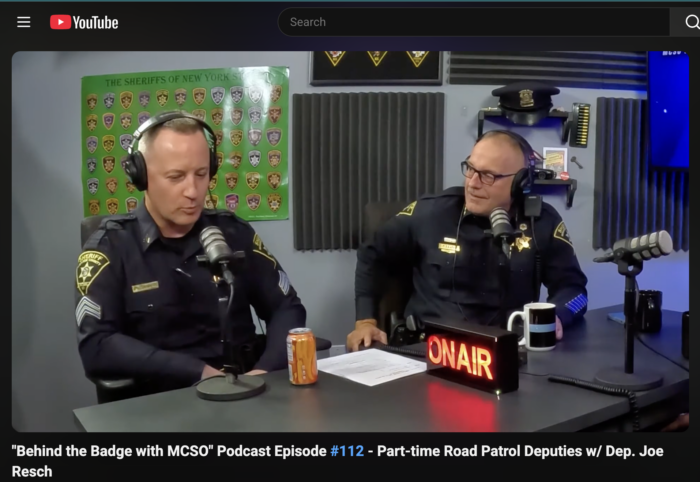
Monroe County’s sheriff last year accused Michael Zamiara of felonies and misdemeanors. Six months later, Erie County Sheriff John Garcia gave him a job anyway.
By J. Dale Shoemaker and Geoff Kelly
Last spring, Monroe County’s sheriff accused a sergeant in his jails division of illegally accessing confidential medical and internal affairs files more than 130 times.
The sergeant resigned before he could be punished. Less than six months later, Erie County Sheriff John Garcia hired him as a part-time guard at the county jail in Alden.
Garcia’s office has refused to discuss the hiring.
Michael Zamiara, according to a 2025 investigation obtained by Investigative Post, illegally accessed medical records five times and internal affairs files 137 times. He did not have permission or authority to do so, according to departmental charges leveled against him in April 2025. Accessing the medical files constituted a felony, while accessing the other files amounted to a high-level misdemeanor, investigators for the Monroe County Sheriff’s Office concluded.
Both classes of crimes can result in fines and prison sentences. Zamiara’s actions also violated the internal policies of the sheriff’s office.

Zamiara, 43, was neither charged nor disciplined. Instead, he was first placed on paid leave while the Monroe County Sheriff’s Office investigated, three sources told Investigative Post. He was then permitted to resign. The sheriff’s office never charged Zamiara, nor made any referrals to the Monroe County District Attorney, according to spokespeople for both agencies.
In November, Erie County Sheriff John Garcia hired Zamiara as a correctional officer. He’s currently assigned to the county jail in Alden. The part-time salary is $18,945 per year, according to a March payroll record obtained by Investigative Post.
In 2024, Zamiara made $121,965 working for Monroe County.
Rachel Barnhart, a Monroe County legislator, said the case raises numerous questions that neither Garcia nor Monroe County Sheriff Todd Baxter have answered.
“We don’t know what Monroe County told Erie County, if anything,” Barnhart said. “There are so many questions here. These are … alleged crimes. Why weren’t the authorities notified that this happened? This just didn’t happen once. This happened dozens of times.”
Neither Zamiara nor Baxter responded to requests for interviews from Investigative Post. In a statement, David Marcucci, a spokesperson for Baxter, said the sheriff’s office conducted a “thorough and lengthy investigation,” that the sheriff “proceeded with the disciplinary process” but that Zamiara “resigned during the disciplinary phase of the internal investigation.”
Asked why the sheriff’s office never charged Zamiara, despite finding that he’d broken the law, Marcucci said the department conducted an internal investigation only, which he said carries a lower evidentiary burden than a criminal investigation. Calli Marianetti, a spokesperson for the Monroe County District Attorney, said the sheriff’s office never referred the case for prosecution.
Garcia, the Erie County sheriff, did not respond to an emailed interview request or to a message left on his cell phone.
Christopher Horvatits, a spokesperson for Garcia, also declined to comment on the hiring. He said in an emailed statement the Erie County Sheriff’s Office “conducts a robust background investigation of each job applicant” including administering a test, checking an applicant’s criminal history and speaking with their former employers.
Jason Haynes, a retired Monroe County Sheriff deputy who had his medical files accessed by Zamiara, told Investigative Post he remains unsatisfied. He said Baxter’s administration did not properly investigate Zamiara.
“I’m pissed off, man. He went into my files,” Haynes said.
“You gave him another job down the road. To me, that’s just corruption right there. That’s not discipline.”
Who is Michael Zamiara?
Three Monroe County Sheriff’s Office sources who spoke with Investigative Post described Zamiara as an ally of Baxter who the sheriff protected.
Hired in 2005, Zamiara was a jail deputy who rose to sergeant over the past two decades. The sources said, however, that Zamiara earned a reputation for nitpicking colleagues’ work and “creating a hostile work environment.”
“He was usually on the radar of jail administration,” one source, a retired sheriff’s deputy, told Investigative Post. “They were always at odds. So the sheriff reassigned him to himself.”
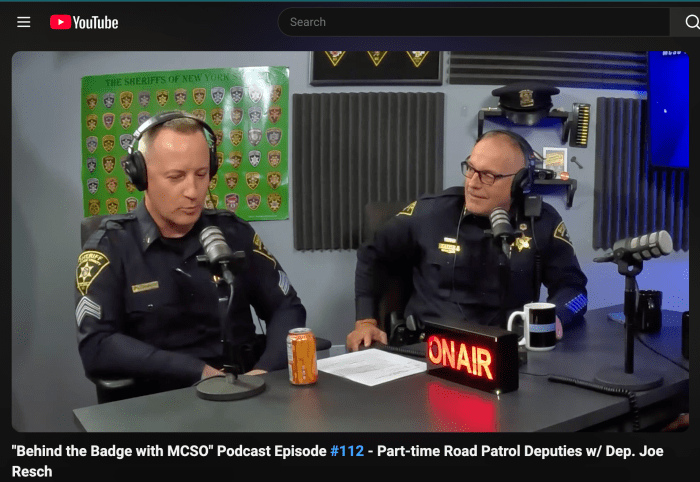
Michael Zamiara, left, with Monroe County Sheriff Todd Baxter on the sheriff’s podcast.
Zamiara began serving as “Sheriff’s coordinator” in January 2022. His duties included co-hosting Baxter’s podcast, “Behind the Badge.” His predecessor in that role, Captain John Kennedy, would assist the Internal Affairs division with its investigations, sources said.
When Zamiara took over the role, he maintained that file access. Marcucci, the spokesperson, said he did so “without permission.”
What happened
Zamiara was caught by accident.
In 2024, a different issue in the Monroe County Jail prompted an audit within the Sheriff’s Office to determine which employees had access to the department’s different file systems. It was during that review that someone noticed Zamiara had been accessing and downloading Internal Affairs files.
“During an internal audit of computer usage, we discovered then-sergeant Zamiara may have accessed files without permission,” Marcucci, the spokesperson, said.
A monthslong Internal Affairs investigation ensued. Investigative Post, through a source, obtained a copy of the 54-page report. The findings were extensive.
Over a six-month period from May 31 to December 13, 2024, investigators found that Zamiara routinely used his access to internal file systems to look up medical and disciplinary files of colleagues. In April 2025, the investigation concluded he’d illegally accessed medical files on five occasions and disciplinary files more than 130 times.
Several charges indicated Zamiara downloaded files, including body-worn camera footage.
Zamiara’s unlawful access to files, however, spanned his tenure in the Sheriff’s Coordinator role, according to the sheriff’s investigation.
“You engaged in a course of conduct both on-duty and off-duty that was unauthorized between January 2022 and September 2024,” the report concluded. “During said time, you knowingly used erroneously given Monroe County computer network permissions to access MCSO files … which you knew were not part of your job description or official duties to access.”
After being confronted by his superiors, Zamiara confessed to knowingly and illegally accessing the internal affairs files, according to the report.
“Shortly after starting your assignment, you admitted you knew your computer access [to the file systems] … was erroneously given to you,” the report continued. “At that point, you failed to ask for clarification to the nature of your computer access permissions, or bring light of the error to your supervisor for direction and correction.”
Subscribe to our free weekly newsletters
Sources told Investigative Post that those who had their files accessed by Zamiara were sent an email by Sheriff’s Office leadership notifying them of what had happened. Each person was then permitted to meet with leadership to discuss the breach of confidentiality.
Haynes, the retired deputy, took the meeting. He said he questioned leadership about what investigatory steps were taken. He wanted to know, for example, if Internal Affairs had searched Zamiara’s personal laptop and phone to determine if he had kept any of the files he’d accessed and downloaded. The answer: no. The investigation ended after Zamiara admitted his wrongdoing.
“There was no investigation,” Haynes said. “There was a questioning. That’s not an investigation. There’s a big difference.”
Zamiara was placed on paid leave during the inquiry, sources said. Pay records indicate he made $121,000 in 2024. The investigation concluded in April 2025 and he left the following month.
The problem of ‘wandering officers’
In New York, law enforcement officers must be trained by the agencies that hire them in order to be certified for employment.
Should an officer resign or be fired in connection with allegations of misconduct, the state strips their certification, preventing them from working elsewhere.
That’s what happened to Zamiara. But under state rules, he was then permitted to regain certification to work in Erie County.
Such decertifications are tracked by the state Division of Criminal Justice Services, which maintains a database to track decertifications.
An officer’s training certificate “is immediately invalidated when an officer is removed for cause for misconduct,” according to the division’s website, or when “an officer has resigned or retired subsequent to, or in connection with, allegations of misconduct.”
The database is meant to help the state’s 528 law enforcement agencies know who they’re hiring. Over the past decade, 1,805 officers have been decertified. That includes 18 officers from the Erie County Sheriff’s Office and four from the Monroe County’s Sheriff’s Office.
But the measures in place don’t always succeed in preventing problem officers from jumping from one department to another, as chronicled in a series of recent reports by the USA Today Network in collaboration with the S.I. Newhouse School of Public Communications at Syracuse University.
In his statement to Investigative Post, Baxter said he reported Zamiara’s resignation to the state, as required by law.
Kirstan Conley, a spokesperson for the Division of Criminal Justice Services, confirmed that Zamiara’s departure was reported “as a removal for cause” on May 23, 2025.
Decertification of police officers for misconduct is permanent in New York, thanks to a 2021 law. However, Zamiara, as a jail guard, previously was certified as a peace officer — a different category — and thus was eligible for re-training and recertification.
Garcia, Erie County’s sheriff, refused to say when and how Zamiara was hired, and whether he knew Zamiara had resigned his previous job under a cloud.
However, Conley, of the state Division of Criminal Justice Services, confirmed Zamiara was hired by Garcia’s office as a corrections officer Nov. 1 of last year. On Dec. 16, he “successfully completed the Basic Course for Correction Officers,” Conley wrote in an email, thus earning recertification.
One retired sheriff’s deputy questioned how Zamiara could regain certification.
“We’re like, ‘Wait a minute. That’s impossible,’” the deputy said. “How do you take a guy who did criminal activity so bad that he was forced to resign with 20 years on, and he could pass the background [check]?”
There is pending state legislation that aims to button down the vetting process for cops. The “Wandering Officer Act” — introduced in April 2025 by state Sen. Cordell Cleare of Harlem — would prohibit “provisional or permanent appointment” of any job candidate who was previously fired by or resigned from a law enforcement agency in any jurisdiction as a result of disciplinary actions or criminal charges.
The bill remains in committee.
posted 2 days ago – July 1, 2026