
The ways that famous Pittsburghers such as Andrew Carnegie and H.J. Heinz shaped the world of industry and commerce are well known, but Southwestern Pennsylvania has also been a major force in the arts and culture world throughout its history.
From songwriters to playwrights to artists to actors, Pittsburgh’s native-born icons have started movements, made headlines and taught generations of kids to be kind.
Stephen Foster
It may be surprising to learn that the Lawrenceville neighborhood of Pittsburgh is essentially the birthplace of American music.
Stephen Foster’s compositions live on in songs including “Oh! Susanna” and “Camptown Races,” which are still popular today. He was born exactly 200 years ago, on July 4, 1826, in Lawrenceville, the son of early Pittsburgh pioneer merchant William Barclay Foster.
After briefly attending Jefferson College in Canonsburg, Foster began publishing songs in the early 1840s while also going into business with his brothers. According to “The Life and Times of Stephen Collins Foster” by Christopher Lynch, head of the Theodore M. Finney Music Library in the University of Pittsburgh Library System, many of Foster’s songs were minstrel songs that were often disparaging toward Black people.
“Foster’s minstrel songs, which he began to write in the mid-1840s, if not earlier, drew on the stereotypes of African Americans that he encountered in these early songs,” Lynch wrote.
Foster penned “Oh! Susanna” at the age of 21 and continued to travel and gain new musical experiences. He published scores of songs after that song became massively popular and widely printed as a “parlor song” throughout the nation.
After much travel, Foster would eventually settle in New York City. He died in 1864.
Mary Cassatt
Impressionist painter and printmaker Mary Cassatt may be most associated with French artists, but she was born in what is now Pittsburgh’s North Side in 1844.
Cassatt began traveling Europe in 1865 and showed her first painting, “A Mandolin Player,” at the Paris Salon in 1868, according to the National Museum of Women in the Arts. She caught the eye of famous French artist Edgar Degas in 1877 and began to show her work with the Impressionist painters of the day.
Cassatt concentrated on images of women and children, often examining the bond between mother and child. One of these pieces, “Mother and Two Children” (c. 1905) has been in the permanent collection of the Westmoreland Museum of American Art since it was donated in 1979. It is one of the most popular pieces in the museum’s collection and was heavily featured during the museum’s Year of Women Artists throughout 2025.
According to the Smithsonian American Women’s History Museum, Cassatt was one of only three women and the sole American to exhibit with the Impressionists in France.
Nellie Bly
Speaking of pioneering women, Elizabeth Cochran — pen name Nellie Bly — was born in Cochran’s Mills, now Burrell Township, in 1864 and turned the world on its ear as a journalist. With perseverance and panache, she elevated investigative journalism to a new level.
As a young woman, she worked at a boarding house in Pittsburgh and first broke into writing after responding to a misogynistic column in the Pittsburgh Dispatch in 1885. The paper hired her and, in fact, gave her the pen name “Nellie Bly” after a song of the same name by Stephen Foster.
The newspaper relegated her to the women’s section, so she headed to New York City instead, taking a job with the New York World. In her time there, she had herself admitted to an insane asylum for the poor and spent 10 days observing the conditions so that she could shine a light on them. She eventually published a full book, “10 Days in a Mad House.”
But Bly is best known for her 72-day-long trip around the world in 1889. The trip was intended to beat the fictional record in Jules Verne’s popular novel “Around the World in 80 Days.”
It also proved that women could travel just as well as men.
Gene Kelly
You may not picture Pittsburgh when you watch Gene Kelly splashing through a downpour in the 1952 musical film “Singin’ in the Rain,” but the legend of dance and performance was born in 1912 in Highland Park.
Kelly first enrolled in dance classes at the age of 8. He graduated from Peabody High School and the University of Pittsburgh and eventually opened the Gene Kelly Dance Studio with his large family.
Taking on dance as a serious profession, he moved to New York City and made his big Broadway debut in “Pal Joey” in 1940. His star rose quickly as his vast abilities as a triple threat drew widespread attention.
While “Singin’ in the Rain” was Kelly’s most famous role, he is remembered for other MGM musicals such as “Anchors Aweigh” (1945) and “The Pirate” (1948).
Kelly is also known in Pittsburgh as the namesake of the Pittsburgh CLO’s Gene Kelly Awards for Excellence in High School Musical Theater. Since 1991, the awards have been presented annually to high school musical productions throughout Allegheny County.
Fred Rogers
It may be obvious, but no list of important local cultural figures would be complete without WQED’s “Mister Rogers.”
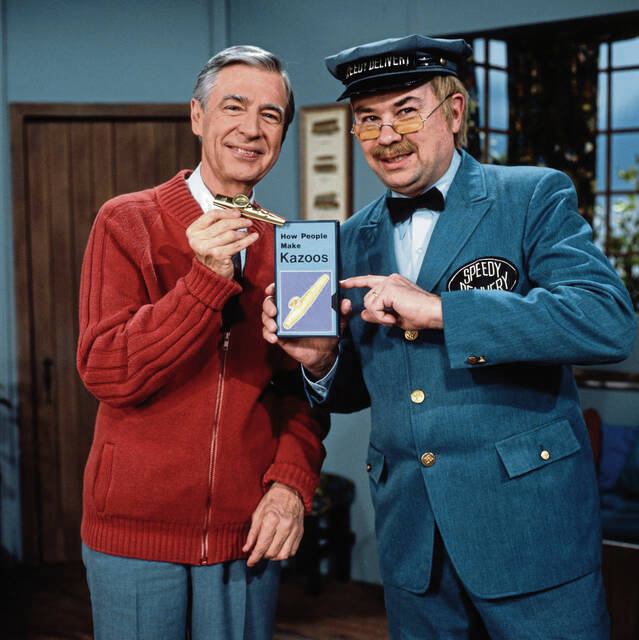
Born in Latrobe — where he is still celebrated annually to this day — Rogers was the longtime host of the public broadcasting program “Mister Rogers’ Neighborhood,” a show filled with education, puppets, empathy and a lot of cardigans.
Rogers held degrees in music and in divinity. He began his career in public television in Pittsburgh in 1953, and “Mister Rogers’ Neighborhood” began airing nationally in 1968. In 1969, Rogers spoke to a U.S. Senate committee in a plea for the importance of funding public television.
In that address, he said, “I end the program by saying, ‘You’ve made this day a special day by just your being you. There’s no person in the whole world like you, and I like you just the way you are.’ And I feel that if we in public television can only make it clear that feelings are mentionable and manageable, we will have done a great service for mental health.”
Rogers’ kindness has been his legacy, with the concept of “look for the helpers” becoming especially popular in times of crisis. He is the subject of a USPS stamp, an exhibit at the Heinz History Center in the Strip District and the 2019 film “A Beautiful Day in the Neighborhood,” in which Tom Hanks portrayed Rogers.