
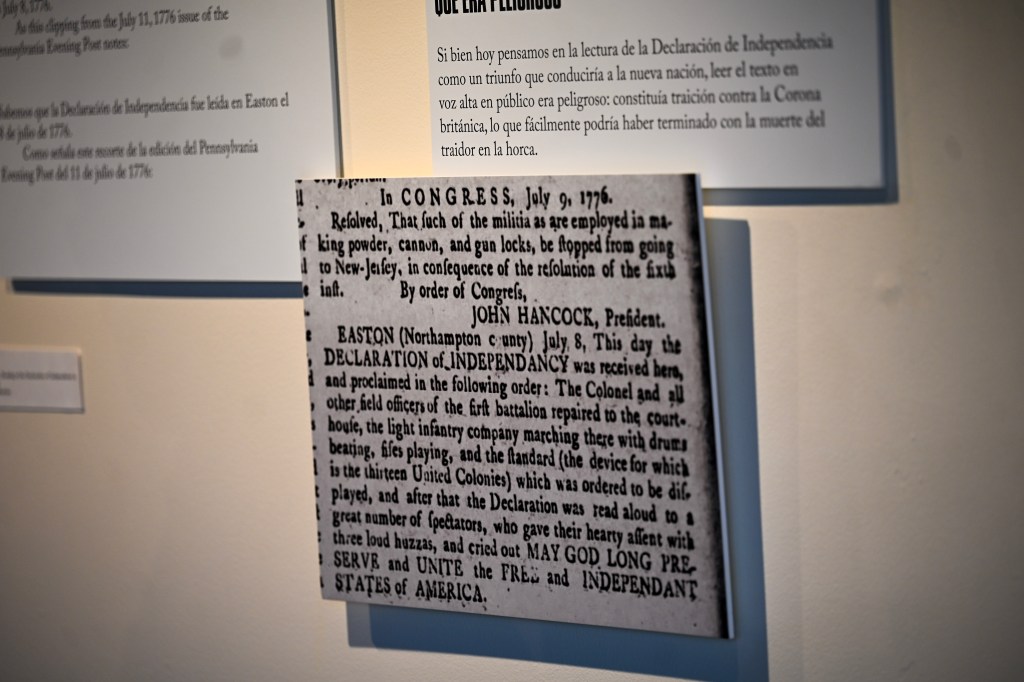
The July 8, 1776, reading of the Declaration of Independence on the steps of Easton’s courthouse is celebrated each year with great fanfare, including a Heritage Day reenactment on Centre Square.
The event cemented the Lehigh Valley’s importance in early American history, and the story of Northampton County Clerk Robert Levers bravely risking arrest for treason by reading the document proclaiming the colonies’ determination to break free of England’s grip has been retold for 250 years.
But what if much of what we know about the reading is wrong?
That’s the question posed by researchers at Northampton County Historical and Genealogical Society’s Sigal Museum in Easton. In an ongoing exhibit, “Read This! The History of Media in Northampton County, exploring the power of print, information, and misinformation in Northampton County during the American Revolution and beyond,” historian Tim Betz is poking holes in the long-told story.
Betz, the museum’s curator of exhibitions and programming, has spent years researching the reading and found only a single document describing the event — a short Philadelphia newspaper article.
In the flowery prose of the time, the July 11, 1776, article describes the local light infantry marching to the Northampton County courthouse with drums and fifes playing, while a large crowd cheered “huzzah!” and spontaneously chanted “May God long preserve and unite the free and independent states of America!”
“I would take it with a grain of salt,” Betz said. “There were certainly people in that crowd who would not have celebrated. This was treason against one of the largest empires on the planet. And it’s 1776, so they don’t know what we know, that America is going to win the war.”
Furthermore, Betz said, there’s no hard evidence that Levers did the reading. While Levers’ role is widely accepted, modern historians cannot explain why Levers never wrote about it, though he wrote prolifically on other subjects. For Betz, that makes it “possible, but highly unlikely” that Levers read the document to the crowd.
“A lot of what we rely on are passed-down stories, kind of like whisper down the lane of history,” Betz said.
“There’s no connection of Levers to the reading of the Declaration, other than family myth,” said Sigal Museum Executive Director Megan van Ravenswaay. “It’s interesting, as an American, to see how little we know about the event.”
Ravensway likened the Levers connection to the Betsy Ross story. While generations of the Ross family passed down the legend of George Washington’s hiring seamstress Elizabeth Griscom Ross to sew the first American flag, historians have found no contemporary diaries, letters or government records supporting the 1776 meeting with Washington or a special flag commission, according to the Smithsonian National Postal Museum.
Levers’ family still lives in Easton and has been active in its Heritage Day tradition, with numerous family members reenacting the reading. Robert Levers, 83, a direct descendant who read the declaration aloud at the 1976 bicentennial festival on Centre Square, issued a statement about the exhibit on behalf of the family: “To dispute 250 years of history presented for generations through family history, Heritage Day celebrations, historical markers, courthouse artwork and community memory because of an unproved opinion is absolutely preposterous.”
Another long-held belief — that the Easton Flag, one of the first non-Colonial flags in the 13 colonies and now the city’s municipal flag, was flown during the reading — is likely also false, Betz said. Historians now believe it was created closer to the War of 1812.
Even if Easton’s reading of the Declaration of Independence has been embellished over the centuries, there is no doubt that Northampton County played a pivotal role in the birth of the nation. With its proximity to natural waterways and strategic location between Philadelphia and New York, the city of about 500 people was a meeting place and supply route for revolutionary fighters.
“America’s 250th anniversary presents a once-in-a-generation opportunity to showcase Easton’s significance in our nation’s history,” said Jared Mast, executive director of the Greater Easton Development Partnership, which organizes the festival. “This year’s Heritage Day is more than just a repeat of an annual tradition. It’s part of a larger national celebration that recognizes the people, places and moments that helped shape the United States. We hope to set a new standard this year and build on it in the years ahead.”
The Sigal Museum exhibit, which includes a wide range of media, including a register of the Lehigh Valley’s enslaved persons and an interactive retelling of Richard Nixon’s “In Event of Moon Disaster” alternate Apollo 11 speech, continues through July 11.