
Valerie Snyder of Northampton is not directly related to Peter Rhoads (1737-1814), the patriot leader who first proclaimed the Declaration of Independence in Allentown on July 8, 1776. But her late husband was. And as a passionate genealogist she got him involved in the pursuit of his roots. Asked how she did so, she says simply, “It was me.”
Snyder talks of her research at the Lehigh County Historical Society and local cemeteries like a historical detective chasing the past. The result in 2015 was a large volume titled Snyder-Greschott Family History. “I just thought, what with the (America 250) anniversary coming, people should be interested,” she says.

Valerie Snyder pages through some of her research at her Northampton home
WFMZ
It is hard to imagine what July 8, 1776, was like in Allentown. It was called Northampton but as early as the 1760s even the ever-accurate Moravian diary keeper in Bethlehem would call it ‘‘Mr. Allen’s little town.’’ The founder was William Allen, a Philadelphia merchant who had given up that business twenty years before as too risky and began to purchase large tracts of land to sell or rent to the vast number of immigrants arriving from the German states.
The crowd that gathered that day to hear Peter Rhoads couldn’t have been large. Allentown’s exact population at the time was probably somewhere less than 150. Early attempts to populate the place in the 1760s had been slowed by a conflict with Native Americans on the outskirts of the village. Zion’s Reformed Church on Hamilton Street, completed in 1773, was among the largest buildings. Its previous home, a log structure behind it, was used by a Lutheran congregation.
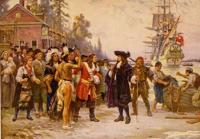
The landing of William Penn, painted by J.L.G. Ferris
Judge Rhoads’ stone home stood at what would become 7th and Linden streets. David Deshler occupied a property at the corner of 7th and Walnut that included a home, store and tavern. Both men had Swiss roots.
The other large, tree-covered property was the estate of James Allen, third son of William Allen. James Allen used it as a hunting property he called Trout Hall and largely lived in a home on Philadelphia’s fashionable Chestnut Street. He had been given the land by his father to rent or sell.
The relationship between Allens and their tenants was apparently not the best. The Allens argued that those who wanted to settle or rent the land were often delayed. They were often paid in nearly worthless Continental currency when they were paid at all. The settlers, for their part, replied that it had been advertised in Europe that settlers were wanted. The only way they could pay for or rent the land was to settle and farm it. The landlords, being landlords, found this logic illogical.
When the first unrest over British taxation was brought on by Parliament acts such as the Stamp Act, the Allens, who had to pay a fee or tax when a property they had was brought or sold, were furious. They were among the families who protested the tax. Writing to her husband in England, who then supported the Stamp Act tax, Deborah Franklin looked out her Philadelphia window to see James Allen “spiriting up the mob,” against the tax.
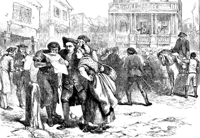
“Reading the Stamp Act in King Street: Opposite the State House”; James H. Stark, “The Loyalists of Massachusetts and the Other Side of the American Revolution” (1907)
But in 1776 things changed. All this talk of independence had the Allens nervous and afraid. The Allens held their property under the British law. If the colonies were no longer part of the British Empire, then their titles and deeds were worthless. A separate America was too risky to venture on. It would bankrupt them. They would eventually side with the Crown and lose it all.
According to an article appearing in the Morning Call on April 22, 1962, probably based on information compiled by his descendent Charles Rhoads Roberts, the founder of the Lehigh County Historical Society, Peter Rhoads, the featured speaker who read the now famous declaration in both German and English, came from an old Swiss family named Roth from the city of Basel. They were prominent there as early as the 1300’s.
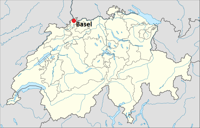
Map of Switzerland showing the city of Basel
Wikimedia
In 1456 a Peter Roth, Burgermeister of that city, was named a Knight of Jerusalem and was put in command of 300 men taking part in the defeat of Charles the Bold, the Duke of Burgendy in the battle of Grandson. That same year a Peter Roth also participated in the battle of Murtan or Morat where Charles was again defeated, ending, notes historian James Blake Weiner, “Burgendy’s role as a major European power.”
In 1733 Johan Daniel Roth and his wife, Anna Margaretha Weis, decided to emigrate to America. They sailed on the ship Hope from Rotterdam arriving in Skippack, Montgomery County where they settled for a time.
But for unknown reasons Daniel decided, in 1737, to move north with his pregnant wife and two daughters to what was to become Whitehall. But in that same year on the same April evening his son Peter was born, Daniel died. With that his wife felt she had no choice but to return to Skippack with her newborn son and two young daughters.
Here Peter Roth was supposedly adopted by Quakers who raised him. According to several sources he changed his name to Rhoads from Roth at their urging. It has been suggested that 18th century Quakers found the name Roth too “déclassé” for a protégé of theirs. As far as is known there is no proof of this. He may have simply changed his name on his own. Whatever else they did it is generally admitted that the Quakers saw Rhoads was well educated. He is known to have been able to read both Latin and Greek. But they also taught him the trade of tailoring as Quakers believed those they taught should also make themselves useful.
Rhoads came to Allentown in 1762 roughly when the town was created. Here he built a large stone house that was also a store. In one form or another (in the early 1920s it was turned into an automobile dealership with a large plate glass window) surviving until 1967. The late Carol Wickeyser, then president of the Lehigh County Historical Society, reported later that the property owner at the time, Morning Call publisher Donald P. Miller, allowed her and others to collect some relics before the parking lot it was on was expanded.
Rhoads married his first wife Sabina Kohler on November 23, 1762. Four of their children died young, and four reached adulthood: George (1769-1853), Peter, Catherine and John (1773-1851).
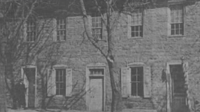
Exterior of the former Peter Rhoads house, circa 1910
Perhaps because he was among the first residents of Allentown, he was friendly with David Deshler. Both were among the early followers of the local movement leading toward the Revolution.
Rhoads was a member of the Constitutional Convention of July 15, 1776. This body was to create a new, more democratic constitution for Pennsylvania. Among its innovations was a bill of rights which was later adopted by other state constitutions and eventually the Bill of Rights in the U.S. Constitution. Rhoads also served on the Committee of Safety, an executive body, in 1776, and as a member of the Assembly from 1777 to the session of 1781 which was the end of the Revolution.
With the war’s end Peter Rhoads acquired the title of judge. In 1784 he was named President Judge of the Courts of Northampton County. In 1812 when Lehigh County was created out of Northampton County, he was commissioned Senior Associate Judge in Lehigh County.
On Sunday evening, December 18, 1814, at nine o’clock, Judge Peter Rhoads, aged 77 years and 8 months old, closed his eyes forever. The following Wednesday he was buried at the 10th and Linden Street cemetery.
In 1926 at the sesquicentennial of the Declaration of Independence, a monument with a large plaque was erected, listing those buried there who served in the Revolution and the War of 1812.