
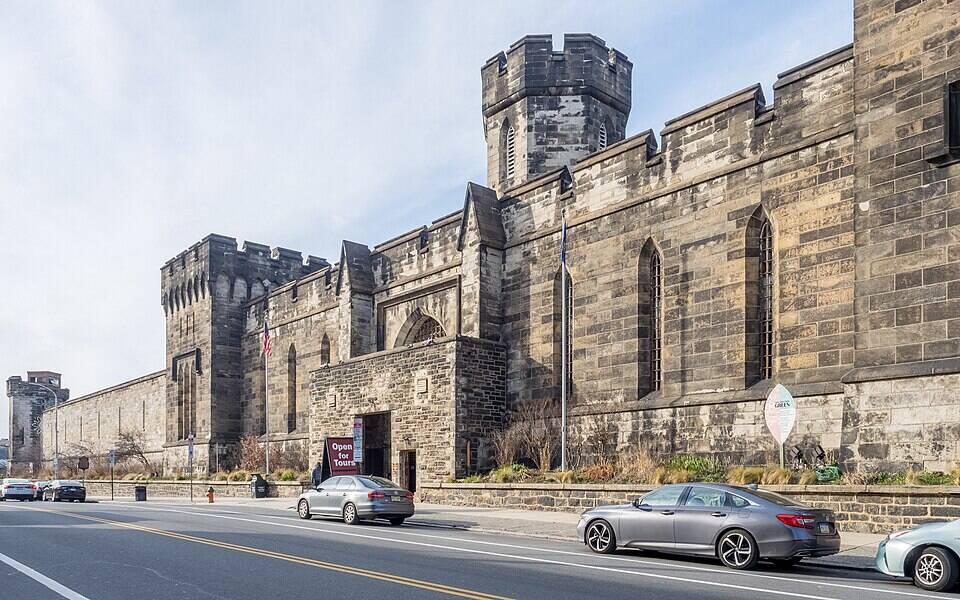
 Eastern State Penitentiary in Philadelphia. (Photo credit: wikicommons/ajay_suresh)
Each person incarcerated at Eastern State Penitentiary was issued an 8-by-12-foot cell with a bed, a workbench, a cast-iron toilet and a Bible. The facility was dedicated to rehabilitation through the Quaker ideals of quiet prayer and isolation.
So it was unusual that some of the prisoners — Jewish and non-Jewish — built a synagogue there in 1922.
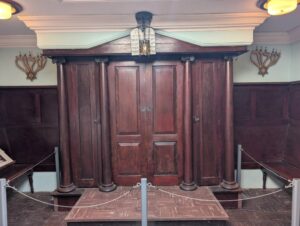 Eastern State Penitentiary’s synagogue is the first established in an American prison. (Photo credit: Zoe Bell)
Eastern State operated in the Fairmount neighborhood of Philadelphia from 1829 to 1971, and exists as a history museum today. It’s believed to be the first American prison to house a synagogue.
The new exhibit “Freedom Through Faith: Judaism at Eastern State and Beyond” explores this unique history and illustrates how religious freedom was represented and practiced inside America’s first penitentiary. It opened to the public on July 2.
“It’s a synagogue inside a prison. That’s revolutionary,” Kerry Sautner, Eastern State’s president and CEO, said at a media preview.
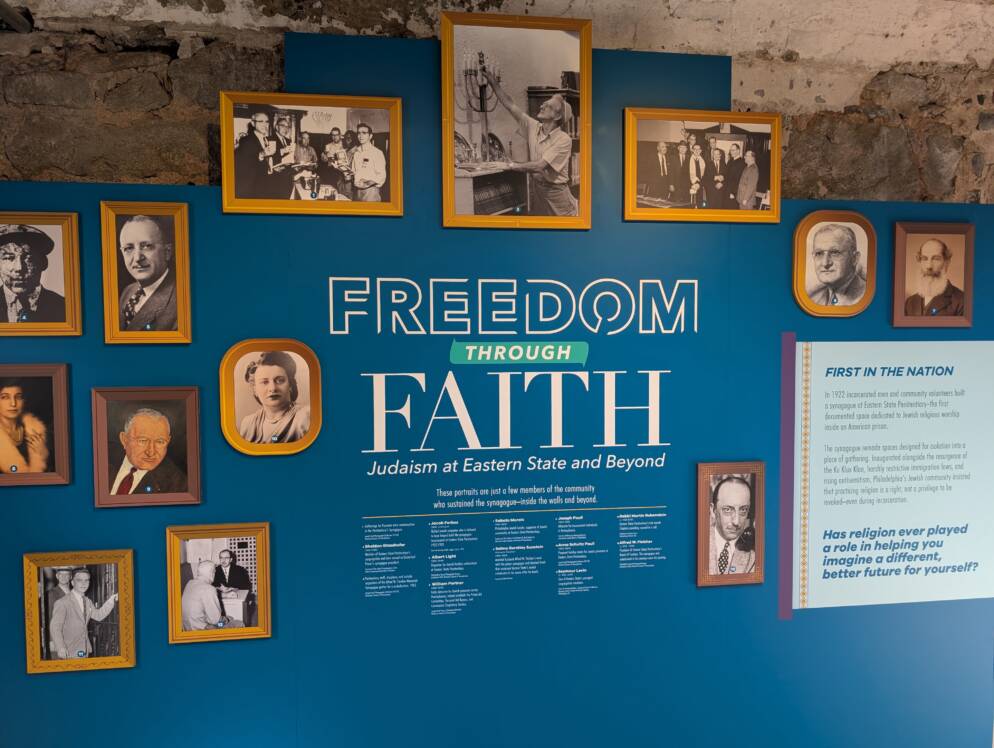 “Freedom Through Faith” tells the stories of the Jewish congregants who gathered at Eastern State’s synagogue, drawing upon recent research. (Photo credit: Zoe Bell)
In a room next to the historic synagogue, artifacts, photos and exhibit displays paint a picture of Jewish life at Eastern State, beginning with the first bris in 1851. Eastern State’s Jewish community first celebrated the High Holidays in 1913, and in 1916, began meeting at the prison’s emergency hospital for religious services.
Because penitentiaries were often government institutions rooted in religious belief, Eastern State largely centered on Christianity, driven by Enlightenment-era reform ideals. “This approach often left little room for prisoners of other faiths,” the exhibit reads.
Local philanthropist Alfred Fleisher found some of the Jewish prisoners were converting or being pressured to convert to Christianity, according to Beth Tinker, Eastern State’s exhibit developer and project lead.
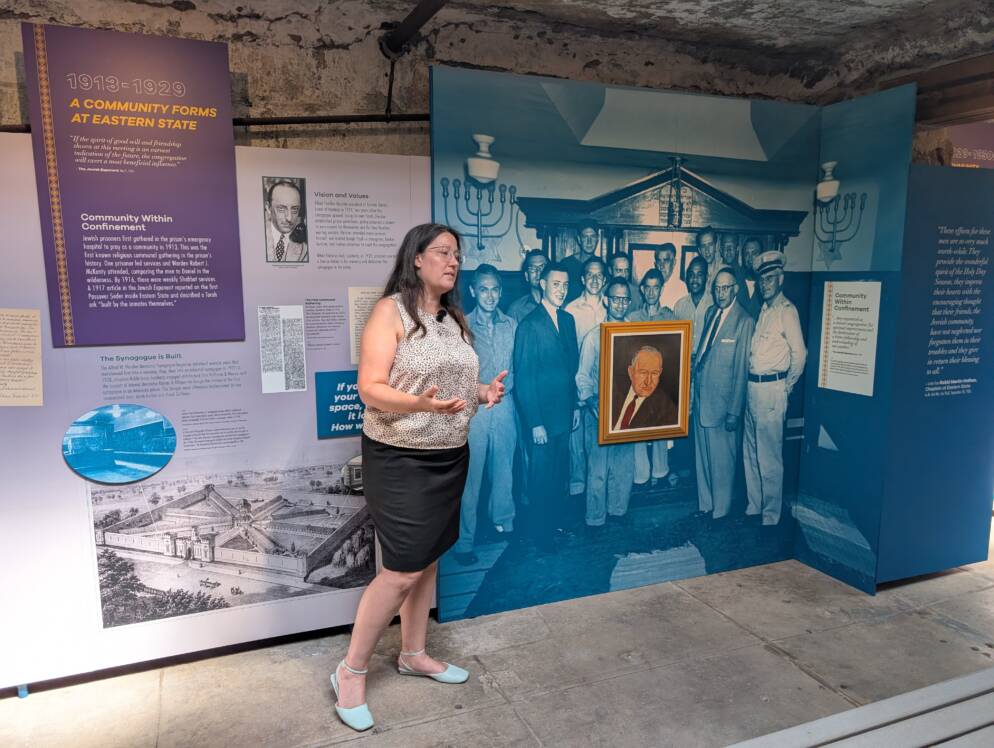 Beth Tinker discusses the history of Eastern State Penitentiary’s historic synagogue, including the support of Alfred Fleisher, the president of Eastern State’s board of trustees, in a media preview of the exhibit. (Photo credit: Zoe Bell)
Philadelphia’s Jewish community rallied to visit the prison, fundraise for a synagogue on the premises and support the Jewish people incarcerated there.
“I hope [visitors to “Freedom Through Faith”] get a sense of … how important it was to people like Fleisher and [Joseph] Paull to not just raise funds, but really become friends, to attend services, to speak out in terms of parole and reentry, to be a resource and friend to the community here,” Tinker said.
In 1922, prisoners began working with community leaders to construct the synagogue, in what the exhibit’s historian, Josh Perelman, called a diverse “interfaith network.”
The shul, rededicated in 1924, was later dedicated to Fleisher after his 1928 death. It was originally preserved in 2009, then again in 2026.
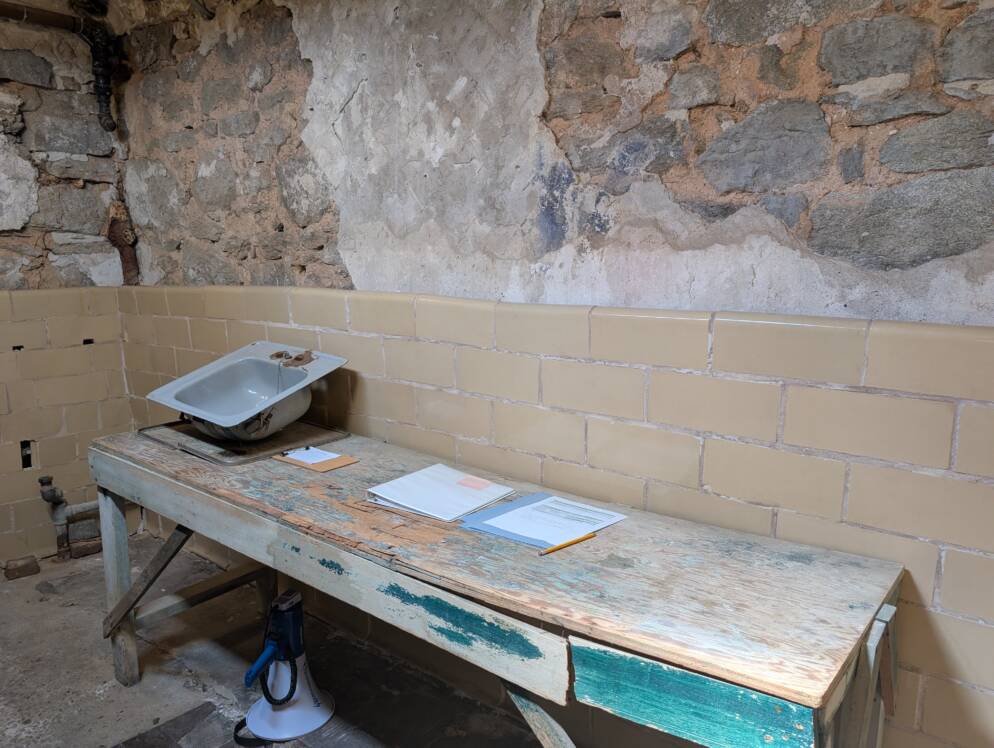 The kosher kitchen at Eastern State Penitentiary was adjacent to the synagogue. (Photo credit: Zoe Bell)
The synagogue and its kosher kitchen combined are no larger than a living room, but the space is historically significant given the events of 1924. The year the synagogue opened was a key year in American history, according to Perelman.
The Johnson-Reed Act, or the Immigration Act of 1924, ended open immigration to the United States and limited the number of immigrants from Eastern and southern Europe. This era was also defined by the eugenics movement, lynching and the resurgence of the Ku Klux Klan.
“What happened in this space in 1924 is no doubt something unique and special, given the national mood at the time,” Perelman said. “The fact that the synagogue lasted from ’24 to ’71 shows that Eastern State was not only a trendsetter, but walked the walk and talked the talk. They maintained the synagogue until the prison’s closing, even though by that time, there were one hand’s worth of Jewish people incarcerated in the prison.”
“Freedom Through Faith” covers Supreme Court cases that impacted prisoners’ rights, or lack thereof. The 1871 case Ruffin v. Virginia mandated that “convicted felons” become “slave[s] of the state” who forfeit their constitutional rights and liberties.
 This Star of David was found in the rubble outside the synagogue in the 1990s. (Photo credit: Zoe Bell)
It wasn’t until 1964 that laws began to redefine freedom of religion in prisons, Sautner said at the preview.
“So that’s what really makes this site especially amazing, because legally, there was no obligation to have a synagogue here,” Sautner said. “This amazing community is a shining example of what’s possible inside prisons.”
She spoke to the excerpts of text on the exhibit’s walls.
“Throughout the space, you’ll see a lot of quotes from individuals who were prisoners here or beyond, and how they were impacted by religion and how it brings humanity back to prisoners in a place that can be really stark and hard,” Sautner said.
“We’re really trying to tell these personal stories that are happening for the congregants here at Eastern State,” Tinker said.
Lauren Zalut, Eastern State’s senior director of learning and engagement, spent hours combing through archives at the Historical Society of Pennsylvania. Her most exciting find was the letters prisoners wrote, which she said humanized the names she was given.
“Incarcerated people are represented through mugshot imagery, and numbers don’t invoke humanity,” Zalut told Philadelphia Jewish Exponent. “To see people’s handwriting was just incredible.”
 The exhibit features handwritten letters from the prisoners. (Photo credit: Zoe Bell)
Some of their letters expressed appreciation for the nourishment of the Jewish ritual foods they ate on Passover and the High Holidays, Zalut said.
“We see that again and again in the letters,” she added. “There’s nothing more that can create community than sitting down to break bread together.”
Philadelphia’s Jewish community didn’t just provide kosher meats and other foods — the exhibit illustrates how these volunteers also helped prepare the prisoners for life after lockup. Joseph Paull, a wholesale butcher, found 300 jobs for those being released from Eastern State.
Tinker said she hopes visitors to the new exhibit walk away with a sense of the humanity and community among Eastern State’s Jewish congregants and the prison community.
“This is a story about community in one of the most unlikely spaces, and it’s a story that I think gives us hope of what we can do when we all come together to support each other,” Zalut said. “Humans all deserve to practice their religion in America, and we all deserve to be in community.”
zbell@midatlanticmedia.com