
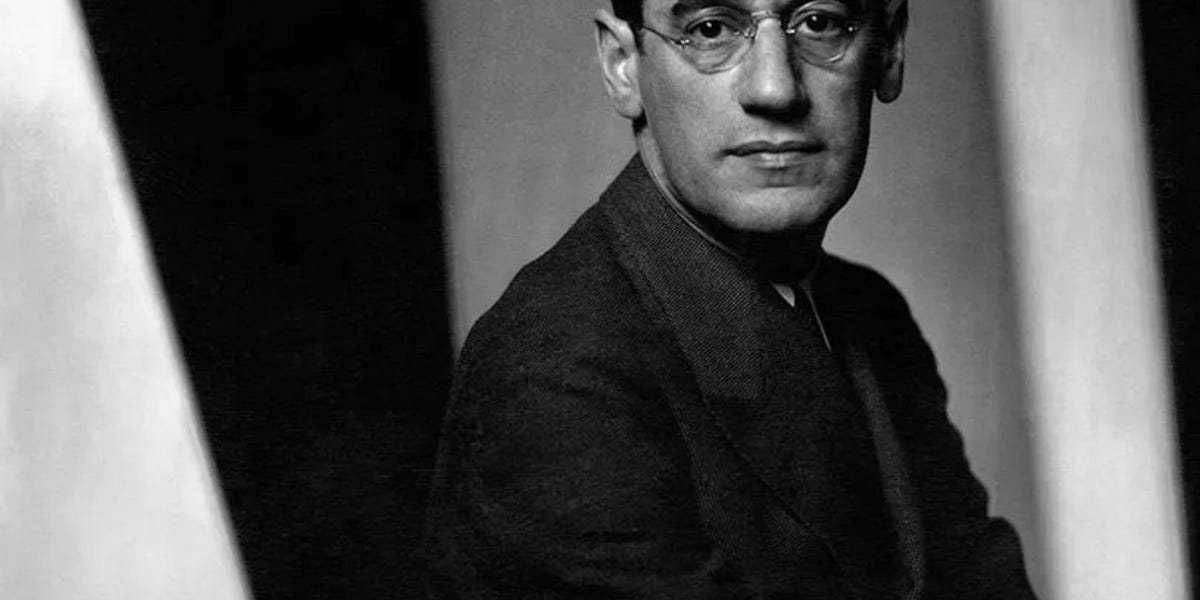
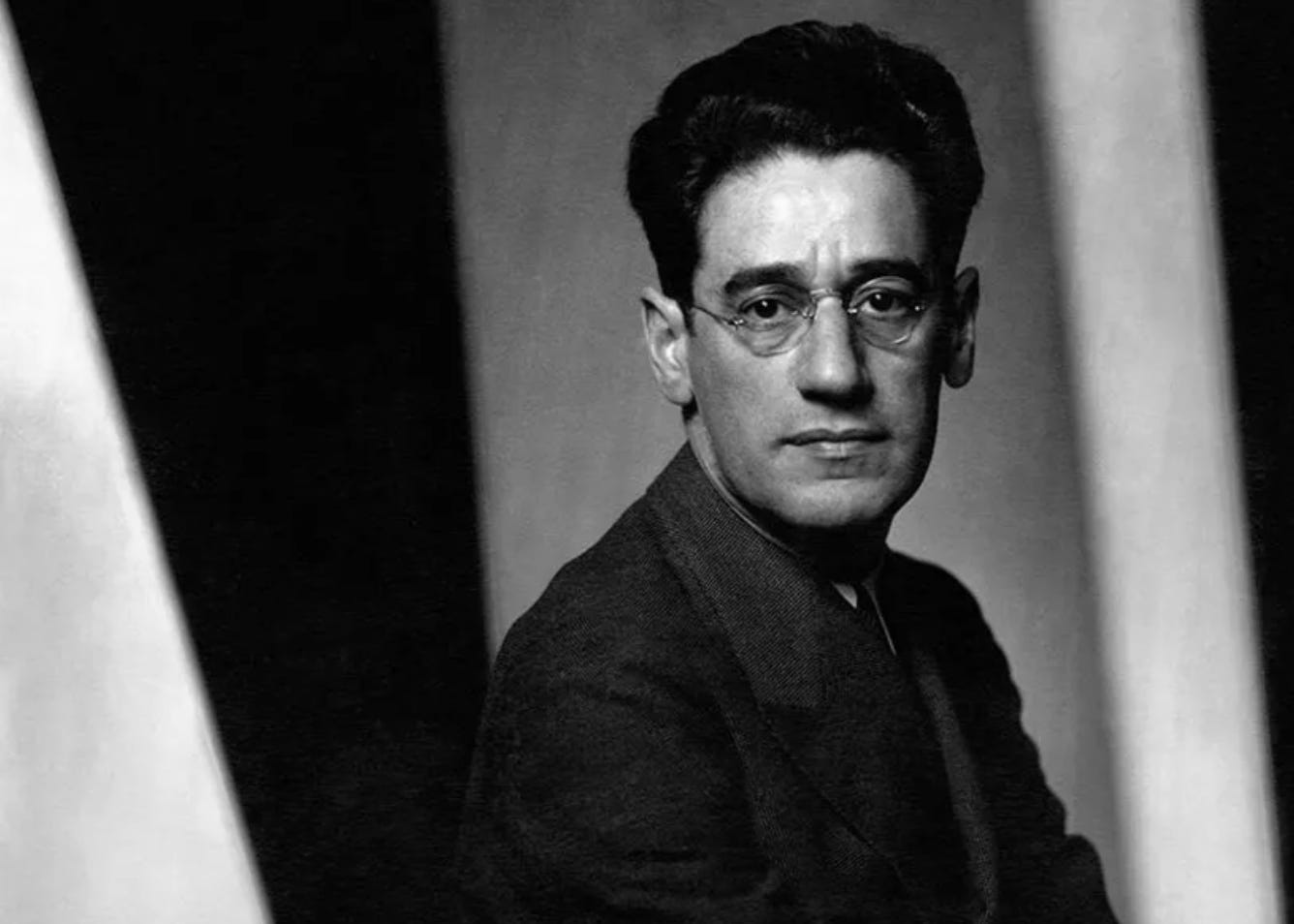
Author’s Note: As I continue to delve into this Leadership Series, I’ve come to realize that the lasting impact of remarkable people is often found in quiet, yet important ways in all of our lives. For centuries, artists have shaped how we see ourselves and our world — translating the values of an era into language, performance, and stories that outlast their creators. George S. Kaufman stands firmly in that tradition: a playwright, director, wit, and satirist whose body of work defined American comedy for the better part of four decades, and whose Pittsburgh roots are rarely given the prominence they deserve.
My own Pittsburgh origin has guided this search. What was is about this smokey, gritty, blue collar town that gave rise to so many creative and culture shifting people. These include a lengthy list of formidable talents: Authors (Rachel Carson, August Wilson), Novelists (Annie Dillard, David McCullough), Journalists (Nellie Bly, Howard Fineman), Screenwriters (George Romero, Carl Kurlander) and Poets (Jack Gilbert, Gertrude Stein).
George S. Kaufman is a name you may not recognize; yet has had a truly profound impact, even to this present day. George shaped Broadway’s Golden Age, gave Groucho Marx his greatest lines, collaborated with the Gershwins to create the first musical to win a Pulitzer Prize, and directed some of the most celebrated productions of the twentieth century — from The Front Page to Guys and Dolls. His impact on American comedy, political satire, and musical theatre is immeasurable. His influence on the writers, comedians, and satirists who followed him — from Neil Simon to Mel Brooks, from Saturday Night Live to The Daily Show — is direct and documented.
It is an honor to feature George — not simply because of what he accomplished, but because of how he accomplished it: through relentless collaboration, fearless satire, and a craftsman’s devotion to the perfectly timed line. That is leadership of the highest creative order.
Like many of the figures who glamorized New York City in the 1920s and 30s, George was born far from Manhattan high society. He was born on November 16, 1889, into a middle-class Jewish family in the East Liberty neighborhood of Pittsburgh, spending his childhood at 6102 Walnut Street in Shadyside until 1909, when his father relocated the family to Paterson, New Jersey. His father, Joseph S. Kaufman, was a hatband manufacturer; his mother, Nettie Meyers. According to George, the family “managed to get in on every business as it was finishing and made a total of $4 among them” — a wisecrack that was also, apparently, a reasonably accurate family history. His Jewish background — with its tradition of irony, self-deprecation, and moral questioning — would color everything he ever wrote for the stage.
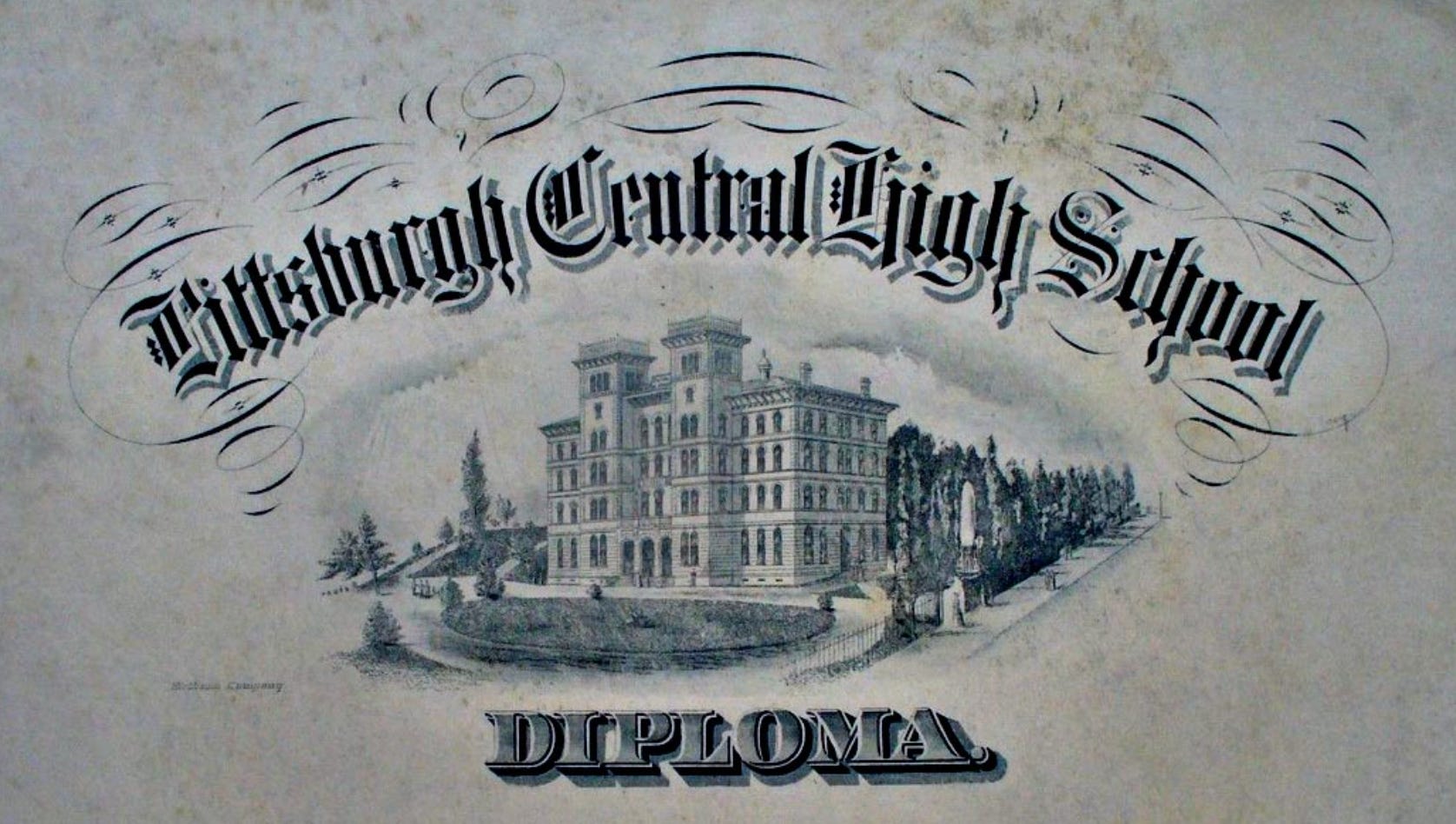
Lanky and laconic, George far preferred plays and books, particularly Mark Twain. He graduated from Pittsburgh Central High School in 1907, briefly studied law at the University of Pittsburgh — a venture that lasted approximately three months — then took on a series of odd jobs selling silk and wholesale ribbon while he figured out what he was actually meant to do with his life. What followed was a departure to Manhattan — not to college, not to law, but to theater and journalism. Adams, recognizing a genuinely gifted comic writer, took George under his wing and eventually secured him a column of his own at the Washington Times in 1912. From there, he moved to the New York Tribune and then, in 1917, to the New York Times as drama editor — a post he held until 1930. Shadyside. East Liberty. Walnut Street. Pittsburgh gave George the rootedness, the irony and hunger that he would carry all the way to Broadway.
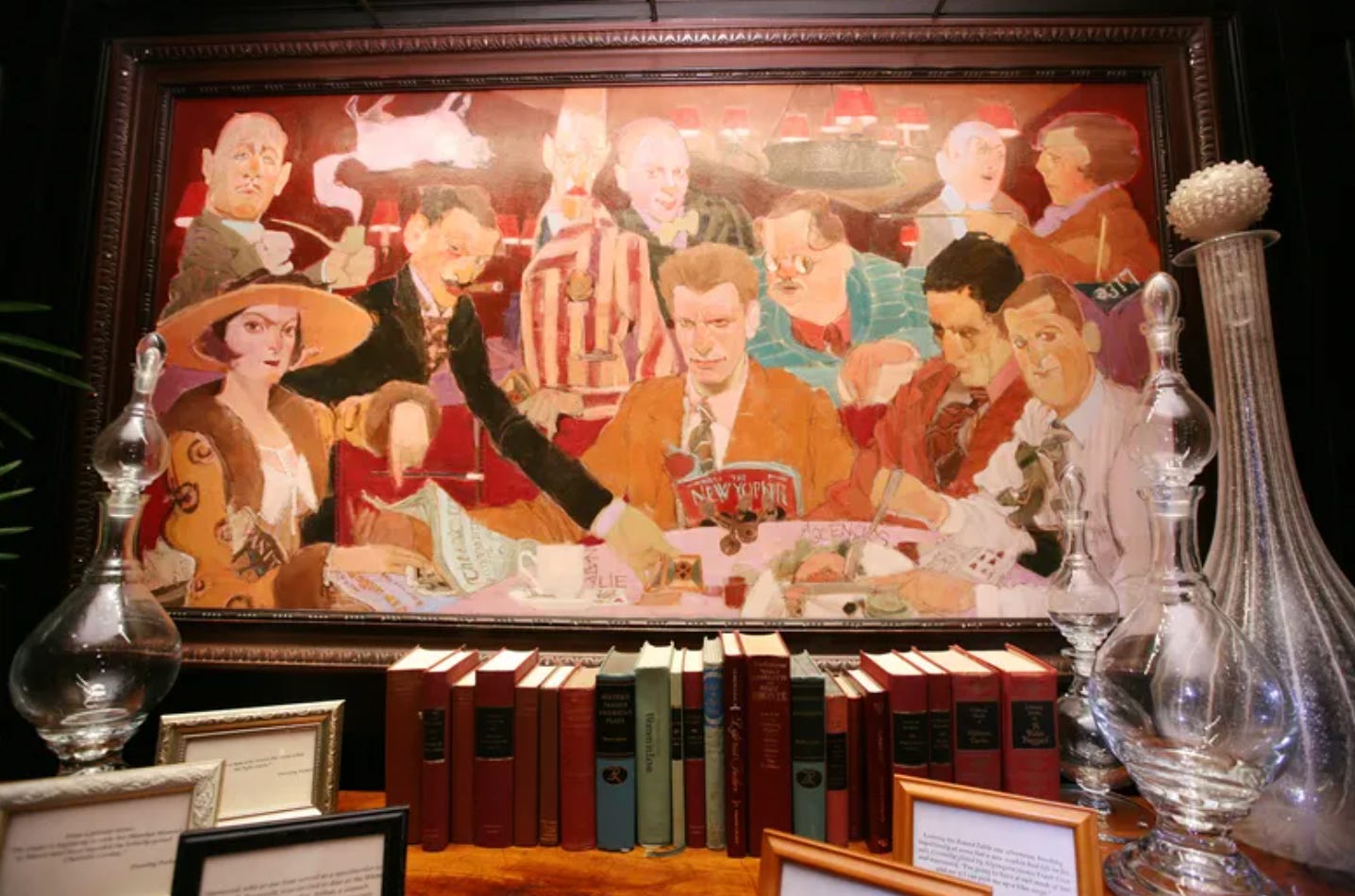
George’s ascent as drama editor of The New York Times placed him at the exact epicenter of the most electrifying literary and theatrical world of 1920s New York. As a drama editor, he had access to every celebrity, and it was convenient — and consequential — for him to take his lunches at a midtown hotel close to the newspaper district: The Algonquin.
The Algonquin Round Table became the name given to the informal group of New York literati who traded luncheon entrées and verbal sorties right up until the stock market crash. Its luminous members included the drama critic and radio personality Alexander Woollcott; writers Dorothy Parker and Robert Benchley; playwright Robert E. Sherwood; critic Heywood Hale Broun; comedian Harpo Marx; and composer Irving Berlin — among many others. The Round Table has entered the realm of American cultural legend, and their blend of wit, insouciance, and arrogance made them the perfect representatives of their age.
George was not merely a member of this circle — he was one of its defining voices. He coined witticisms that have outlived entire theatrical movements, most famously the immortal: “Satire is what closes on Saturday night.” He wrote such famous Groucho Marx lines as this gem from A Night at the Opera: “When I invite a woman to dinner, I expect her to look at my face. That’s the price she has to pay.” These were not throwaway jokes. They were precisely engineered weapons of wit, deployed with the elegance of a surgeon and the speed of a fencer.
Fred Allen once said: “There are only two genuine wits on American television: Groucho Marx and George S. Kaufman. Without Kaufman, television is half-witted.” He was, in the truest sense, the wit’s wit — the comedian that other comedians studied and envied. And it all grew from lunches at a midtown hotel with the sharpest minds in the English-speaking world.
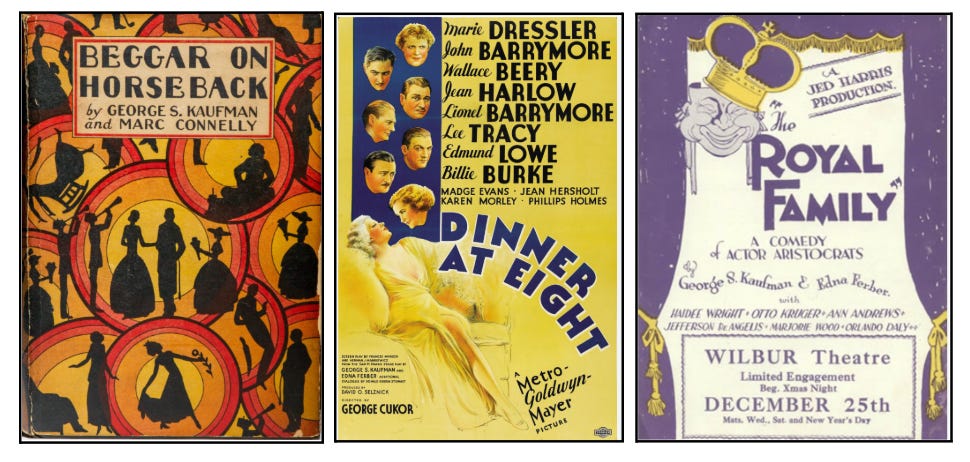
George’s theatrical career took shape in the 1920s, when he became Broadway’s most sought-after collaborator and helped define a new kind of American comedy—smart, satirical, and structurally precise. With Marc Connelly, he produced a string of influential works: Dulcy (1921), which marked his breakthrough; Merton of the Movies (1922), an early Hollywood satire; and Beggar on Horseback (1924), a surreal critique of capitalism. His solo play, The Butter and Egg Man (1925), skewered the theater business itself.
Merton of the Movies (1922) was one of the earliest and sharpest Hollywood satires, skewering the film industry’s myth-making machinery with affectionate contempt. Beggar on Horseback (1924) took on the dehumanizing efficiency of American capitalism in a form that was expressionist, surreal, and devastatingly funny.
His later partnership with Edna Ferber yielded major successes, including The Royal Family (1927), Dinner at Eight (1932), and Stage Door (1936), each offering sharp, character-driven portraits of American life and theatrical culture.
Across all these works, George became known for his obsessive attention to dialogue and structure, refining scenes down to the rhythm of a single word. His precision and collaborative ethos earned him the enduring nickname “The Great Collaborator,” reflecting both his method and his belief that great work emerged from partnership rather than ego.
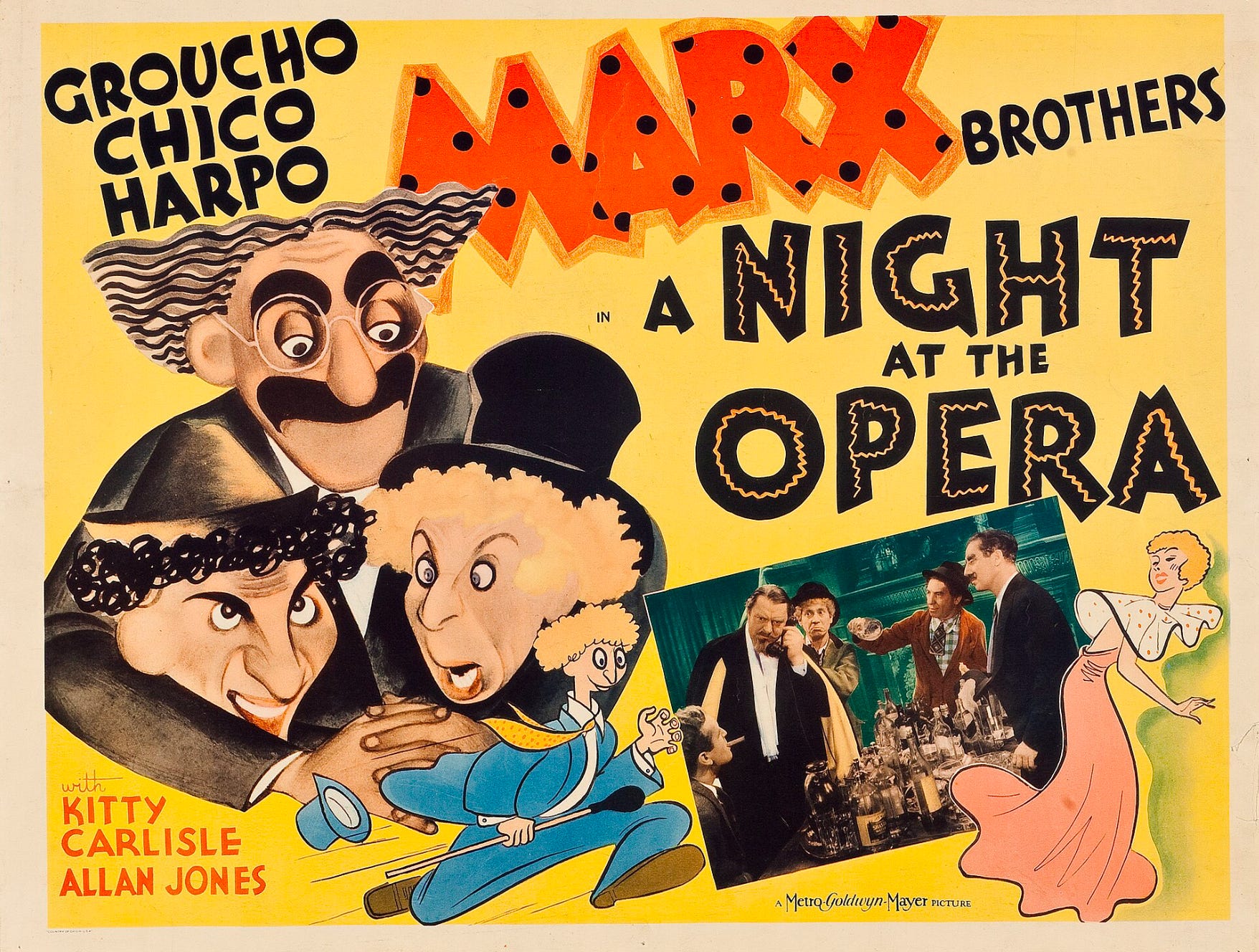
As vaudeville declined in the mid-1920s, George helped bring the Marx Brothers to Broadway, collaborating with Irving Berlin on The Cocoanuts (1925), a major hit that launched a famously chaotic but productive partnership. He followed with Animal Crackers (1928), written with Morrie Ryskind and featuring a score by Kalmar and Ruby; both shows became the basis for the brothers’ first films. George and Ryskind later co-wrote A Night at the Opera (1935), widely considered the Marx Brothers’ finest work.
Though Groucho Marx was known for improvisation, many of his sharpest early lines were Kaufman’s, and he credited George with shaping his comic persona. The collaboration was often strained by Kaufman’s exacting standards versus the Marxes’ anarchic style—captured in George’s dry aside during a performance: “Excuse me, I thought I heard one of my original lines.” The remark reflects his belief that great comedy depended on precision, not just spontaneity.
The Marx Brothers themselves were culturally transformative, redefining American comedy with a style that fused vaudeville slapstick, verbal wit, and gleeful subversion of authority. At a moment when institutions—from high society to government to business—still demanded deference, their comedy dismantled them with irreverence and speed, creating a new comic language that influenced everything from screwball film to modern satire. Their work captured a distinctly American skepticism of power, and in doing so, helped set the template for generations of comedians who saw humor not just as entertainment, but as a form of critique.
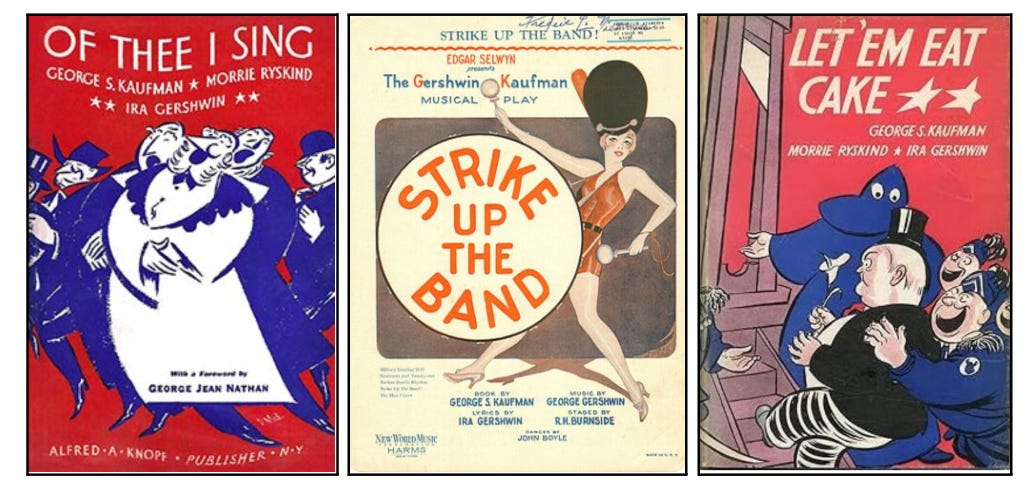
George turned to Tin Pan Alley for one of the most ambitious theatrical projects of his career: a collaboration with the composer-lyricist team of George and Ira Gershwin. The 1927 show, Strike Up the Band, was an aggressive political satire on American government with a strong anti-war sentiment. It closed out of town — prompting Kaufman’s oft-quoted remark that “satire is what closes on Saturday night.” In retrospect, that line is funnier than ever, given what followed.
In 1930, with George’s blessing, Morrie Ryskind softened the book’s tone and restructured much of it, giving the Gershwins the Broadway hit that had eluded them three years before. That success set the tone for the four collaborators’ next project — a groundbreaking masterpiece that would make American theater history.
Of Thee I Sing (1931) put presidential politics center stage, spoofing the electoral process and the tenuous tenets of American governance with a sophistication and integration of libretto and score that the Broadway stage had not seen before. The Pulitzer Prize committee recognized exactly what they were looking at: they awarded the 1931 show the first Pulitzer Prize ever given to a musical — though the committee, in a notorious oversight, ignored the musical contributions of George Gershwin himself. It was also the first time in Broadway history that politics had been so directly, so brilliantly, and so unapologetically parodied on the musical stage.
The quartet’s next attempt — a sequel entitled Let ‘Em Eat Cake (1933) — brought the characters of Of Thee I Sing face to face with the implications of international fascism. It was too sharp, too dark, and too prescient for its moment. Audiences were not yet ready for a musical comedy about the end of democracy. That reckoning would come later — and when it did, the whole country would feel the absence of George S. Kaufman on Broadway.
George’s most celebrated and productive collaboration began unexpectedly in 1929, when a young writer named Moss Hart sought him as a partner for a comedy he had written about the chaos that talking pictures had unleashed on Hollywood. George was already the most sought-after director on Broadway after helming Ben Hecht and Charles MacArthur’s 1928 smash, The Front Page, which many consider one of the great American comedies. He was also revered as the best play doctor in the business. Hart’s approach was bold, even audacious — and Kaufman said yes.
The Hollywood spoof, Once in a Lifetime (1930) — with George directing and taking the supporting role of a Broadway playwright — was a smash hit of the season. Hart’s trials and tribulations with his older, vastly more experienced partner during the show’s creation are beautifully documented in his extraordinary 1959 memoir, Act One — one of the greatest books ever written about the making of theater.
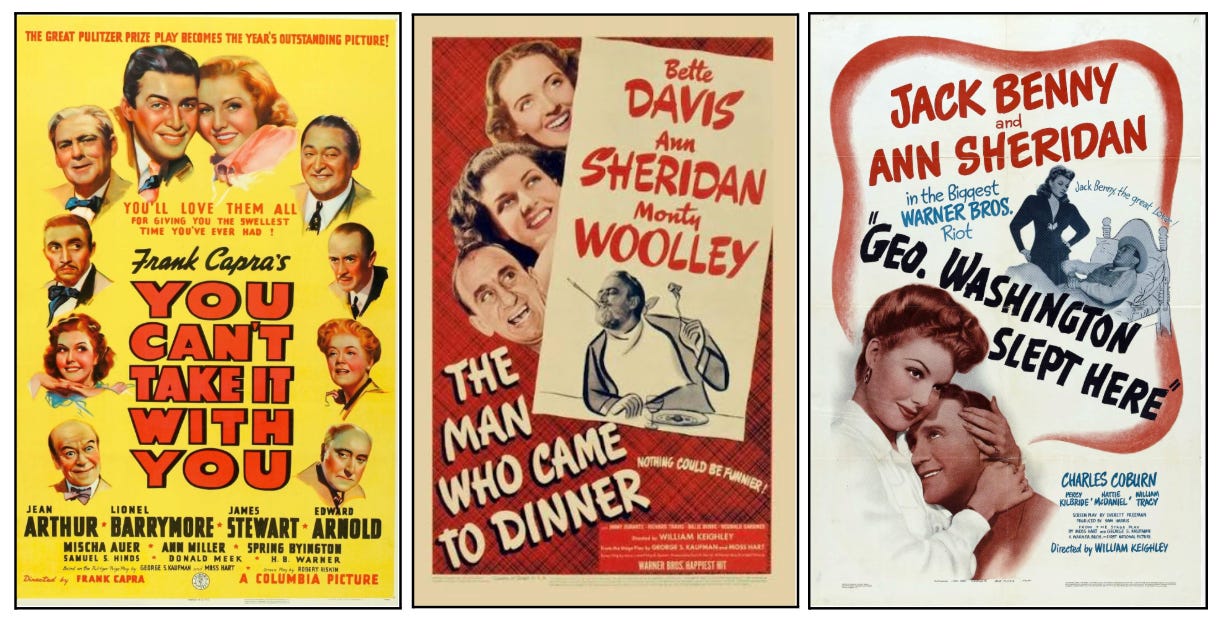
Between 1930 and 1940, Kaufman and Hart wrote eight plays together — ranging from dreamlike fantasies to epic extravaganzas — and produced some of the most beloved comedies in American theatrical history. Their biggest financial bonanza was You Can’t Take It with You (1936) — a culture-clash comedy between two families, one anarchic and one conservative, that captured both the spirit of Depression-era America and the eternal human longing to live on one’s own terms. The play ran 837 performances and earned Kaufman his second Pulitzer Prize.
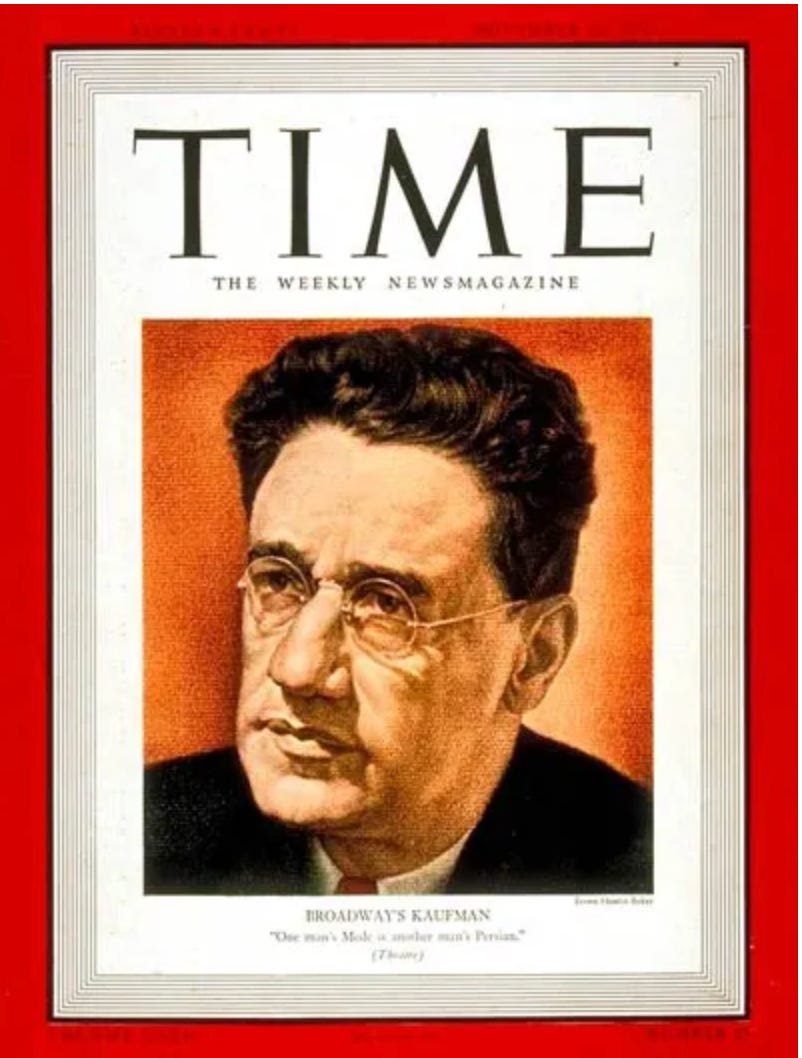
The Man Who Came to Dinner (1939) — based on the magnificently overbearing character of their old friend Alexander Woollcott, transformed into the egomaniacal celebrity Sheridan Whiteside — put George on the cover of Time magazine as the most successful comic playwright of the 1920s and 30s. Their final collaboration, George Washington Slept Here (1940), was a popular and charming comedy about the inconveniences of country life. Like Marc Connelly before him, Hart eventually left Kaufman amicably, with genuine admiration and a need to write his own work.
The plays written with Hart showed a greater depth of characterization than any of Kaufman’s previous works. Together, they found a way to make broad satirical comedy emotionally resonant — a combination that is infinitely harder to achieve than it looks, and that has set the standard for American comedy writing ever since.
From World War II onward, George never quite matched the peaks of his earlier decades, though he remained a major Broadway presence. He avoided Hollywood, preferring others to adapt his work; fourteen of his plays became films, though he rarely wrote screenplays himself beyond A Night at the Opera. His time in Hollywood also brought personal scandal when Mary Astor’s diary, detailing their affair, became public in 1936.
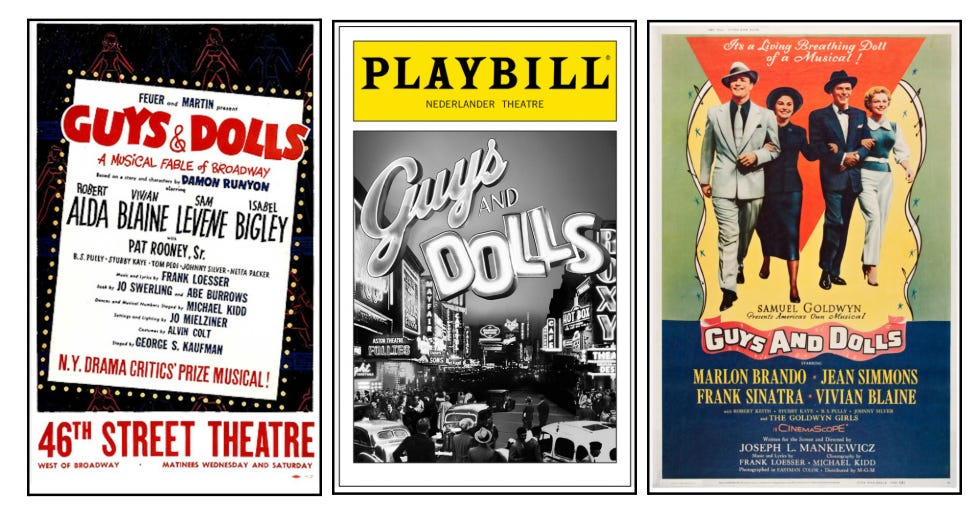
His later years still included notable successes. The Solid Gold Cadillac (1953) was a long-running satire of corporate life, and Silk Stockings (1955), written with his wife Leueen MacGrath, adapted Ninotchka into a musical. His greatest late-career achievement, however, came as a director with Guys and Dolls (1950), which earned him a Tony Award. Despite a formidable reputation, collaborators described an underlying warmth.
Guys and Dolls itself became one of the defining works of American musical theater, celebrated for its seamless integration of character, music, and narrative, and its vivid, affectionate portrait of mid-century New York. Frank Loesser’s score produced enduring standards, while Kaufman’s direction brought clarity, pacing, and comic precision to a show built on Damon Runyon’s stylized world. The 1955 film adaptation, starring Marlon Brando, Jean Simmons, Frank Sinatra, and Vivian Blaine, extended its cultural reach, translating the musical’s charm to a global audience and cementing its place in the canon of both Broadway and Hollywood classics.
George died in 1961, widely regarded as Broadway’s grandmaster, though doubtful of his lasting legacy. In fact, his work enjoyed sustained revival in the decades that followed. For 37 consecutive years—from 1921 to 1958—every Broadway season featured a play he wrote or directed, a record that remains unmatched.
Although it is easy to chart George’s successes, his influence on American playwriting is harder to define — and perhaps that is exactly as he would have wanted it. If Eugene O’Neill represents the tragic mask of American drama, Kaufman can lay claim to its comedic counterpart. He added a distinctly American touch to his comedy, bringing the brashness of the postwar era to the Broadway stage with a deftness that made social commentary feel like entertainment and entertainment feel like social commentary.
Above all, George helped launch American comedy into the arena of social criticism. Aiming his satire at big business, politics, and the entertainment industry, he attacked the crass commercialism of American life and turned the American success myth on its head — showing, again and again, how the incompetent and the foolish rise to the top. He scorned the theatricalization of American life: its media hype, its image makers, its cult of personality. From the boardrooms of General Motors to the production rooms of Hollywood, from small-town America to the elite of New York society, from Fascism to the New Deal, George rattled the complacency of American life.
James Thurber, writing in Theatre Arts in 1961, said it most precisely: “The legend of George Kaufman will grow, the truth about the man himself will probably stay just where it is, but time will brighten the light he brought to American humor, comedy, and wit. If the theater is to have a renaissance of comedy, it will need another Kaufman and the need is extremely great in this present period of decadence.”
In a paradoxical contrast to George’s most famous remark about satire, there has not been a Saturday night since 1925 when a George S. Kaufman comedy hasn’t been playing somewhere in America.
George S. Kaufman did not simply write plays. He invented a template — for political satire, for comedic dialogue, for the strategic deployment of the wisecrack as a weapon of democratic critique — that every major American comedy writer and performer of the past century has either consciously or unconsciously followed.
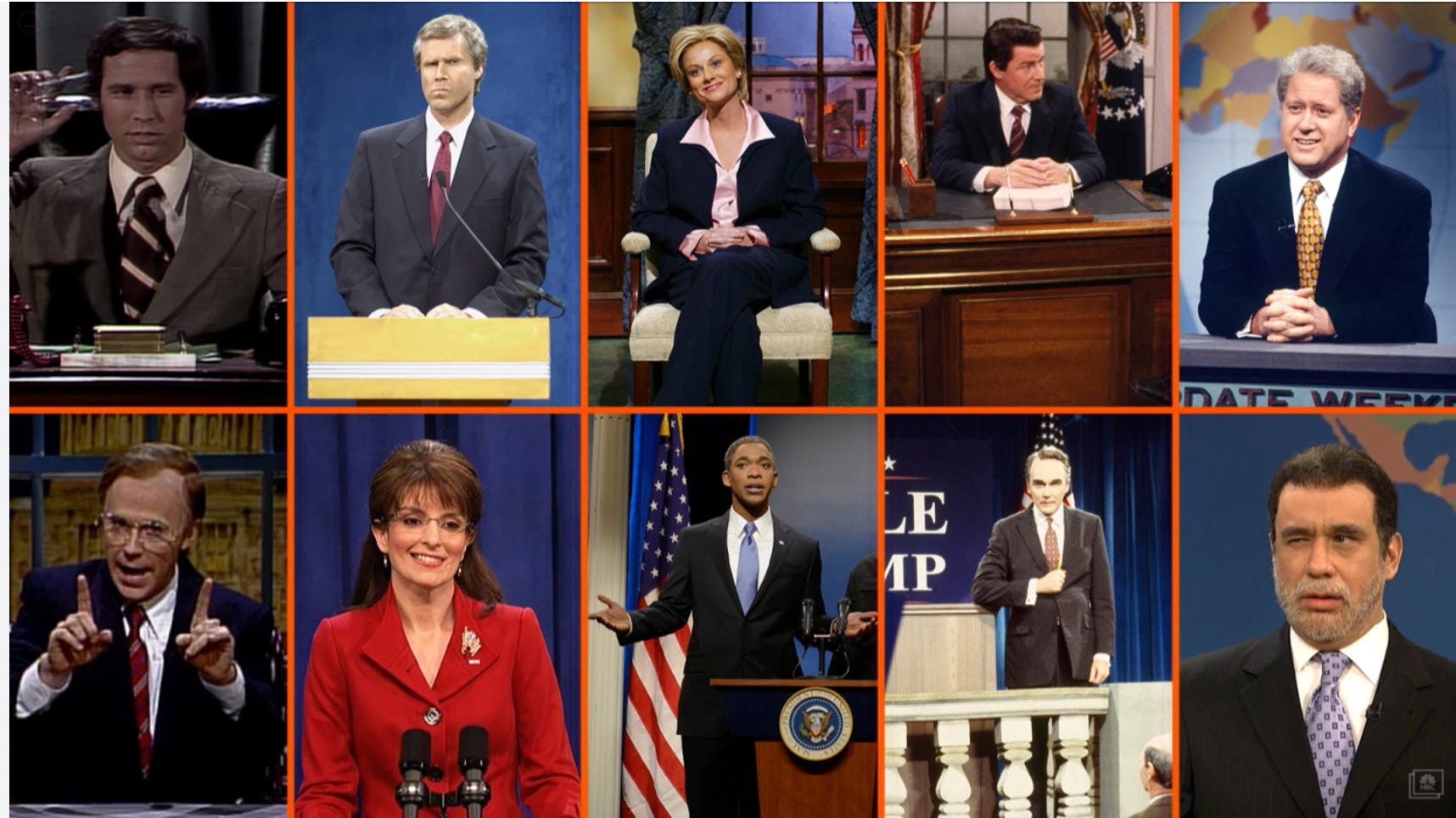
The lineage is direct and documented. When Saturday Night Live debuted in 1975, Time magazine noted that the new show was proving Kaufman’s most famous maxim wrong — satire was not closing on Saturday night; it was opening. The cold opens that pilloried Gerald Ford, the Weekend Update segments that surgically dissected political hypocrisy, the entire DNA of political impersonation-as-commentary — all of it descends from the theatrical tradition that Kaufman built. Chevy Chase, Tina Fey, Alec Baldwin, and every performer who ever put on a presidential mask on that stage owes something — knowingly or not — to the man who made presidential satire a Broadway art form in 1931 with Of Thee I Sing.
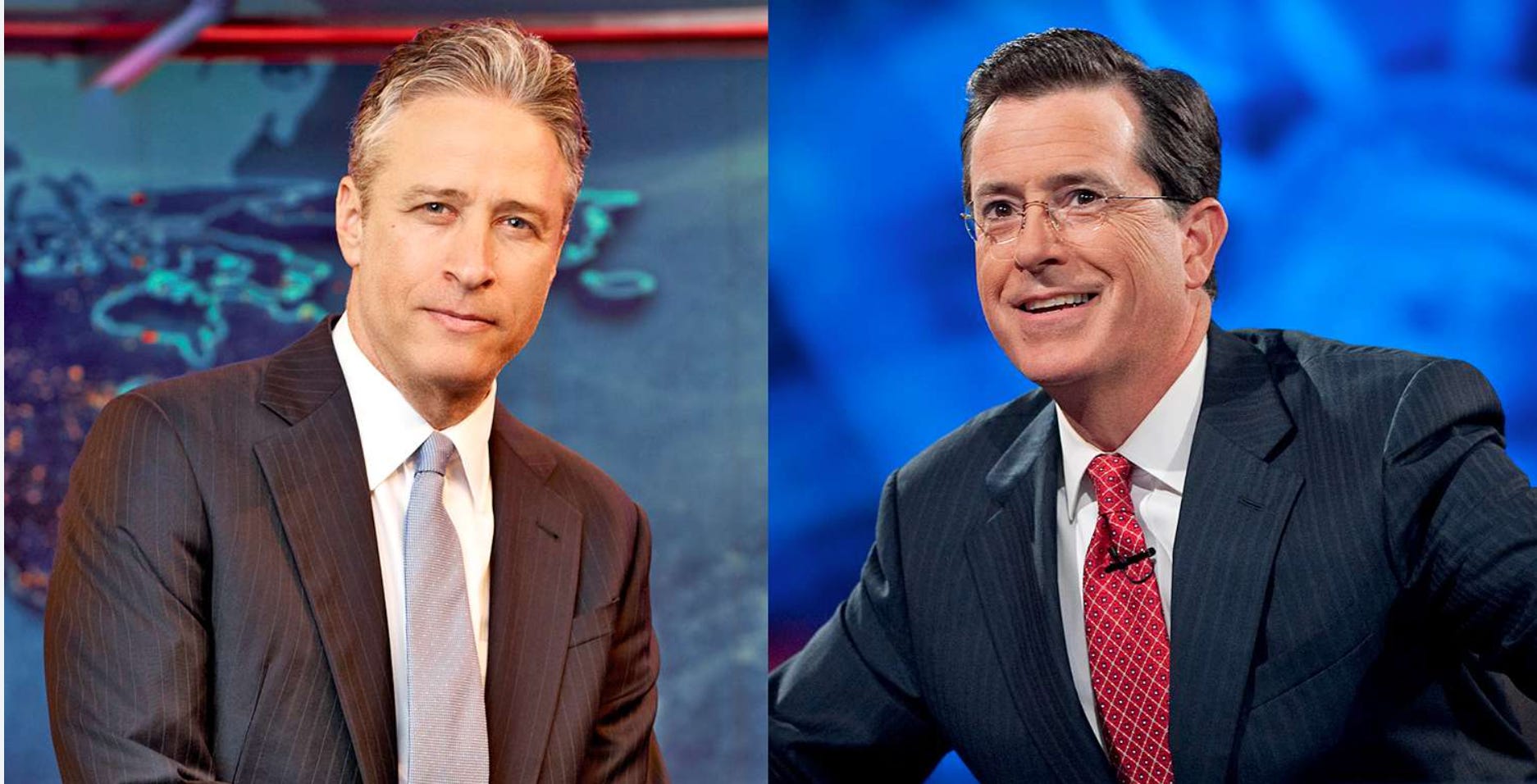
The lineage extends far beyond SNL. Jon Stewart’s The Daily Show and Stephen Colbert’s synthesis of punditry and performance are both built on the architecture of George’s work: the assumption that political figures are inherently comic material, that satire serves democracy, and that laughter can be a form of civic courage. David Letterman’s ironic detachment, Conan O’Brien’s absurdist wit, Jimmy Kimmel’s capacity for righteous comedy — all of it traces back to a tradition that Kaufman codified, professionalized, and proved could win a Pulitzer Prize.
Stand-up comedy owes him a debt as well. George Carlin’s savage political material, his willingness to use comedy to say what polite society refused to acknowledge — that is George’s spirit, translated to a different medium. Even Rich Little, the master of political impersonation, was working in a form that Of Thee I Sing had legitimized fifty years earlier. When Kaufman gave Groucho Marx his best lines, he also proved something essential: the best comedy is written, crafted, and constructed. Genius, in this tradition, is not spontaneous. It is made.
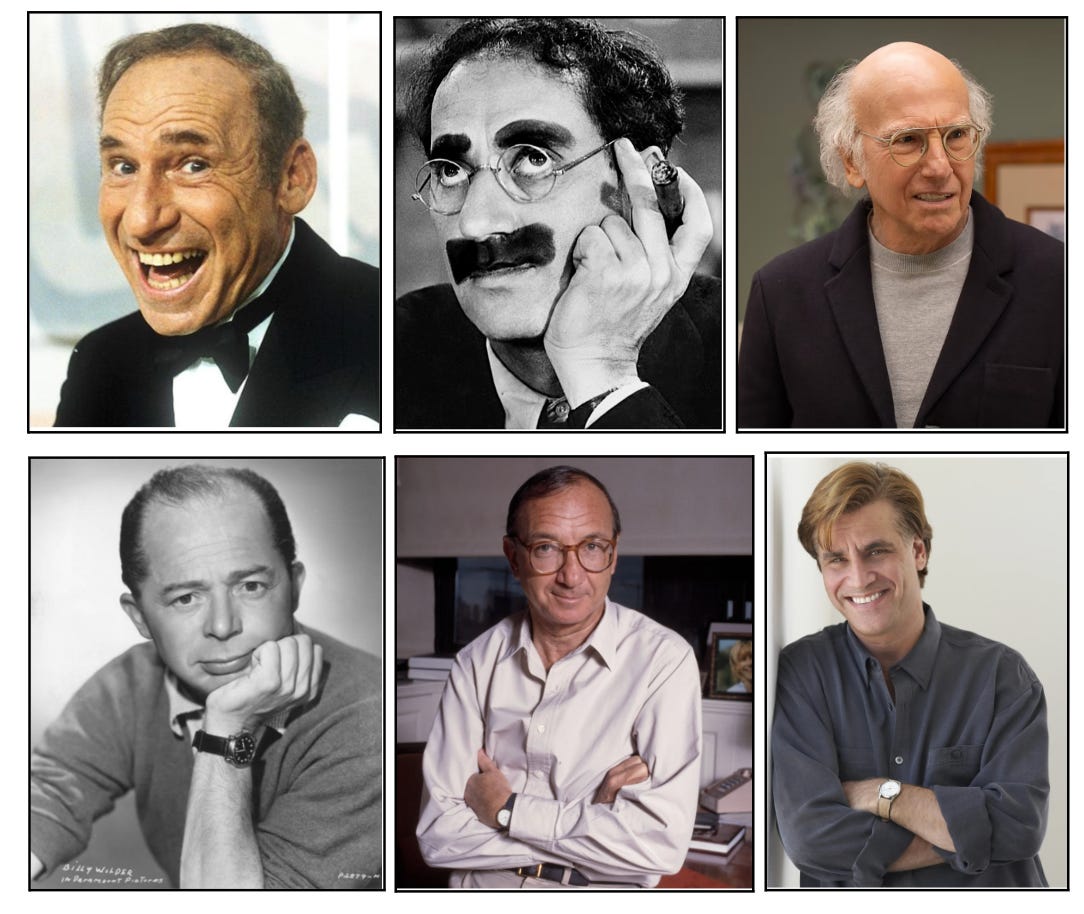
The writers who have most directly acknowledged George’s influence represent the cream of American comedy and drama across the second half of the twentieth century — and their debt to him is both profound and surprisingly explicit.
Billy Wilder — who, like George, turned to directing his own work partly out of self-protection, frustrated by what others were doing to his writing — was profoundly shaped by Kaufman’s comedic model. The economy of Wilder’s dialogue, the precision of his comedic construction, the willingness to use laughter to expose the darkest corners of human nature: these are all qualities that Kaufman pioneered.
Neil Simon, who dominated Broadway from the 1960s through the 1990s, is George’s most obvious and acknowledged theatrical heir. The rapid-fire wit, the urban Jewish sensibility, the deep investment in the architecture of the well-made comedy — Simon essentially built his career on the foundation that Kaufman laid.
Mel Brooks — whose comedic genius is perhaps the most spectacular, and most Kaufmanesque, of all — uses exactly the same weapons: political satire, the subversive deployment of the absurd, the exploding of pomposity through laughter. The Producers, which itself satirizes theatrical production, is directly descended from Kaufman’s The Butter and Egg Man.
Aaron Sorkin — whose rapid-fire, overlapping dialogue in The West Wing, The Social Network, and A Few Good Men defined a new standard for American dramatic writing — is working in a tradition of elevated, witty, morally serious dialogue that George essentially invented for the American stage.
Larry David — the great chronicler of the social transgression, the man who made mortifying self-awareness into high comedy — is operating in the tradition of Kaufman’s satirical mirror: holding American life up to the light and watching it squirm.
Groucho Marx himself may have said it best, and Groucho was not given to false generosity: he considered George the greatest comic playwright in history. Coming from the man whose best lines Kaufman wrote, that is a verdict worth taking seriously.
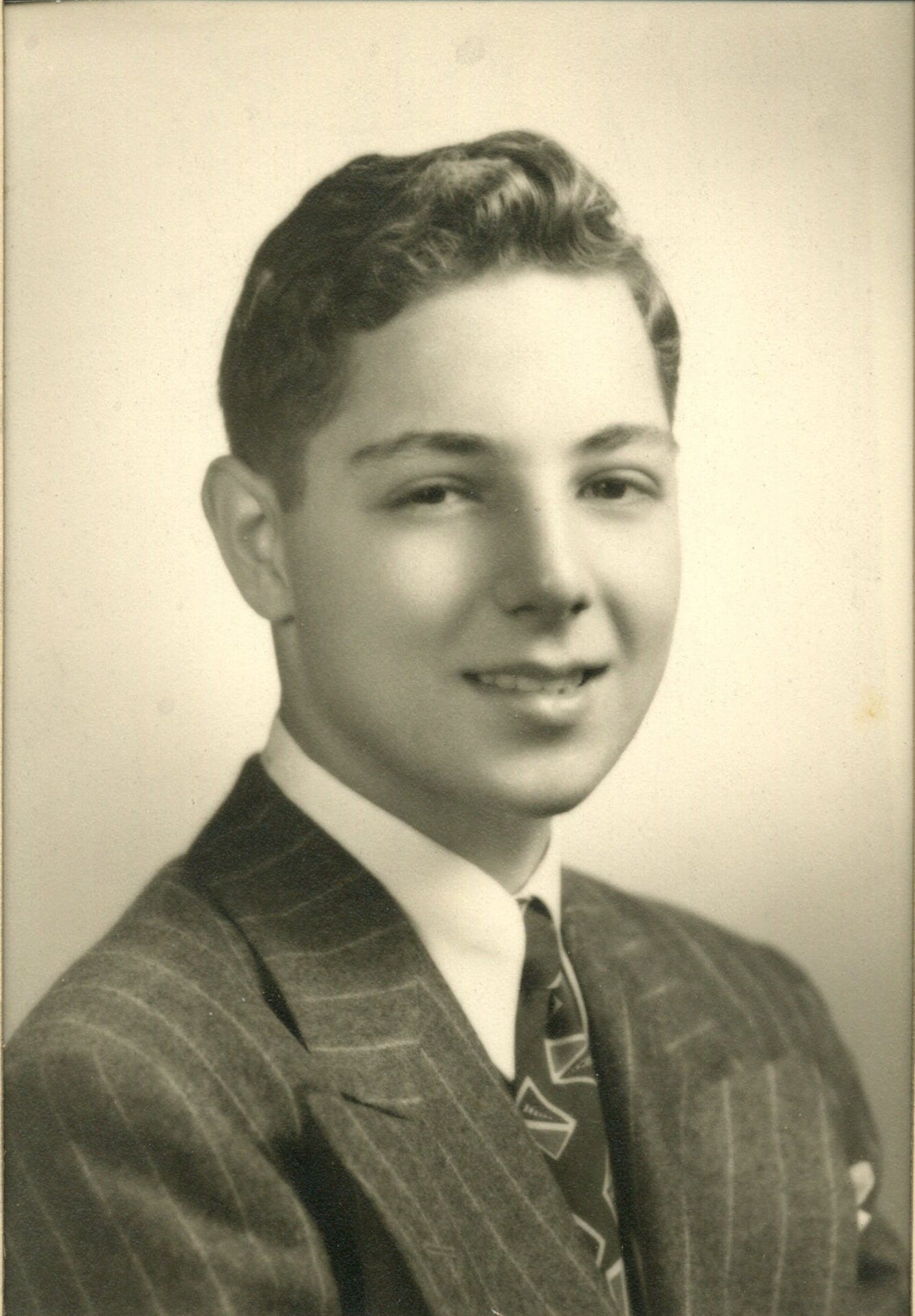
Every piece in this series has a personal thread — a moment, a memory, or a relationship that pulls the subject off the page and into my own life. For George, there are several. But let me start with my father.
My father, Jerry Segal — whose own Pittsburgh story I’ve written about elsewhere in this series — played the lead role of Newton Fuller in Kaufman and Hart’s George Washington Slept Here in his senior production at Taylor Allderdice High School in Squirrel Hill. The same school that gave us Rob Marshall and Billy Porter.
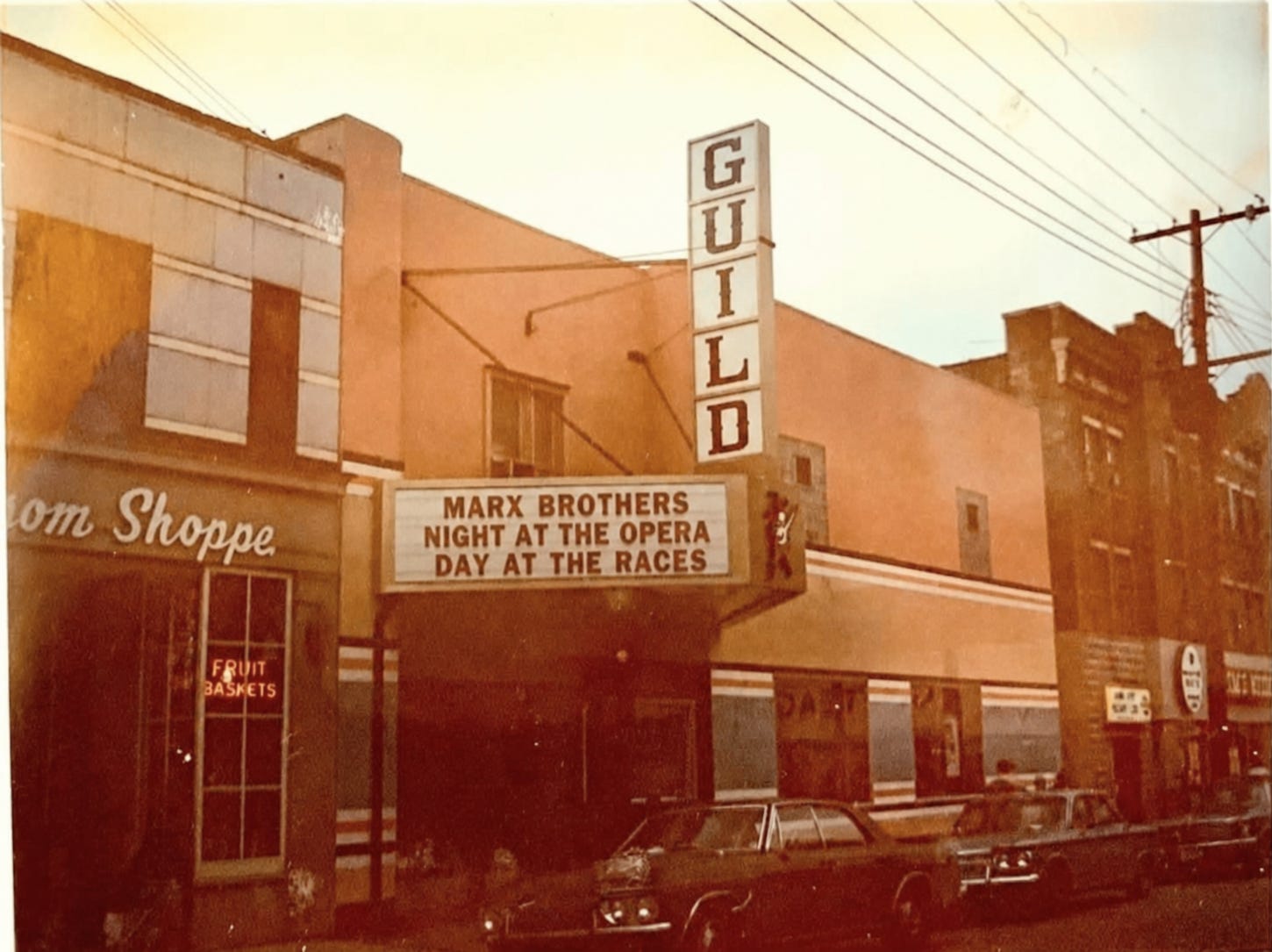
Then there is the Guild Theatre. Growing up in Pittsburgh, I spent Friday nights at the Guild Theatre on Murray Avenue in Squirrel Hill — a revival house that, through the 1970s, specialized in the films of the Marx Brothers, Humphrey Bogart, W.C. Fields, and Charlie Chaplin. The Guild ran double features of Marx Brothers classics with the cheerful frequency of a museum rotating its permanent collection. I would sit in that theater watching Groucho, Harpo, Chico, and Zeppo, laughing at lines I didn’t yet know had been written by a Pittsburgh kid who’d grown up just a few miles from where I was sitting.

And then there is Comic Relief. Serving on the Board of Comic Relief has been one of the great privileges of my professional life — an organization that uses comedy as a vehicle for radical generosity, marshaling the power of laughter in service of human dignity and social change. That is exactly what Kaufman spent his life doing on stage. His comedies were never merely entertainment. They were, at their best, acts of civic courage — using humor to say what polite society preferred to leave unsaid. In that sense, the thread from Kaufman to the mission of Comic Relief is direct and real.
Pittsburgh gave George his roots, his irony, and his hunger. My father performed his words on a Pittsburgh stage. I watched the Marx Brothers’ best performances — the ones shaped by Kaufman’s pen — at a Pittsburgh revival house on Friday nights. And now I sit on the board of an organization whose entire premise — that comedy is a force for good — is the thesis that George spent forty years proving. I didn’t plan this connection. But I recognize it, and I’m grateful for it.
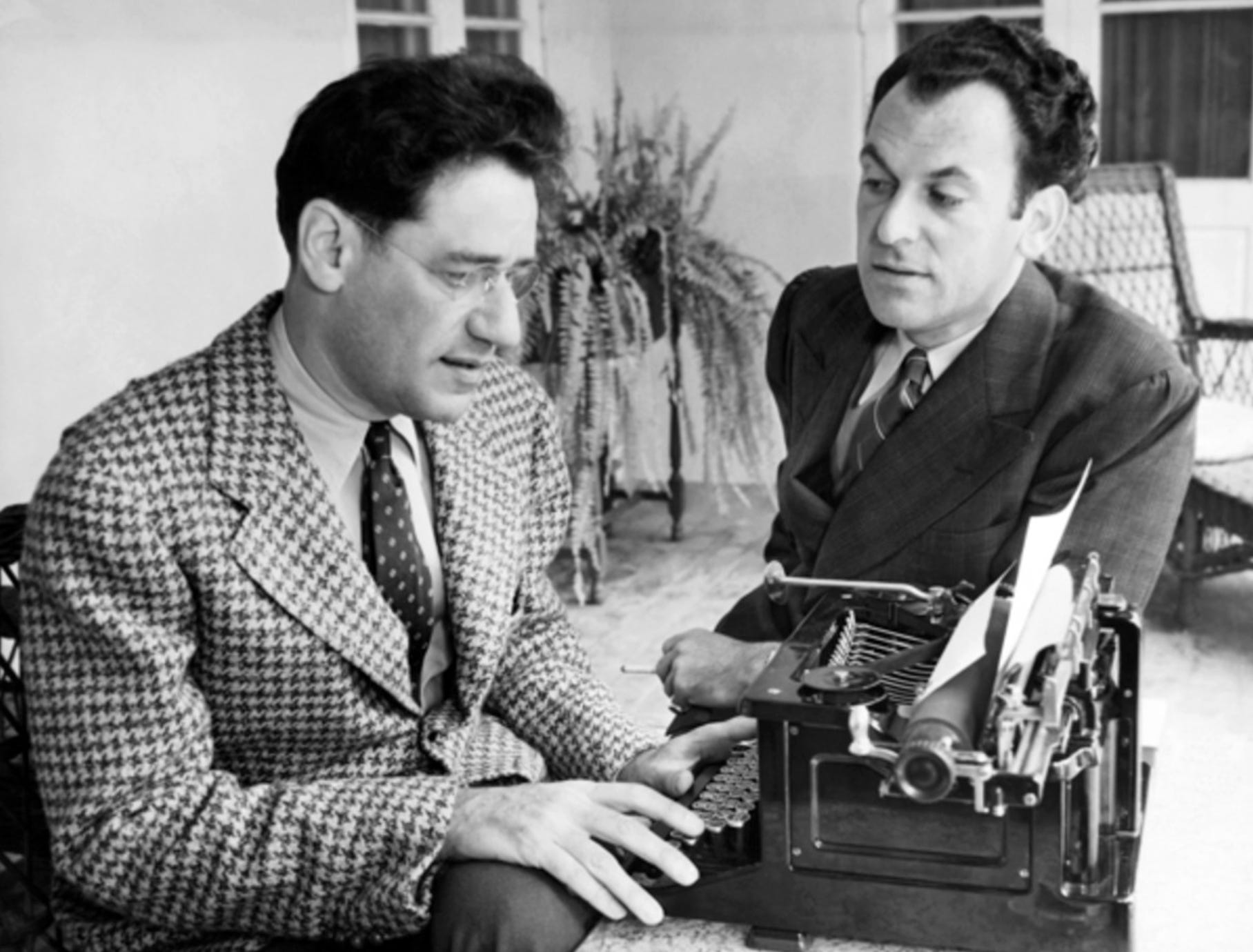
Leadership, in the Kaufman tradition, is not about authority or title. It is about craft, collaboration, and the courage to say the true thing in a way that cannot be ignored. Over a forty-year career, George modeled a form of leadership that was rigorous, generous, and transformative. These are the lessons I take from his life and work.
George wrote forty-five Broadway productions with sixteen different collaborators — and he never lost a partnership bitterly. With Marc Connelly, Edna Ferber, Moss Hart, Morrie Ryskind, and the Gershwin brothers, he brought out the best in writers who were already exceptional, and elevated the work beyond what either partner could have achieved alone. His daughter Anne reflected that every collaborator left him with admiration and affection, even as they moved on to their own independent work.
The leadership lesson is fundamental: genuine collaboration is not compromise. It is amplification. The best leaders — in theater, in business, in civic life — are the ones who make the people around them better. George was, by all accounts, demanding and exacting. But he was also generous with credit, honest in his feedback, and invested in the success of the shared enterprise. That combination — high standards plus genuine generosity — is the signature of every great creative leader.
George used comedy not to escape reality, but to confront it. When he co-wrote Of Thee I Sing — a musical that put presidential politics on a stage and made audiences laugh at the electoral process itself — he was doing something genuinely brave. Political satire in 1931 was not the safe, institutionalized form it has since become. It was a risk. Kaufman took it anyway, and the result was a Pulitzer Prize and a permanent shift in what American comedy was allowed to say.independent+1
The leadership lesson here is about moral clarity and creative courage. The most important things are often the hardest to say. Satire — done well — is not cruelty. It is truth-telling in a form that people can actually receive. George understood that laughter lowers defenses, and that a well-aimed joke can land a truth that a lecture never could. Every leader who has ever had to deliver an uncomfortable message to a resistant audience would do well to study his method.
Throughout his career, George was famous as Broadway’s premier “play doctor” — the person producers called when a show was in trouble out of town. He would arrive, diagnose the problem with extraordinary speed, offer his prescriptions, and often save productions that would otherwise have collapsed. He did much of this work uncredited, asking nothing in return beyond the satisfaction of having fixed what was broken.
This is leadership as service — the willingness to put expertise and energy at the disposal of others, without requiring recognition or reward. In a world that prizes visibility and credit, George’s quiet service to dozens of productions he would never take a bow for is a model worth emulating. The best leaders in every field are the ones who make the work better, whether or not anyone knows it was them.
George’s directorial method was built on an almost obsessive attention to the rhythm of language. He would rehearse a scene for fifteen minutes listening only to the dialogue, and then stop to remove a single word that interrupted the flow. No actor ever slipped in an ad-lib without his catching it. His plays are masterclasses in comic construction: every word earns its place, every scene builds on the last, and every curtain line is engineered to maximize its impact.
The leadership lesson is about the discipline of communication. In an era of constant noise and endless content, the leader who can say the essential thing in the fewest, most precise words has a decisive advantage. George’s genius was not volume — it was precision. He understood that the difference between a good joke and a great one is often a single word, and that the same principle applies to every act of communication that matters.
George’s later career, from the 1940s onward, never recaptured the extraordinary heights of the 1920s and 30s — and he knew it. He remained productive, directed some of the greatest productions of his era, and continued to contribute to American comedy until the very end of his working life. But the blaze of the You Can’t Take It with You years was behind him, and he was clear-eyed about it.
What he did not do was quit. He kept working, kept directing, kept showing up for the theater that had given him everything. He directed Guys and Dolls at sixty-one and made it one of Broadway’s all-time great productions. He appeared on early television as a witty raconteur, adapting to a new medium with characteristic sardonic grace. The leadership lesson is about sustainability and adaptation: the ability to keep contributing meaningfully even when the peak is past, and to find new forms for enduring talent.
Throughout his career, George’s comedies were built on a single democratic premise: that the incompetent and the foolish rise to the top, that success in America is as often a product of luck and bluster as it is of merit, and that the people best equipped to see through the charade are the ones at the bottom looking up. His heroes were invariably without lineage, money, or breeding — but they had industry, intelligence, and wit in large supply, and they usually won.
This is a profoundly democratic vision of comedy, and it is a form of leadership in itself. Kaufman used laughter to level the playing field — to remind audiences that the emperor has no clothes, that the powerful are often ridiculous, and that ordinary people with sharp eyes and quick wits can see what the establishment refuses to acknowledge. In a democracy, that kind of leadership — the leadership of the court jester, the satirist, the playwright — is not optional. It is essential.
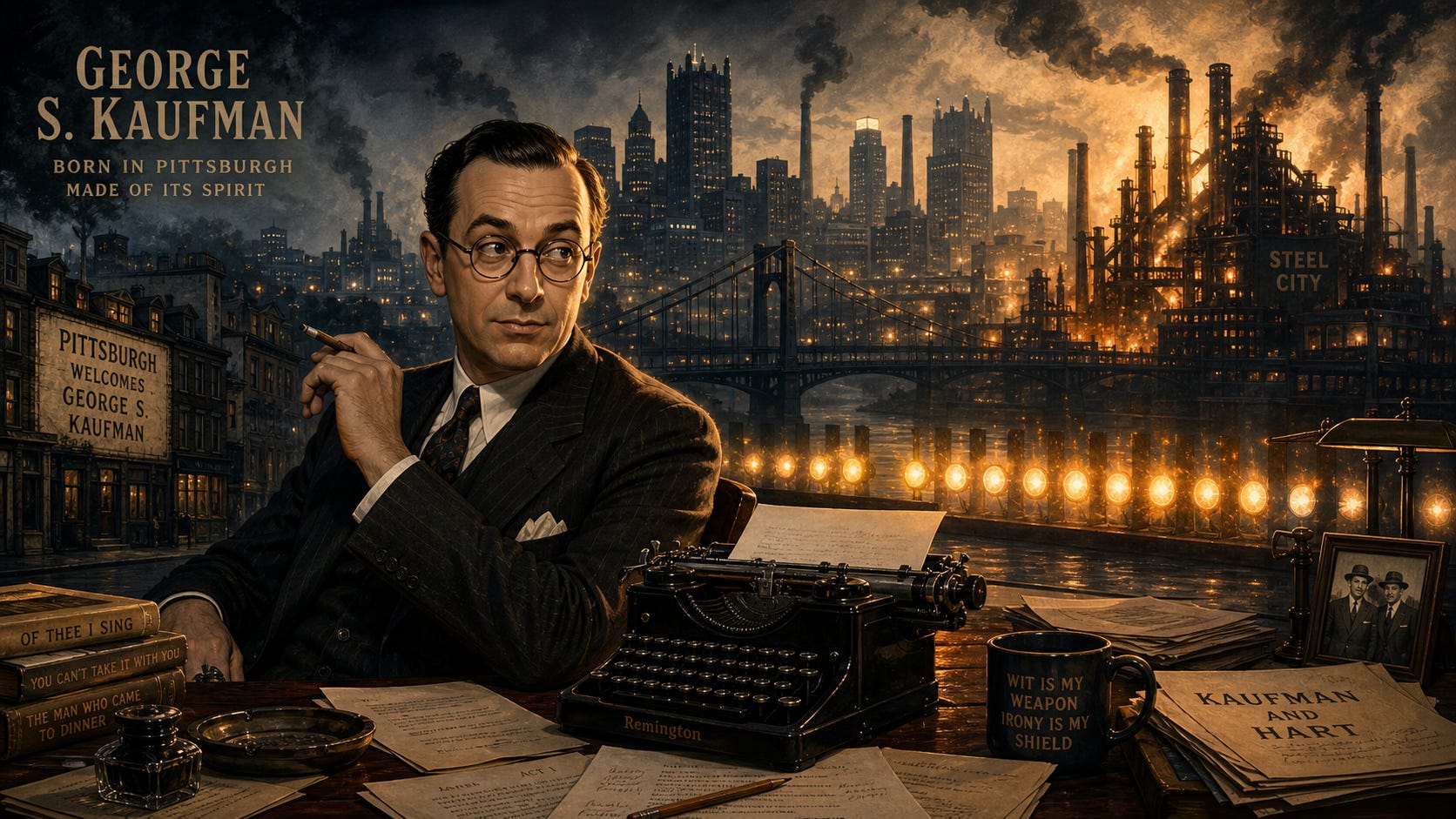
It’s tempting to say Pittsburgh produced people like George S. Kaufman in spite of itself, but the truth is almost the opposite: the city’s rough edges are precisely what sharpened them. This was a place where steel mills lit the sky orange at midnight, where neighborhoods were tight and interdependent, and where class, race, and power collided in ways you couldn’t ignore. If you grew up here paying attention, you saw the natural world under assault, working people carrying the weight of the economy on their backs, and political decisions playing out not in abstractions but in the air you breathed and the streets you walked.
Pittsburgh also forces you to live in layers. The rivers and bridges, the ethnic enclaves and parish basements, the collision of old-world traditions with new-world ambition—all of it trains you in double vision. You learn to see beauty and decay at the same time, generosity and corruption inside the same institutions, hope and resignation sitting next to each other on the streetcar. That layered perception is exactly what a satirist like George S. Kaufman needs: the ability to hold contradiction without flinching, to recognize that every story has both a surface and an undercurrent, and to turn that tension into comedy that bites.
And then there’s the chip on the city’s shoulder, which is its own creative accelerant. Pittsburgh has never been coastal enough to be fashionable, or midwestern enough to be bland. It had to earn every ounce of attention it got, and so did its people. That pressure bred a particular stubbornness—a refusal to accept easy answers, a willingness to challenge authority, and an instinct to look for what’s being left out of the official story. Put all of that inside the mind of George S. Kaufman, and you get a writer whose jokes don’t just decorate the culture; they change the way the culture sees itself.
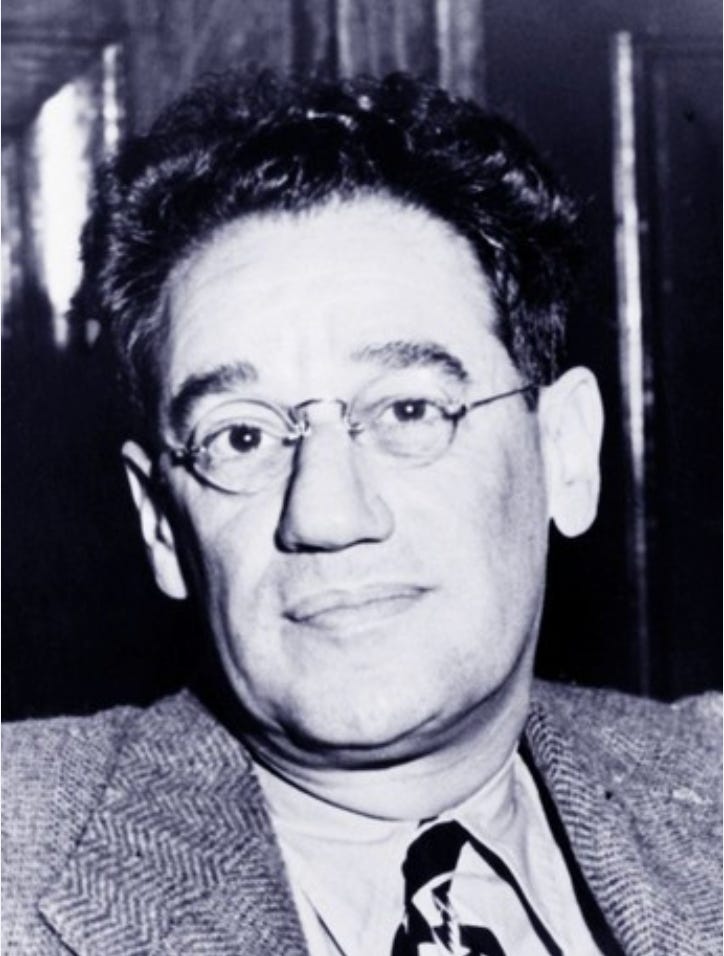
There is a line in the George S. Kaufman Legacy Project that has stayed with me since the first time I read it: “There has not been a Saturday night since 1925 when a George S. Kaufman comedy hasn’t been playing somewhere in America.” Think about that for a moment. Over a century of unbroken performance. A century of audiences in cities and small towns, in professional theaters and high school auditoriums, in community playhouses and regional repertory companies, laughing at the words of a lanky kid from Shadyside who preferred Mark Twain to law school.
My father performed his words on a high school stage. I watched his Marx Brothers movies in a Pittsburgh theater on Friday nights. And I have spent the better part of a professional life in rooms where comedy, leadership, and civic purpose intersect in exactly the way George spent forty years insisting they could. The through-line is real. The inheritance is real. And the work of honoring it — by taking laughter seriously, by using satire as civic courage, by building partnerships that amplify rather than diminish — is very much still underway.
George was not a quiet leader. He was a loud one — in print, on stage, in the collaboration rooms of Broadway and the lunchroom of the Algonquin. But his noise was disciplined and purposeful. He said the things that needed to be said in the forms that people could actually receive. He made America laugh at itself — and in doing so, he made it a little more honest, a little more self-aware, and a great deal more entertaining.
Pittsburgh gave us George S. Kaufman. He gave us the wisecrack as a democratic weapon, the collaborator as a model of shared leadership, and the satirist as civic conscience—using comedy to expose the vanity, greed, and authoritarian impulse in American public life. Long before television and today’s late-night monologues, Kaufman understood how rhetoric, propaganda, and spectacle could soften the ground for fascistic forces, and he answered them with precision-engineered mockery that made abuse of power look ridiculous rather than inevitable. In an age when democratic norms feel newly fragile, his work reminds us that sharp, principled laughter is one of democracy’s oldest and most underrated defenses.
Some things close on Saturday night. George S. Kaufman is not one of them.