
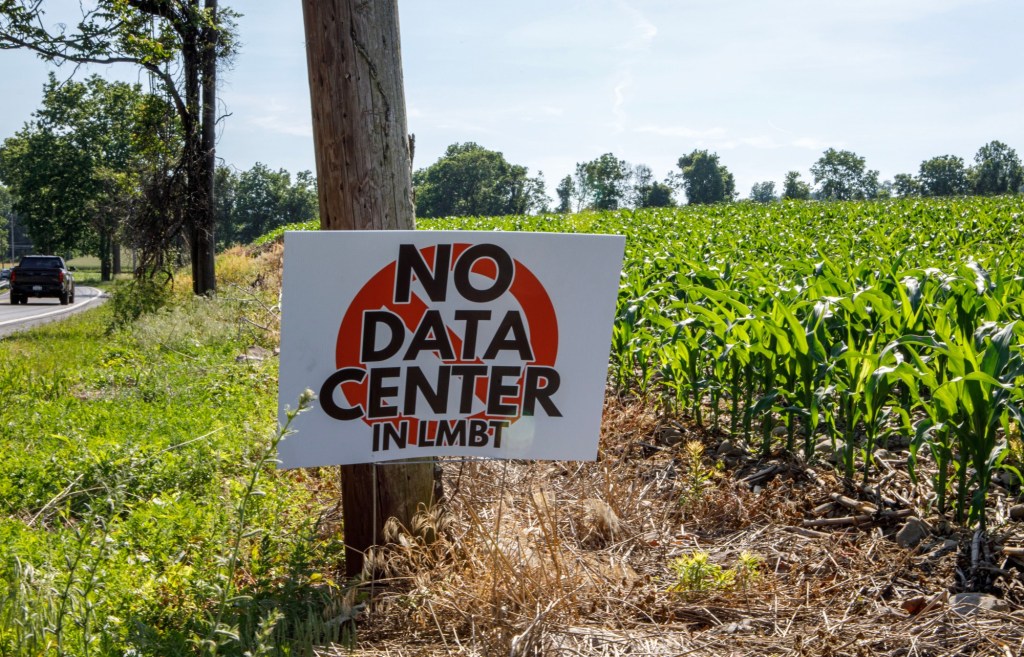
Not since the start of the Lehigh Valley warehouse boom a decade ago have development projects caused so much angst. Nobody, it seems, wants a large data center in their backyard.
But the angry crowds who fill municipal meetings chanting “just say no” may be wasting their collective breath, because town leaders don’t have the power to ban a project just because residents don’t like it.
Here’s why.
Pennsylvania is a “fair share” state
A 1968 law that created the Municipalities Planning Code, which gives local governments the power to enact zoning ordinances, requires that all types of zoning have a space. Because data centers are lawful, municipalities are legally required to provide space for them, typically in industrial-zoned districts.
Towns can attempt to ban data centers, but that would be considered illegal exclusionary zoning, potentially opening the municipality up to expensive lawsuits.
What else could happen?
When a Pennsylvania municipality violates the fair share zoning doctrine, its zoning ordinance can be declared invalid in court. This strips the municipality of its authority to block the development.
That’s what happened in 1977 to Upper Providence Township in Delaware County. A developer named Robert Surrick wanted to build townhouses on 22 acres of land he owned. Multifamily homes like apartments and townhomes were allowed in Upper Providence, but only in a 43-acre business district, which was less than 2% of the municipality’s land and mostly developed.
Surrick’s application was denied, so he sued, complaining that the town’s zoning was unconstitutional. The Pennsylvania Supreme Court agreed, and invalidated that part of the town’s zoning ordinance, making it impossible for Upper Providence to stop Surrick from building townhouses.
Can’t towns just change their zoning ordinances to thwart data center developers?
Pressing a pause button and trying to rewrite zoning ordinances to exclude data centers may also be illegal. Under the law, if a developer submits a proper application while an ordinance is being rewritten, the municipality must review it under the laws that were in place at the time of submission.
That’s why Allentown’s new ordinance, which limits where data centers can be built and requires a public hearing on each project, won’t affect the proposed West Emmaus Avenue project. Developers got their application in before the ordinance passed.
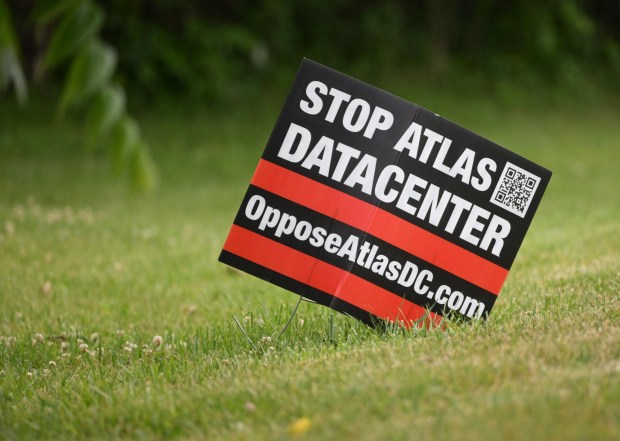 Signs opposing the Atlas Data Center line the roads Monday, June 8, 2026, in South Whitehall Township. (Monica Cabrera/The Morning Call)
Extra, significant hurdles in the Lehigh Valley
The Project Atlas data center near Parkland High School in South Whitehall Township, for example, is proposed for the township’s Planned Innovation, Research and Technology overlay district. This unique zoning feature permits data centers “by right,” allowing developers to bypass a zoning board hearing and move straight to the planning phase.
“It essentially places the burden of proof on the municipality to prove that the developer does not meet the requirements of all applicable ordinances, laws and required permits,” said Spurgeon J. Dunbar, a member of the South Whitehall Alliance, a group formed to fight the data center.
The PIRT zoning also makes it easier for data centers to repeatedly revise their plan if its rejected, Dunbar said. The Planning Commission will meet July 9 to review Project Atlas.
Can lawmakers do anything?
Besieged with pleas to stop data centers, lawmakers are pitching bills to halt or limit where the projects can be built. State Sen. Jarrett Coleman, R-Lehigh, in May introduced a package of bills in the state Senate and House along with Rep. Jamie Walsh, R-Luzerne, to repeal the 2021 tax break being given to data centers to locate in Pennsylvania and allow municipalities to place a moratorium on data center development applications. The bill recently advanced out of the Senate Local Government Committee.
Coleman, who attended a packed zoning board hearing on the proposed data center at the former Air Products headquarters in Upper Macungie Township and has held telephone town halls on the subject, has urged residents to keep up the fight.
“When you show up at meetings and you make public comment and tell them your personal stories, those are your elected officials who are sitting up there. They’re going to have to see you in the community. You’re a lot more influential than you think,” Coleman told callers.
Lawmakers in other parts of the state are waging similar battles against data centers. The state House of Representatives on June 24 passed a bill that would empower local governments in Pennsylvania to place up to a six-month pause on their consideration of a data center application. If adopted, the law would allow municipalities to adopt, amend or repeal sections of their related land-use ordinances during the pause. Those changes would then apply to any projects submitted during the pause.
The measure’s sponsor, state Rep. Paul Friel, D-Chester, said the pause window would give local governments time to research, draft and pass comprehensive land-use ordinances pertaining to data centers.
“The bill gives our local officials necessary breathing room to update these ordinances, evaluating demands like water and energy usage and other considerations related to protecting our communities from potential harms caused by data center development,” Friel said.
The bill is now with the state Senate for consideration.