
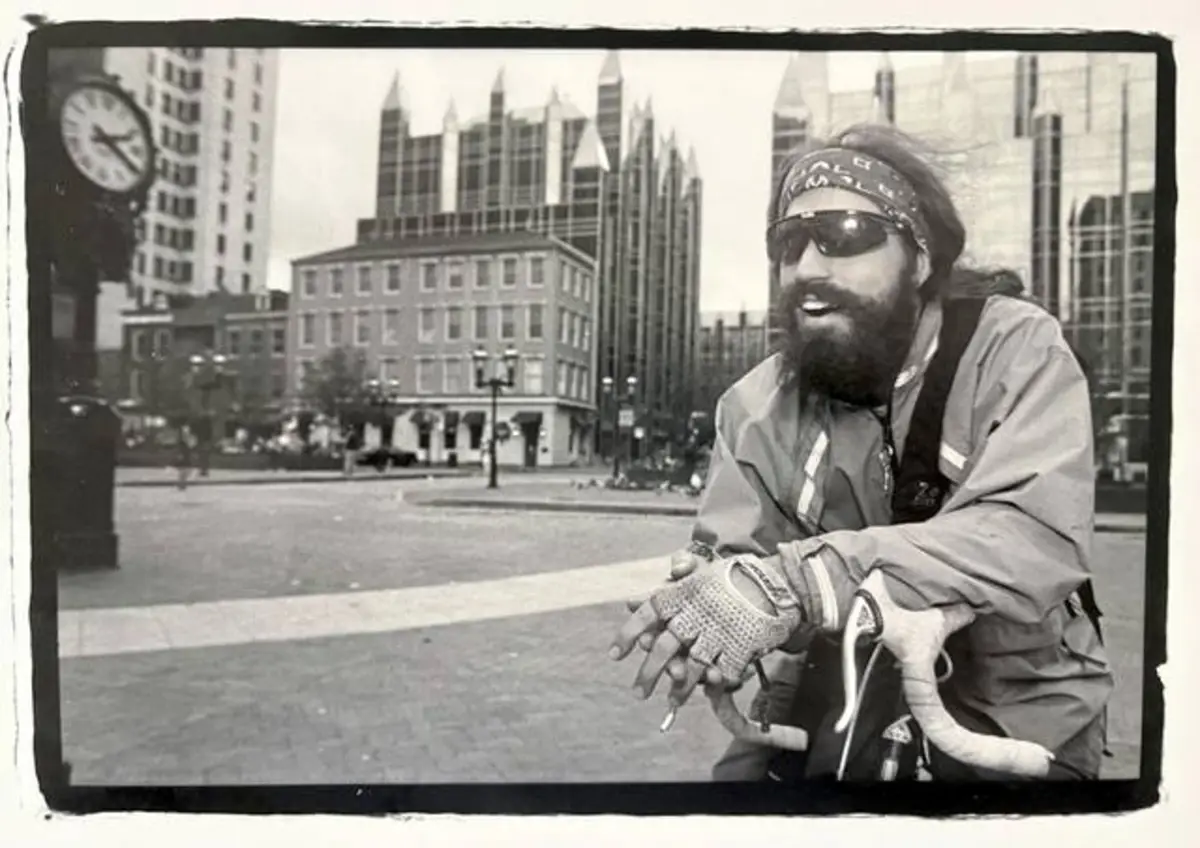
Before smartphones, electronic signatures and GPS, Pittsburgh’s bike messengers raced against the clock, traffic and topography challenges.
On any given day in the early 1990s, Greg Park might be pedaling a stack of legal documents from one Downtown Pittsburgh law office to another, balancing architectural drawings through rush-hour traffic or racing with a bundle of fur coats across the city before a department store closed for the day.
There were no smartphones to provide directions. No GPS to reroute around traffic — not even any bike lanes to offer protection.
Just a fold-out paper street map, a single-speed bicycle and a deadline.
“It was one of the greatest jobs and best times of my life,” Park said. “There isn’t a day that goes by that I don’t look back and think about it.”
For nearly two decades, beginning in the late 1980s, Park was among the bike messengers who helped keep the Downtown business community moving. The messengers hustled contracts, court filings, blueprints and countless other time-sensitive deliveries across the city.
“It definitely isn’t anywhere near what it was during the heyday,” said Park, 56, of Squirrel Hill. “There are still a few guys out there, but most of the work now is lunch deliveries and DoorDash.”
The industry that once thrived gradually faded as fax machines disappeared, electronic signatures became commonplace and businesses no longer needed someone to physically shuttle paperwork across town.
Park’s introduction to messenger life came almost by accident.
While attending the University of Pittsburgh, he combed through the Yellow Pages, found Triangle Messenger’s phone number and called.
“They hired me on the spot,” he said.
He had recently moved to the South Side, where his apartment rented for just $235 a month.
“It was kind of a charmed time to be a late teen or early 20-year-old,” he said.
Triangle Messenger operated out of Bingham Street on the South Side before later relocating to Josephine Street. After several years, Park joined competitor Jet Messenger, where he spent about 15 years.
Every morning, the messenger garage filled with an eclectic mix of riders waiting for dispatches.
“It felt like walking into an episode of (the TV show) ‘Taxi,’ ” Park said. “There were all these characters.”
Many were musicians, artists or young people just drawn to the job’s flexibility.
“Most of the people doing it weren’t looking for corporate careers,” he said. “They wanted enough money to pay rent, buy food and have the freedom to do what they loved.”
Messengers worked as independent contractors, meaning every delivery represented another paycheck — think Uber and Lyft of the 1980s and ’90s.
“If you didn’t work, you didn’t make money,” Park said. “But if you wanted to work, you could always make money.”
Learning the city was part of the job.
Without GPS, new addresses meant unfolding a paper map on a street corner. Experience eventually replaced maps as riders memorized office buildings, shortcuts and customer routines.
“You had to have paper maps,” Park said. “Eventually you just knew where everything was.”
Cycling through Pittsburgh was a lot different than it is today.
“There were no bike lanes,” he said. “Back then, you were kind of a pariah. Drivers just weren’t used to cyclists.”
The bikes at Triangle were simple: sturdy single-speed machines with large carrier baskets and coaster brakes built to withstand constant abuse.
The cargo could be almost anything.
One regular assignment became known as the “fur run.” Nearly every day, Park transported fur coats from Horne’s department store to a cleaner for embroidery work before returning them.
Other days involved emergency legal filings that demanded speed and precision.
“You’d pick up a package at a law firm, get it signed and bring it back,” he said. “Those were the sweet runs because everyone was waiting on you.”
Messengers biked through snow, freezing rain and summer heat. Park remembers dodging pedestrians, avoiding aggressive geese near the riverfront on the North Shore and hearing about fellow riders crashing into the river after swerving to avoid obstacles.
Featured Local Businesses
“We were fearless,” he said.
Looking back, he marvels at some of the routes he routinely tackled in and around the city and its hills.
“Everyone who did that job was in incredible shape,” he said.
Christopher Bobnar, who helped found Jet Messenger in Pittsburgh, said insurance rates eventually became the downfall of bike messengers.
“Insurance rates were the absolute reason why they went away,” he told me. “There were a lot of injuries. There were a lot of good athletes that got into it, but also a lot of people who got hurt.”
Jet Messenger still exists in Pittsburgh today, delivering solely through trucks and vans with 10 employees. The company also handles managed storage and fulfillment.
“Yeah, bikes are gone,” Bobnar said. “It was something back then.”
Eventually, Park left the bike game to study massage therapy in Thailand. He returned to Pittsburgh in 1995 to build his own practice. He still occasionally drives for Uber and says the work reminds him of his courier days — working independently and deciding when to clock in.
Still, nothing has matched life on a messenger bike.
“It wasn’t always easy,” Park said. “There was rain, snow, slush and freezing temperatures. But I wasn’t sitting in a cubicle with someone looking over my shoulder.”
He has nothing but fond memories when reflecting on those years weaving through Downtown traffic with a messenger bag slung across his back.
“Looking back, it was probably a little crazy,” he said. “I’m grateful I got to live that life.”