
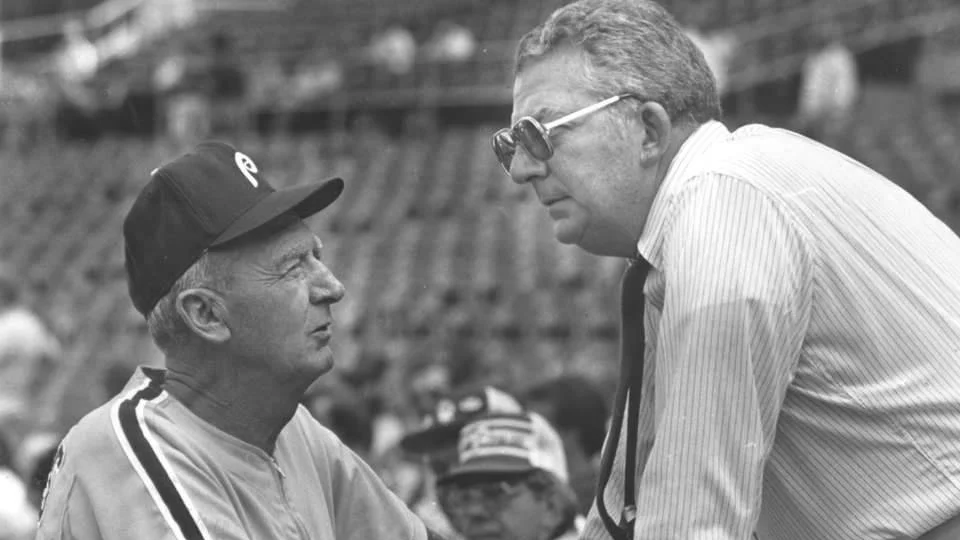
 Before All-Star Week became a traveling baseball festival, before FanFest, before All-Star Village, before the sport learned to stretch one exhibition game into a week of events, concerts, youth showcases, sponsor activations and civic branding, Bill Giles looked at the 1976 All-Star Game in Philadelphia and saw something larger.
He saw the city.
That may be the most important legacy of the 1976 All-Star Game at Veterans Stadium. The National League beat the American League, 7-1, on July 13, 1976. George Foster was the game’s MVP. President Gerald Ford threw the ceremonial first ball. Five Phillies — Greg Luzinski, Bob Boone, Dave Cash, Larry Bowa and Mike Schmidt — were introduced to thunderous ovations in their home park.
But the part of the story that still echoes 50 years later happened the night before, near the Liberty Bell.
Giles, then the Phillies’ executive vice president, wanted the All-Star Game to be more than a ballgame and a formal hotel dinner. In his memoir, Pouring Six Beers at a Time, as quoted by longtime Phillies executive Larry Shenk in an MLB.com retrospective, Giles wrote that baseball was showcasing the best players in the world, so the event deserved a stage worthy of them.
Philadelphia, in the summer of 1976, had one.
The city was nine days removed from America’s Bicentennial celebration. Independence Hall and the Liberty Bell were not merely tourist stops. They were the centerpieces of the national story. So Giles surveyed sites across the city and chose the Judge Lewis Quadrangle in Independence Park, close enough to the Liberty Bell and Independence Hall to make the symbolism impossible to miss, according to Shenk’s MLB.com account.
Then he built a party around it.
There was a large awning, a bandstand, a dance floor, a New York dance band and a Mummers band, Giles recalled in his memoir, according to Shenk. About 1,500 guests were transported from their hotels in cable-car-style trolleys. The Phillies’ Hot-Pants Patrol greeted them with trays of drinks. Food stations and bars were spread throughout the site. Around 10 p.m., fireworks exploded overhead.
In another era, it might have been treated as a reception.
In Giles’ hands, it became civic theater.
Shenk later wrote for Phillies Insider that Giles organized the giant tent party on Independence Square because he wanted to showcase Philadelphia during the Bicentennial. Shenk also wrote that the party, held the evening before the game, became an MLB tradition.
That is the line that matters now.
Giles did not invent the All-Star Game. He did not invent the Home Run Derby. He did not create FanFest or the modern All-Star Village. Those came later. But what he helped create in Philadelphia was the idea that the host city should not simply provide the ballpark. It should become part of the show.
That was very Giles.
Triumph Books, in its description of Pouring Six Beers at a Time, refers to Giles as a man once called the “P.T. Barnum of Major League Baseball.” It is not hard to see why. He built his career around the understanding that baseball was not just innings and lineups. It was experience, memory, spectacle and connection.
In Philadelphia, that meant turning baseball into local language.
It meant Mummers at an All-Star party. It meant trolleys near Independence Hall. It meant fireworks over the city that had just celebrated the nation’s 200th birthday. It meant making sure visitors did not merely attend an All-Star Game in Philadelphia. They felt Philadelphia around the game.
That instinct showed up throughout the Bicentennial season. In a 2026 Philadelphia Inquirer story, Alex Coffey reported that Giles devised another Bicentennial promotion in which brothers K.C. and Russ Peterson rode 318 miles on horseback from Boston’s Old North Church to Veterans Stadium dressed in colonial garb, delivering a Phillies game ball as part of a Paul Revere-inspired stunt. Coffey reported that Giles had been fascinated by Revere’s lesser-known 1774 ride to Philadelphia with the Suffolk Resolves and turned the history into baseball promotion.
That was the point. Giles understood that Philadelphia history could be baseball programming.
The 1976 All-Star party now looks like an early version of something MLB has fully embraced. When the All-Star Game returns to Philadelphia in 2026, it will arrive with All-Star Village, the Futures Game, the HBCU Swingman Classic, the Home Run Derby, youth tournaments and days of events spread across the city. The modern version is larger, more corporate and more polished.
But the blueprint feels familiar.
Make the host city visible. Make the game feel bigger than the game. Give fans and visitors something beyond the box score. Build the week around place, not just players.
Giles seemed to understand that before most people did.
After the 1976 party, Giles wrote that future All-Star parties kept growing until the break became a “three-day celebration,” according to Shenk’s MLB.com retrospective.
That is the through line from 1976 to 2026.
Long before All-Star Week became a branded baseball convention, Philadelphia had Bill Giles, a Bicentennial summer, a tent near the Liberty Bell, a Mummers band, trolleys, fireworks and the belief that the Midsummer Classic should be more than one night at the ballpark.
The modern All-Star celebration was not born fully formed.
But one of its clearest ancestors was staged in Philadelphia, in the shadow of Independence Hall, by a baseball executive who knew the city itself belonged in the spotlight.
Recent Philly | Phillies Baseball News | Philadelphia Baseball Review
How Bill Giles and the Phillies turned the 1976 All-Star Game into a Philadelphia festival (July 11)
For Griffey and Rollins, the HBCU Swingman Classic is about who baseball has overlooked (July 10)
Roman Catholic grad Santino Harwood brings his parents’ lessons to the HBCU Swingman Classic (July 10)
Why Philadelphia’s youth events may be the most important part of All-Star Week (July 10)
Bryce Harper, Kyle Schwarber give Phillies two hometown stars in Home Run Derby (July 10)
Jesús Luzardo silences Reds as Phillies win 1-0 in Cincinnati (July 10)
From Malvern Prep to Latin America, Project Béisbol builds opportunity through the game (July 10)
As All-Star Week opens in Philadelphia, MLB’s labor problems loom over the celebration (July 9)
Why the HBCU Swingman Classic matters in Philadelphia (July 9)
Philadelphia native and Father Judge grad Dan Hammer reaches Majors with Mets (July 8)
Late pick, thin depth put pressure on Phillies’ as 2026 MLB Draft nears (July 8)
Philly Select League All-Star Game puts league’s rising talent on display (July 8)
Wheeler answers All-Star snub with 14-strikeout statement as Phillies beat Reds (July 7)
Luzardo joins Phillies’ All-Star contingent, while Wheeler remains odd man out (July 6)
Phillies open Reds series looking for cleaner response as All-Star spotlight shifts home (July 6)
Philadelphia flavor will frame All-Star Game pregame ceremonies at Citizens Bank Park (July 6)
Royals bury Phillies in ugly series finale as Sánchez unravels (July 5)
Rake’s Joe Lifsted lets his game speak while waiting for his next opportunity (July 5)
Nola gives Phillies a needed start, but bats go quiet in loss to Royals (July 4)
Five Phillies named All-Stars as Wheeler waits on potential replacement call (July 4)
On the Fourth of July, baseball still belongs to the kids in Philadelphia (July 3)
Bryce Harper’s Home Run Derby decision has become one of All-Star week’s biggest questions (July 3)
Alvarado falters as Phillies’ bullpen cracks in heat as Pirates split series (July 2)
Wheeler wanted one more out. but Mattingly had to think bigger (July 2)
After a year of waiting, Patrick Kilgus uses summer to prove he belongs (July 2)
Phillies turn Wheeler-Skenes duel into slugfest, then survive late push (July 2)
All-Star Game Rewind: When Philadelphia became baseball’s summer capital in 1996 (July 1)
How Cristopher Sánchez turned precision, power and poise into an All-Star case (July 1)
Sánchez dominates, Turner powers Phillies to Fireworks Night rout of Pirates (June 30)
Aaron Nola has earned patience, but the Phillies need answers (June 30)
Phillies News from the Philadelphia Baseball Review