
In a flurry of votes on Sunday afternoon, the general assembly passed a $50.8 billion state budget– nearly two weeks past the legal deadline to do so.
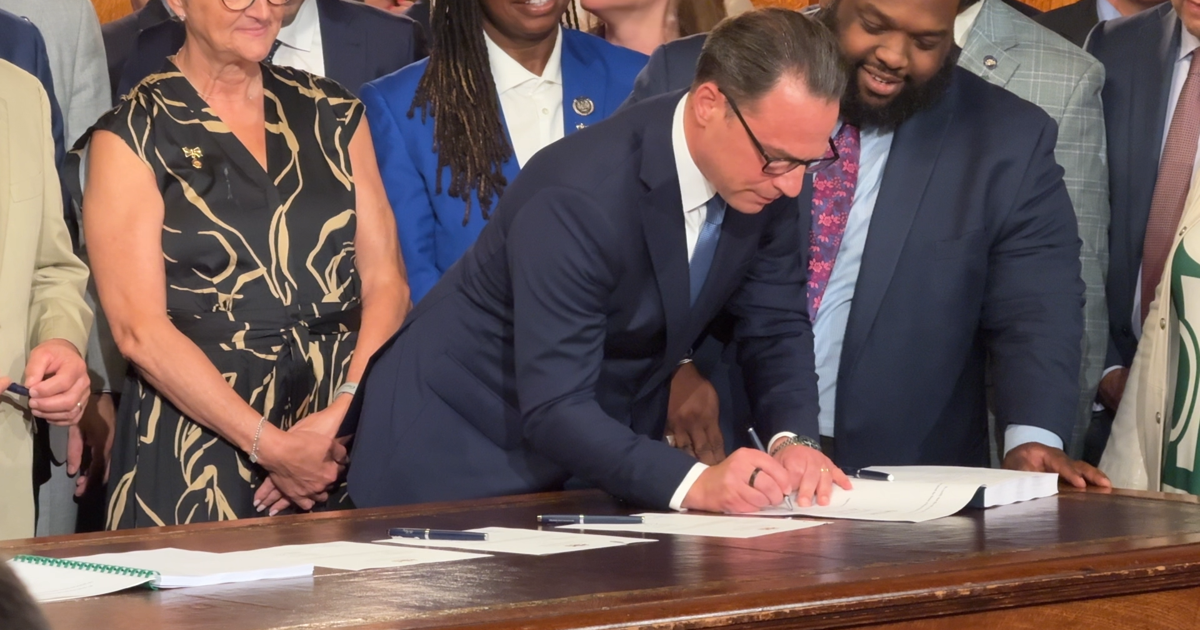
Democratic Gov. Josh Shapiro signed the final documents around 6pm on Sunday; an approved spending plan will allow state funds to flow to schools and counties after a 12 day delay.
“We managed, as the math indicates, to find compromise without compromising our core values,” Shapiro said during remarks before the signing.
The $50.8 billion budget is just a 1.5% increase to last years spending.
Legislative leaders designed the spending plan in close door negotiations over the past month; with most local elected officials only learning all details of the plan on Saturday evening.
Out of 252 state representatives and senators, 211 voted in favor of the deal.
The Democratic controlled house and Republican controlled senate had to find common ground to approve the spending plan–
“It doubles down on making Pennsylvania more affordable, our schools better funded and more equitable,” said Rep. Matt Bradford, House Democratic Leader, when asked what he thought of this year’s deal.
“I feel much better coming out of this budget with our fiscal stability,” said Sen. Scott Martin, Republican chair of the Senate Appropriations Committee, during remarks from leaders after the passage.
The budget does not dip into the state’s $8 billion rainy day savings, a priority for Republicans. Still, several Democratic policy priorities saw significant fund increases… like over $900 million for education.
In the northern tier, local school districts averaged between 3-5% fund increases.
In Erie County, the Erie School District and Fairview both received roughly 8% in increases– though districts like Girard and Union City saw closer to 2% raises.
The state will delay payments to managed care organizations— private groups that manage Medicaid programs for the Department of Human Services— to balance the books. Clients will still be able to access all benefits.
The funding bumps are also partly possible from reallocating unused agency funds.
“Our team has been looking at all the historical trends as to what’s coming into those accounts, what’s going out of those accounts,” Martin said.
Other pricey updates include a $125 million grant for bio tech start ups, $775 million for roads and bridges pulled from accounts in the Motor License Fund, and roughly $81 million increase to nursing homes.
Rape crisis centers received an additional $12 million in funding, nearly doubling their annual allocation.
Data center regulation was minimal, with some energy and water reporting standards inputted. Potential elimination of tax credits or allowing local governments to pause (moratorium) data center applications were not touched.
There is a cost-of-living adjustment for teachers, government employees, and fire and police officers who retired before 2001. Shapiro referenced George, a Pennsylvania firefighter who worked for 31 years before retiring in 2000, who had not seen a pension increase in over two decades.
“George and retirees like him will see an additional $300 a month. That’s 3600 bucks a year,” Shapiro said.
Budgets also reflect regional opportunities for spending.
Rep. Ryan Bizzarro shared that several projects in Erie County received funding.
“Great economic development opportunities for our region.. investments in our schools.” Bizzarro said. “This budget is definitely a win win, not just for Erie County but for every county in Pennsylvania.”
Rep. Clint Owlett praised the road and school funding, but shared some disappointments around regional priorities.
“[We] could have had more funding for streams and creek maintenance. That’s a big issue for us in our district right now,” Owlett said. “Also, some economic development money for our district that we were hoping for didn’t quite make the cut.”
Sen. Gene Yaw said a Bass Pro project in Lycoming County did not receive requested economic development help from the state.
This is the fifth year in a row the state budget has been late. While the 12 day delay is an improvement from last year’s 4 1/2 month budget impasse, local leaders say the trend sets a double standard. Schools and counties are penalized if they do not pass their budgets on time.
While a July deal was reached- tensions remain among Harrisburg leadership.
“If we go a full day without giving a counteroffer, that to us is too long. It’s frustrating,” Martin said, referring to parts of the negotiating process.
“The senate has become dysfunctional. There’s just no doubt about that,” Bradford said, referring to slowness in the chamber to bring bills to the floor for a vote.
A plethora of complex or contentious policy issues were left unfinished. The state’s minimum wage remains at $7.25 an hour, skill games could be seized as illegal gambling machines starting in October, and starting July 24 counties could be left to their own interpretations of a court reversal on 2nd degree sentencing laws if the legislature does not take action.