
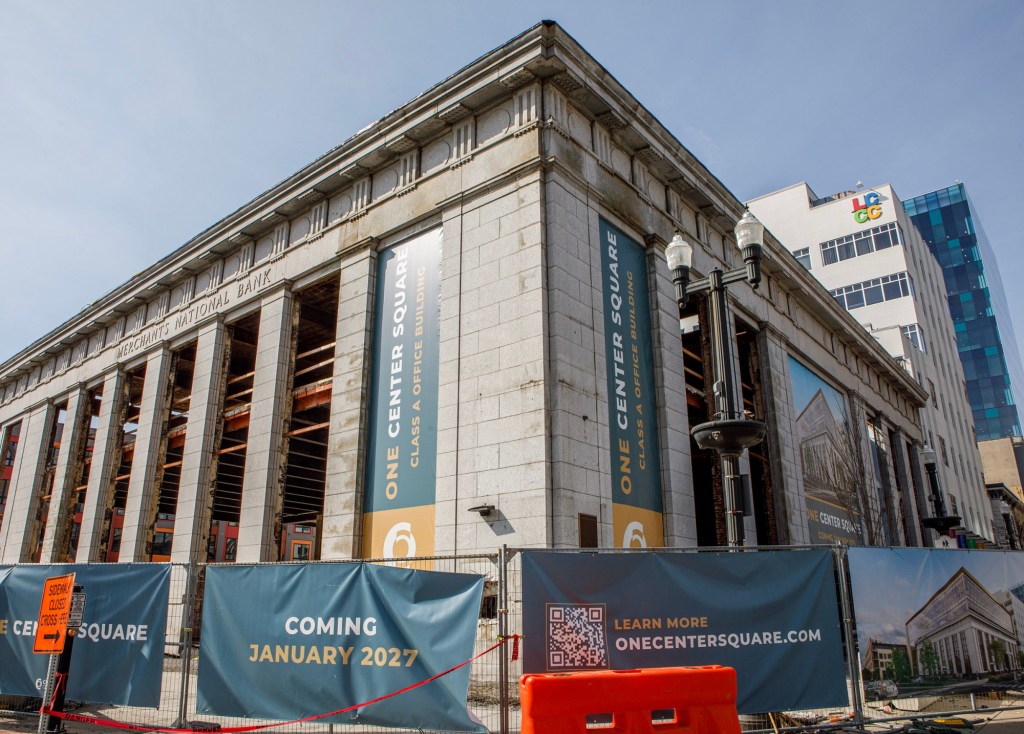
Thomas Jefferson University announced Monday it will open a Lehigh Valley location of its Sidney Kimmel Medical College in July 2029.
It will be in the heart of Allentown, at the One Center Square mixed-use development at 702 Hamilton St, and will feature more than 54,000 square feet of medical education space. When it opens, the college will offer the same curriculum with the same learning objectives, assessment standards and graduation requirements as the Philadelphia campus.
“They will not be distinct from the rest of the residency and fellowship program. They will be all integrated as one program,” said Dr. Said Ibrahim, dean of the Sidney Kimmel Medical College.
The project was announced in a news release and during a news conference Monday in front of the former Merchants National and Wells Fargo bank building that was attended by a host of elected officials, including state Sen. Nick Miller, state Rep. Mike Schlossberg and Revenue Secretary Pat Browne.
“It’s a real opportunity for Allentown kids to stay here and pursue their dreams,” Allentown Mayor Matt Tuerk said.
Schlossberg said he and his colleagues were recently able to secure $2.5 million in state funds for Jefferson.
“That money will go to the medical school and subsidize the cost of tuition, medical research, purchasing equipment and allow Jefferson to lead and innovate,” he said.
Clinical training will be conducted at Jefferson Health’s Lehigh Valley Health Network hospitals and outpatient locations. Ibrahim said new clinical research will be incorporated into education at the campus, expanding beyond trials already occurring in Jefferson’s Lehigh Valley hospitals.
Ibrahim said a great deal of work needs to be done before the medical school opens, including refurbishing and outfitting the building, bringing together the faculty to educate students, establishing student housing and receiving accreditation. He said the school plans to start recruiting students in summer 2028. The inaugural class will have 49 students.
“Usually, it takes much longer than that to actually stand up a medical school. But fortunately, a lot of the infrastructure for medical education already exists,” Ibrahim said.
Construction crews were actively working, and sounds of grinding power tools could be heard in the background.
Plans include a library, research space, wellness rooms and counselors on the second floor; a third-floor student lounge along with lecture halls, an auditorium and study areas; and simulation labs and offices on the fourth floor.
Dr. Susan Aldridge, president of Jefferson University, said as part of preparations, Jefferson already has met with the presidents of local colleges and universities to discuss their premedicine programs to establish pipelines into the medical school, as well as discuss pipelines for other health professions needed at the hospitals in Lehigh Valley.
The new campus marks the latest milestone in Jefferson University’s academic expansion and growth. In June, Delaware selected Sidney Kimmel Medical College to establish the state’s first four-year medical school. And in May, Jefferson announced that it would begin offering nursing education and other other healthcare education programs at the Lehigh Valley Health Network Center for Healthcare Education and online by the end of 2026. Aldridge said since the expansion was announced, all programs have been approved and accredited by the state.
The announcement of a new medical school program is long-awaited as LVHN ended its medical school program with the University of Southern Florida following the finalization of the merger between Jefferson and LVHN about two years ago. It also adds another layer of competition to the business rivalry that Jefferson and LVHN have with St. Luke’s University Health Network, which operates its own medical school program in partnership with Temple University, and has long operated its own nursing school and health science programs in the Lehigh Valley.
Aldridge said previously that Jefferson University’s expansion into the Lehigh Valley is not about competing with St. Luke’s, but addressing current and growing workforce challenges. She said there is a regionwide shortage of 156 physicians across the Lehigh Valley and this is expected to only grow without any intervention.
She said the commitment of Jefferson University and Jefferson’s CEO, Dr. Joseph Cacchione, since Jefferson merged with LVHN in 2024 has been to invest in the community and build upon work that was already being done.
“That’s why we spent a year researching the medical school and how we could be supportive of that community. It’s to train physicians in that community and give them opportunities to stay in that community to address the physician shortage,” Aldridge said.
Ibrahim said that though the Lehigh Valley campus of the medical college will not open for several more years, Jefferson already has students training in the region. During the previous academic year, eight physician assistant students and more than 80 medical students completed clinical rotations at LVHN hospitals. He added that during the next academic year, about 120 Jefferson students will do clinical rotations in Lehigh Valley hospitals, anywhere from two weeks to a month.
“We’ve already actually trained more than 200 practicing physicians in the Lehigh Valley region — they are the graduates of our medical school,” Ibrahim said. “There’s already a long-standing relationship where people came to our college to train and then go back to the region. But the demand for more positions is expanding and that’s really what we’re trying to get ahead of with this new medical school expansion.”