
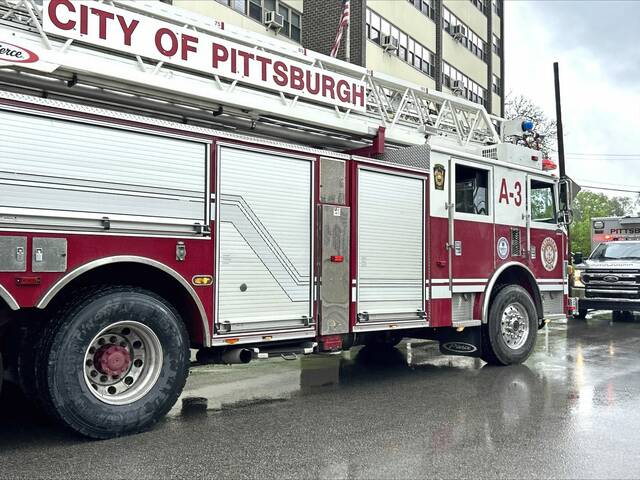
The City of Pittsburgh on Monday filed an antitrust lawsuit against more than two dozen fire truck manufacturers and related companies in federal court in Wisconsin alleging they’ve engaged in a conspiracy to monopolize the fire truck and parts market.
“Through their illegal schemes, defendants have reaped extraordinary profits on the backs of fire departments, taxpayers, cities and counties,” the lawsuit said. ”The public has suffered harm alongside the city, as the higher prices and costs defendants have forced on fire departments have drained localities’ health and safety budgets.”
Similar lawsuits have been filed by officials in Milwaukee and Los Angeles County, and the state of Texas has launched an investigation into the allegations.
“By hiking prices for trucks and replacement parts without competition, the defendants have made it harder for the City of Pittsburgh and other municipalities across the country to make the required investments in lifesaving safety services and put the burden back on our communities,” Pittsburgh Mayor Corey O’Connor said in a news release.
The 132-page lawsuit, which includes claims for antitrust violations and conspiracy against 26 defendants, asks the court to prohibit the companies from continuing the alleged anticompetitive behavior and seeks divestitures and money damages.
Pittsburgh’s lawsuit asserts the city has suffered substantial overcharges and lost equipment value after the defendants shut down plants, increased prices, extended delivery timelines and restrained the city’s ability to get replacement parts.
The lawsuit further asserts that New York-based private equity firm American Industrial Partners, one of the defendants, sought to consolidate a number of smaller fire truck manufacturers “into an industry giant with the power to extract high prices.”
That company, the lawsuit said, since 2008, has acquired four additional manufacturers. It also, in 2022, after obtaining two plants in Nesquehoning, Pa., in Carbon County, and Roanoke, Virginia, shut them down.
“This deliberate output reduction had its intended effect — backlogs skyrocketed to a record $4.2 billion in undelivered orders by fiscal year 2024,” and prices were hiked 50 to 100%, the lawsuit said.
“Our fire departments do not deserve this. Our firefighters do not deserve this. The taxpayers those firefighters swear an oath to protect do not deserve this,” the lawsuit said. “The extraction of excessive private rents from the public must stop, and it must stop now.”
According to the lawsuit, 15 to 20 years ago, fire departments could choose from a number of fire truck providers, and as recently as 2015, there were still more than 20 independent companies producing the vehicles.
However, the lawsuit continued, now — as a result of the various consolidations — two corporate families, the REV Group and Oshkosh, dominate the market.
The lawsuit cites several examples of fire trucks purchased by Pittsburgh in recent years, including a $1 million Pierce Heavy Duty Custom Rescue for approximately $1 million in January; two $2 million Spencer Custom Aerial ladder trucks in December 2024 and March 2025, and four Custom Pumpers in late 2023 and early 2024 for $1 million each.
“Defendants have deliberately lessened competition in the relevant markets by intentionally limiting output and implementing price hikes. The city paid higher prices for fire apparatuses as a direct result of this deliberate concentration of the relevant markets,” the lawsuit said.
It asserts that municipalities are regularly waiting three to five years between the time they order a fire truck and when they receive it.
Defendants named in the lawsuit include: REV Group LLC and its brands, E-ONE Inc., KME Global, FFA Holdco, Spartan Fire LLC, American Industrial Partners, Oshkosh Corporation, Pierce Manufacturing Inc., Maxi-Metal Inc., and Boise Mobile Equipment Inc.
Messages left with REV Group, American Industrial Partners and Oskosh Corp. on Monday evening were not immediately returned.
The City of Pittsburgh said it filed suit in U.S. District Court for the Eastern District of Wisconsin in Green Bay because several of the defendants are based there.