
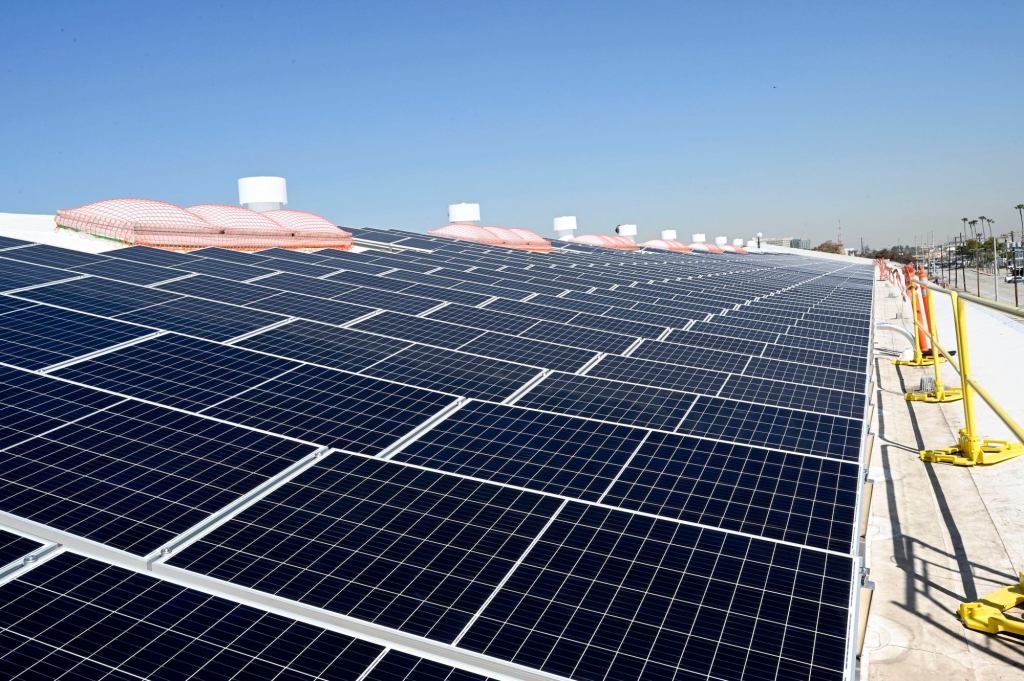
The blazing sun almost seemed to be a prop as it bore down on the parking lot outside of Owatin Creek Middle School on a recent morning, driving home the point that those gathered at the Exeter Township school were trying to make.
Throughout Pennsylvania there are acres of square feet of flat roofs atop warehouses, they said, and these are prime spots for solar panels.
“There are millions of warehouse rooftops sitting and baking in the sun every day,” state Rep. Jacklyn Rusnock said at the Friday event. “It’s low-hanging fruit.”
Rusnock, a Muhlenberg Township Democrat, is the prime sponsor of a bill that looks to pluck that fruit.
House Bill 1260 would require that new warehouses be constructed with roof space and structural support capable of accommodating solar arrays and create optional local tax exemptions for developers who retrofit existing warehouses to make them solar-ready.
The bill has passed the House but is stalled in the Senate.
A group of political leaders, activists and officials from the Exeter School District got together to push for senators to approve the bill.
Rusnock called her bill a win-win-win.
She said that by encouraging solar projects on warehouses there is a potential to create sustainable, stable jobs for Pennsylvanians. At the same time, those projects would have positive impacts on the economy and strengthen the state’s power grid.
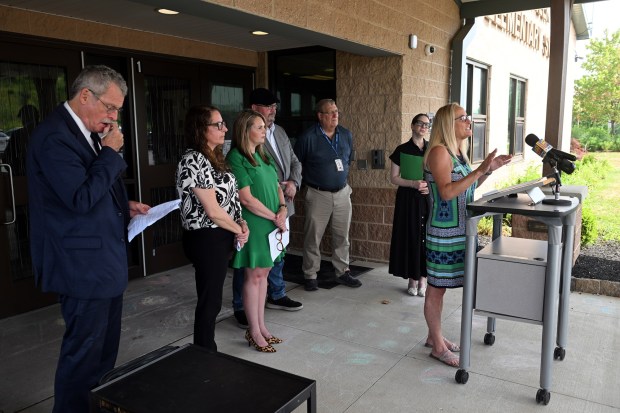 State Rep. Jacklyn Rusnock, during a press conference at Owatin Creek Elementary School in Exeter Township on Friday, July 10, 2026, speaks about her bill that recently passed in the House that would encourage warehouses to install rooftop solar panels. (BILL UHRICH/READING EAGLE)
“We are making an investment that will pay dividends for years to come,” she said.
Rusnock said the idea is one that all Pennsylvanians should agree on due its economic and environmental benefits.
“This is not about choosing between a strong economy and protecting the environment,” she said. “We can do both.
“These goals are something that should unite all of us.”
Warehouse roofs offer staggering potential, according to those at the Exeter press conference.
Dr. Stephen Herzenberg of the Keystone Research Center presented data from a recent report by his organization.
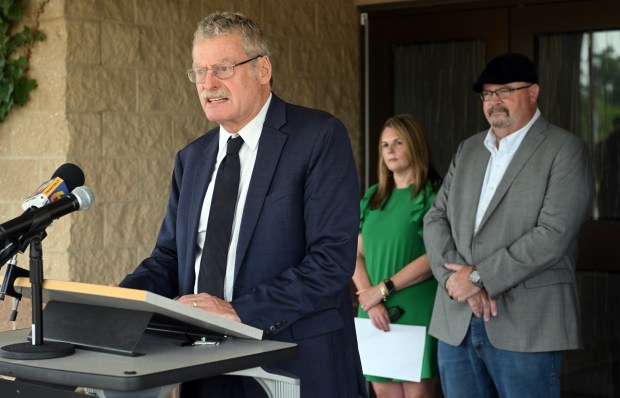 Dr. Stephen Herzenberg of the Keystone Research Center speaks about the positive effects of solar panels on warehouses at a press conference at Owatin Creek Elementary School in Exeter Township on Friday, July 10, 2026. (BILL UHRICH/READING EAGLE)
It showed that Pennsylvania has about 581 million square feet of warehouse roof space suitable for solar.
“Warehouses are everywhere in our state,” he said.
If solar arrays were put on all of them, it would create about 9,000 gigawatts of electricity each year, enough to power 1 million homes, he said.
Herzenberg said that power can be generated without impacting farms or other green space, which is a major win for the environment.
Robert Bair, president of the Pennsylvania State Building and Construction Trades Council, said the state desperately needs the energy that solar on warehouses would create.
And while he called himself an “all of the above energy” guy — supportive of any energy-producing project — he said that solar on warehouses simply makes sense.
“Solar for warehouses is probably the easiest fix for Pennsylvania,” he said. “Why are we leaving these things sit blank?”
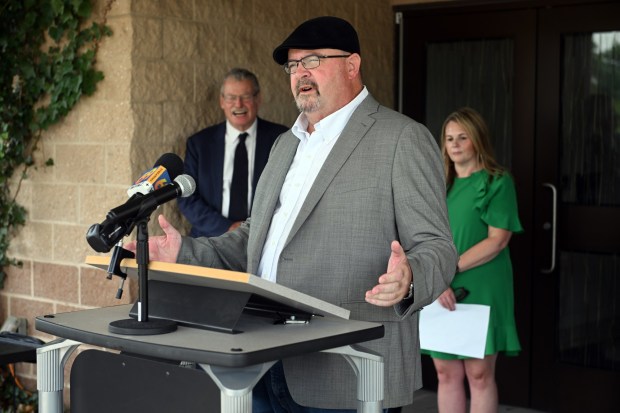 Robert Bair, president of the Pennsylvania State Building and Construction Trades Council, says solar arrays on warehouses simply make sense. (BILL UHRICH/READING EAGLE)
Bair said there is no excuse for not passing Rusnock’s bill and that it’s time to push ahead with solar in warehouses.
“When there’s a simple solution in front of us, it is on us to get it done and across the finish line,” he said. “The solution is staring us in the face.
“There is an easy solution, if we don’t take this opportunity then shame on us.”
Rusnock’s bill is based on legislation already enacted for a similar type of building. The Solar for Schools program encourages and supports adding solar arrays to the often large, flat roofs of school buildings.
One school that is taking advantage of the program is Owatin Creek, which is about to break ground on a major solar array project.
Exeter School Board President Julie Shaffer said that project will power about 40% of the district’s seven schools and transportation building, creating a savings about about $10 million over the next 30 years.
The project allows the district to be a good community steward, she said, protecting the environment while saving taxpayer dollars.
“Fiscal responsibility and innovation can go hand in hand,” she said.
Dr. Christy Haller, Exeter superintendent, said the Solar for Schools program is a model that should be expanded.
“It’s a program that demonstrates what can happen when state and local leaders work together,” she said.
Molly Parzen, executive director of Conservation Voters of Pennsylvania, said that is what needs to happen with the solar for warehouses bill.
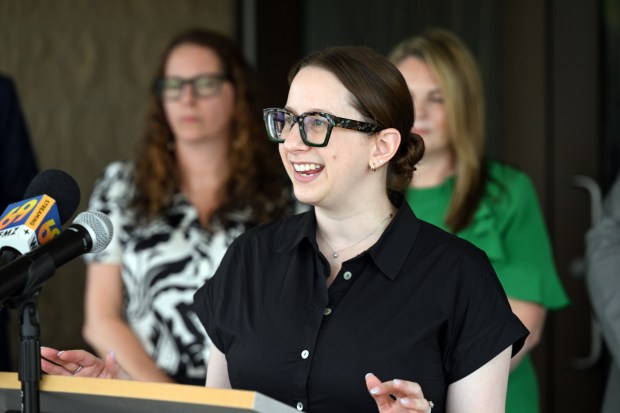 Molly Parzen, executive director of the Conservation Voters of Pennsylvania, talks about legislation that would make it easier to install solar panels on warehouses. (BILL UHRICH/READING EAGLE)
She said there is no reason to resist a program that would benefit the economy and environment and tackle the energy crisis.
“We can no longer allow gridlock in Harrisburg to prevent us from passing commonsense legislation,” she said.
Rusnock called on Pennsylvanians to reach out to their state senators and express support for her bill.