

AI startups may be dominating venture funding, but that doesn’t mean local investors are chasing AI for AI’s sake.
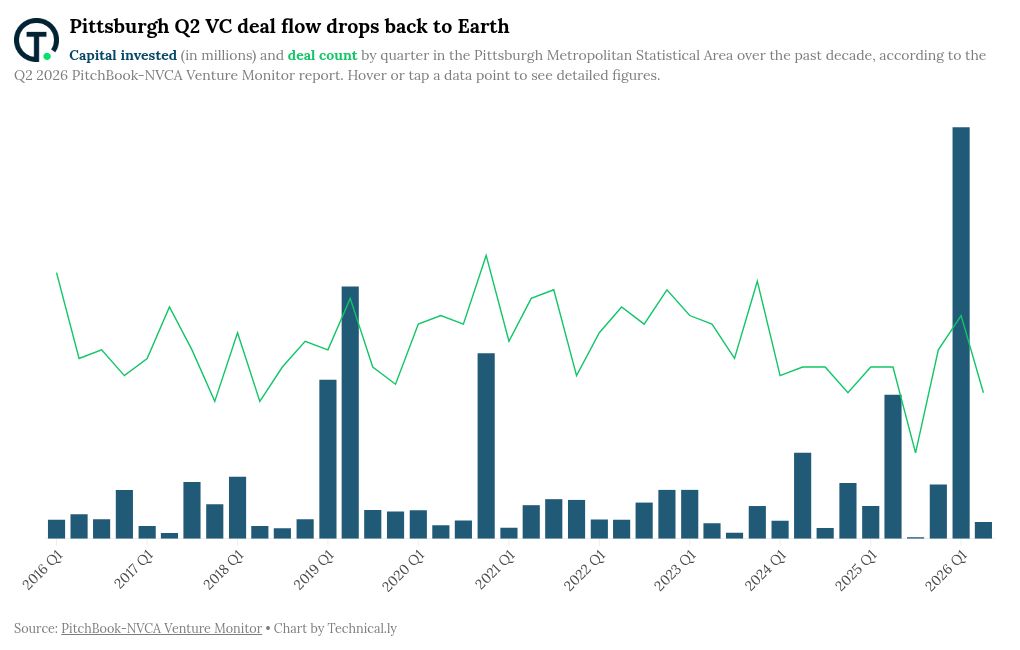
Companies in the Pittsburgh metro area raised approximately $70.2 million across 17 deals during Q2, according to the latest Venture Monitor report from PitchBook and the National Venture Capital Association (NVCA). It was a below-average deal count and raise total for Pittsburgh, but there was a broader trend, both locally and nationally, that held true — fewer deals are being made and the winners are often AI companies.
“We’re very, very leery of AI companies right now.”
Malcolm Handelsman, Active Angels Network
In Pittsburgh, about 75% of the total raised went to just two startups: AI security firm Gray Swan’s $40 million raise and AI hardware company Hellbender’s 12.5 million raise.
Local investors aren’t necessarily looking for AI companies, though, according to Malcolm Handelsman, managing director of the Active Angels Network, a Pittsburgh-based group of roughly 40 angel investors that participated in the latest Hellbender raise.
“We’re very, very leery of AI companies right now,” Handelsman told Technical.ly.
AI startups can be great today and gone tomorrow if big firms like OpenAI or Anthropic take notice and decide to pursue similar ventures, so in this case, “we did not look at Hellbender as an AI company,” Handelsman said, “we looked at them as a robotics company.”
The angel group had its eye on Hellbender for at least three years before investing, according to Handelsman. What ultimately sealed the deal was the combination of Hellbender’s traction in the market, the investor’s relationship with the management team and the startup’s relatively low valuation — the group generally invests when valuations are between $15 and $50 million, he said.
Healthcare-focused companies also made a healthy showing, making up about 15% of the top deals.
The region’s top ten deals:
Gray Swan (AI security)— $40 million, Series A
Hellbender (AI hardware) — $12.5 million, seed
Contra Healthcare Solutions (in stealth) — $4.1 million, early-stage VC
IK Start USA (sports streaming platform) — $4 million, seed
ThoroughCare (digital healthcare platform) — $2.3 million, later-stage VC
Aethl Bio (regenerative healing therapeutics) — $1.6 million, seed
NOCTEM Health (insomnia management platform) — $1.5 million, later-stage VC
Duo Oncology (cancer-killing drug development)— $1.4 million, later-stage VC
Pipe Force (subsurface inspection tech) — $1 million, seed
Avenue to Close (real estate) — $12,950, angel funding
Besides Handelsman’s angel group, the only local investor that participated in the quarter’s top deals was Magarac Venture Partners, which joined both Gray Swan’s and Hellbender’s raises.
A majority of the Active Angels Network’s investments over the last four years have gone to companies outside the Pittsburgh region.
“The companies in Pittsburgh were not as strong as some of the companies outside of the region,” Handelsman said, but he’s noticed somewhat of a shift in the landscape over the past year with new AI, robotics and life sciences startups.
Investors are looking for companies that clearly solve a worthwhile problem, have a strong team and show early signs of traction, like a consistently growing customer base and revenue, according to Handelsman.
“You can have a great team, but if you have a lousy product, you may not be successful,” he said.
Another possible factor affecting local investment is a lack of fresh funds flowing into VCs.
Pittsburgh-based firms haven’t raised additional funding to date this year, according to PitchBook’s report, and this tracks with national trends.
In the first half of the year, almost 50% of all the money that investors, or limited partners (LPs), put into VC funds went to only three firms, according to Nizar Tarhuni, executive vice president of research and market intelligence at PitchBook. This means smaller firms across the US have fewer funds to deploy.
“LPs aren’t spreading bets anymore,” Tarhuni said, “they’re consolidating around track records and brands, a response to five years of thin distributions. This year’s numbers will look like a recovery, but for most of the industry, it likely won’t feel like one.”
The lone exit
There was one local exit during the quarter.
Idelic, a commercial trucking analytics company founded in 2016, was acquired by Descartes Systems Group in April for $28 million. Before the acquisition, Idelic had raised approximately $38 million.
One of Idelic’s lead investors was local firm Birchmere Ventures, which participated in the company’s seed, Series A and Series B rounds, according to PitchBook.
Another exit during the quarter — humanoid robotics company Agility’s merger and pending $2.5 billion IPO — was not counted in Pittsburgh’s totals since Agility is technically headquartered in Oregon.
AI robotics firm Gecko Robotics continues to have a high probability of an IPO, with an estimate of 97%, according to PitchBook’s latest report. Gecko remains the only Pittsburgh company on PitchBook’s top unicorns ranking.
Some thought SpaceX’s IPO could kick off a wave of companies going public again, an “IPO window”, according to PitchBook’s Tarhuni, but that doesn’t represent what’s happening with typical VC-backed startups.
“The pipeline of companies in IPO registration remains low, and broad liquidity hasn’t yet returned,” Tarhuni said, “leaving exit value very concentrated through Q2, and very likely through the rest of 2026.”
The national picture
The country more broadly had a better quarter than Pittsburgh.
Almost $144 billion flowed through more than 3,650 deals, making it the second-highest total in a decade, according to the PitchBook report.
This year’s Q1 holds the top ranking, with approximately $413 billion raised across more than 9,600 deals. That was the case for Pittsburgh too, which had its biggest quarter in over a decade during Q1 — a combined $1.7 billion raised across 26 deals.
On a national level, the second quarter reinforced an emerging trend that capital is flowing back into American innovation, according to Bobby Franklin, NVCA president and CEO
“Investment activity is picking up,” Franklin said, “fundraising is improving and there are early signs the IPO market is beginning to reopen.