
This story is part of the WHYY News Climate Desk, bringing you news and solutions for our changing region.
From the Poconos to the Jersey Shore to the mouth of the Delaware Bay, what do you want to know about climate change? What would you like us to cover? Get in touch.
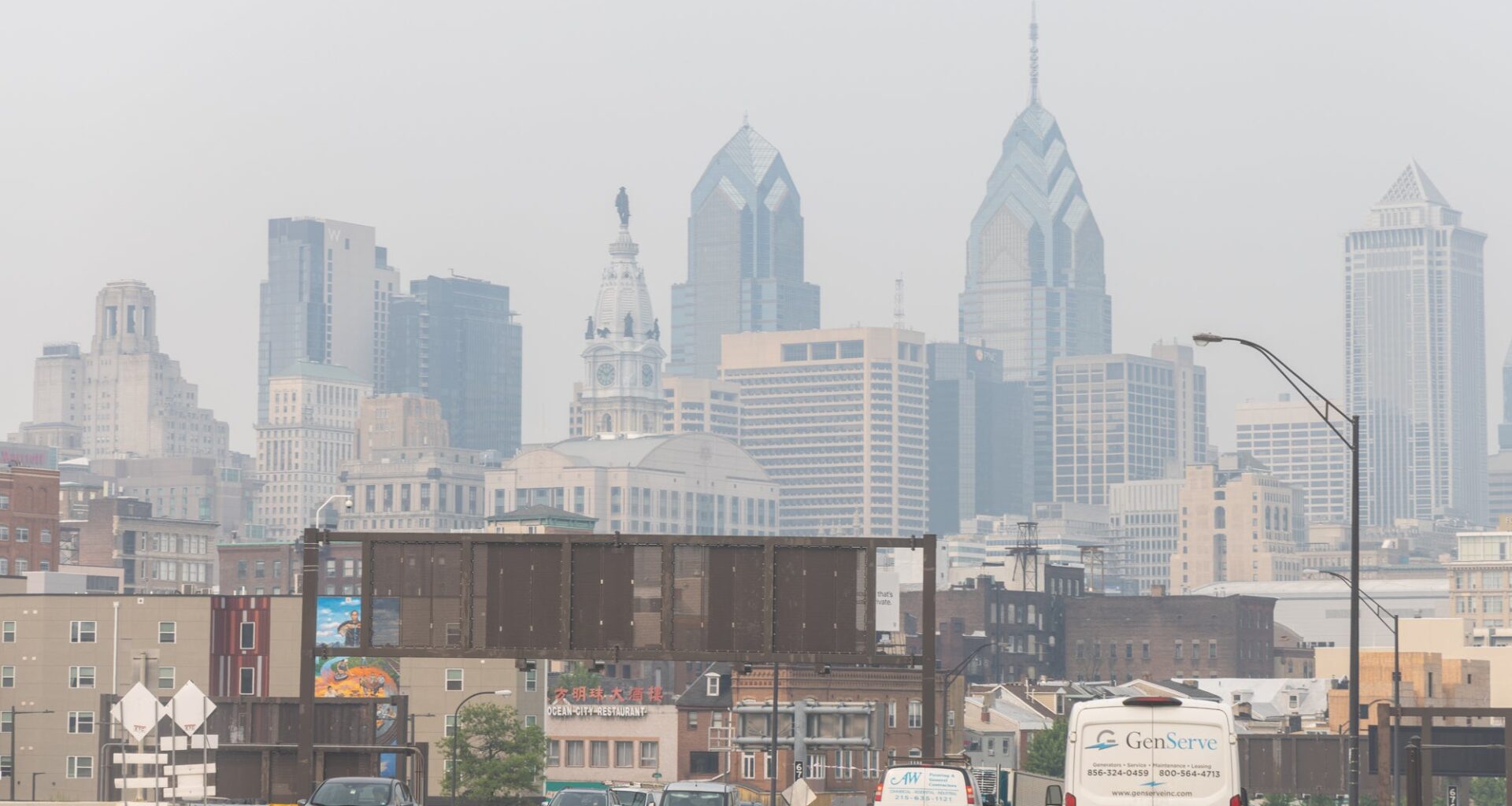
Philadelphia residents were hit with the smell of smoke and hazy skies as they made their way to work Thursday morning.
Health officials are warning people to limit their time outdoors as air quality across much of the U.S. reaches unhealthy levels because of wildfire smoke traveling from Canada.
Pennsylvania is under a Code Red Air Quality Action Day due to harmful air quality caused by high levels of particulate matter. These fine, tiny particles, known as PM 2.5, are 30 times smaller than the width of human hair, and are easily inhalable. The particles can settle deep in the lungs and enter the bloodstream.
Breathing in particulate matter can cause respiratory and cardiovascular problems, and impact vulnerable populations like children, the elderly and people with health conditions such as asthma.
“Wildfire smoke is among the most toxic air pollution that we can have,” said Ruth McDermott-Levy, co-director of the Mid-Atlantic Center for Children’s Health and the Environment at Villanova University College of Nursing.
“That’s because it burns things like wood and other things that are not meant to be burned and breathed,” she said.
“It could be a camper, it could be a refrigerator, all kinds of things then become toxic pollutants that we breathe in, and as the wildfire travels, it picks up the other pollutants.”
More than 180 wildfires are burning in Canada, causing severe levels of smoke to travel more than a thousand miles — impacting multiple states in the U.S. Several wildfires are also burning in northern Minnesota.