
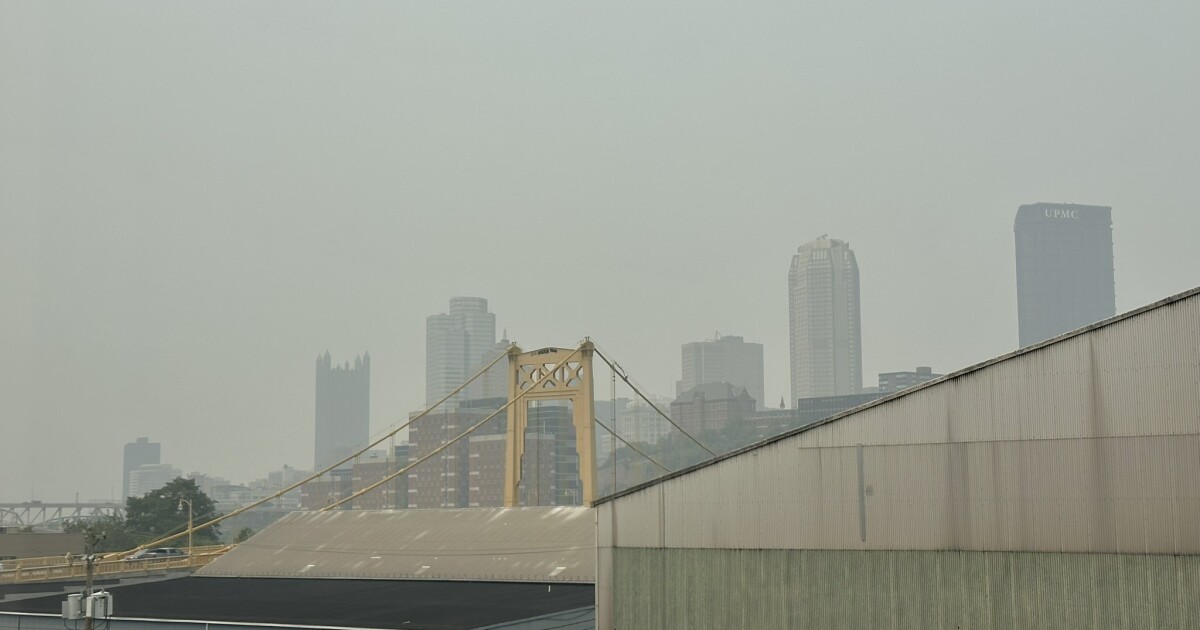
Heavy smoke from wildfires burning in Canada and Minnesota moved into the Pittsburgh region Thursday, and the worst is likely yet to come.
“We’re expecting to have the highest concentration of smoke finally move into the area today,” said David Shallenberger, a meteorologist with the National Weather Service.
Thursday afternoon, Allegheny County Health Department upgraded its air quality warning to Code Maroon, the most severe status in the U.S. Air Quality Index system. Until the Code Maroon alert is lifted, the health department advises that all people should avoid physical activity outdoors, and that children, elderly people and people with respiratory illnesses or other conditions should remain indoors, keep activity levels low and avoid air from outdoors.
In response to dangerous conditions, the city of Pittsburgh has announced all outdoor city programs are closed today, including all city pools, the Northside Farmers Market and the Dollar Bank Cinema in the Park. Six cooling centers across the city remain activated.
In addition to carrying health risks, the smoke may cause a thick fog to develop in Pittsburgh’s river valleys, known as a super fog.
Wildfire smoke from Canada and Minnesota has driven high pollution in eastern Pennsylvania already today, and the smoke is expected to grow thicker in the Pittsburgh region as the day goes on.
“You could have enough moisture where you get a little bit of that fog and then that smoke mixing together and a lot of times it generates a really dense fog where you can’t see two or three feet in front of you,” Shallenberger says.
But Shallenberger also says the smoke in the air is mitigating another dangerous weather condition: the heat. The particles are blotting the sun, and almost acting like cloud cover.
“It’s actually keeping temperatures from soaring into the nineties,” Shallenberger said. “I guess that’s one good thing with the smoke, but other than that, it’s real hazardous for today.”
Stagnant air is expected to keep the heavy smoke and dangerous air in the region throughout Friday.
On Saturday, a cold front is expected to push through the region, bringing showers, thunderstorms, damaging winds and heavy downpours – but also, relief from the smoke.
“We should have relatively clear conditions by Saturday night into Sunday,” Shallenberger said.
Protect yourself from smoke
Meanwhile, wildfire smoke is dangerous to breathe, and you can be exposed to it even when you’re indoors. To keep yourself safe, avoid being outdoors while the smoke lingers, and consider taking extra steps for cleaner indoor air:
Stay indoors with the windows and doors closed, with central air conditioning running, or your HVAC system on “fan” mode. You want to move the air in your home through your HVAC’s filter so it can catch particles and clean the air.Build a DIY air purifier using materials you may already have at home. You can tape a filter that you use for your air conditioner to a box fan, and it will filter smoke. Find instructions here, but don’t get too hung up on having the specific filter the U.S. Environmental Protection Agency suggests. Even a lower-quality filter will be better than nothing.If you don’t have central air conditioning, or any air conditioning at all, the heat plus the air pollution could be dangerous for you. Find a cooling center, or try to spend time in air conditioned indoor spaces. If you must go outdoors, wear an N-95 particle mask. Masks can help filter smoke. You can also wear them indoors if you aren’t able to keep your indoor air filtered.Don’t exercise outdoors, and possibly reconsider plans to exercise indoors. Indoor air is affected by outdoor air, and the conditions in the Pittsburgh region are as bad as they get right now.
With wildfire smoke, the primary pollutant is particulate matter, or airborne soot. The particles are so small they can penetrate deep into the lungs, and even enter the bloodstream, where they can affect other organ systems.
Acute effects of breathing wildfire smoke include respiratory symptoms, such as irritation of the airways, asthma aggravation and coughing. Long-term effects are systemic, and can result in premature death.
Wildfire smoke may be especially dangerous when fires engulf manmade structures, releasing pollutants from burning plastics, treated wood, resins and other materials.
The last time the region saw wildfire smoke this severe was in June 2023, when orange haze dimmed the sun for several days.